Pilates Resistance Bands
China Non Latex Exercise Resistance Bands Manufacturer | TPE Flat Therapy Bands Wholesale
High quality non latex resistance bands made from TPE for physical therapy, rehab, Pilates, yoga and stretching. 5 resistance levels, custom sizes, colors, logo and OEM packaging
Non Latex Resistance Bands – TPE Flat Bands for Therapy, Pilates & Stretching
A Latex-Free Resistance Band Made for Controlled, Lower-Impact Training
Not every resistance band needs the high rebound and extreme stretch of natural latex.
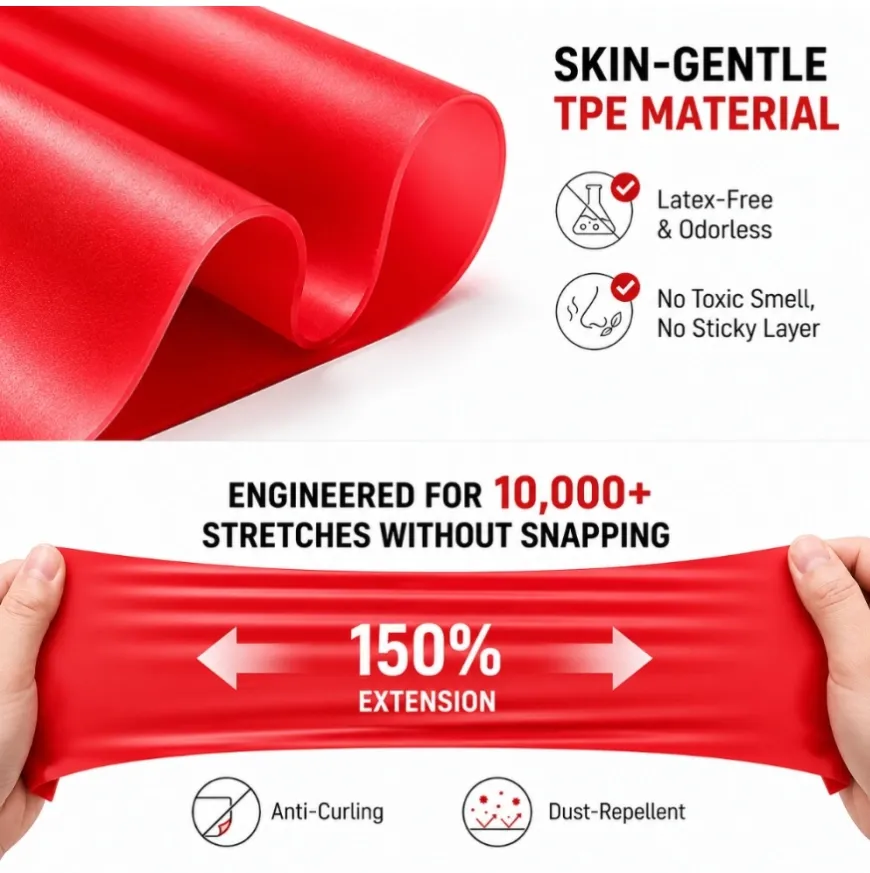
Our non latex resistance bands are made from TPE (thermoplastic elastomer) and are designed for applications where users need controlled resistance, a latex-free material option and a clean, powder-free training experience.
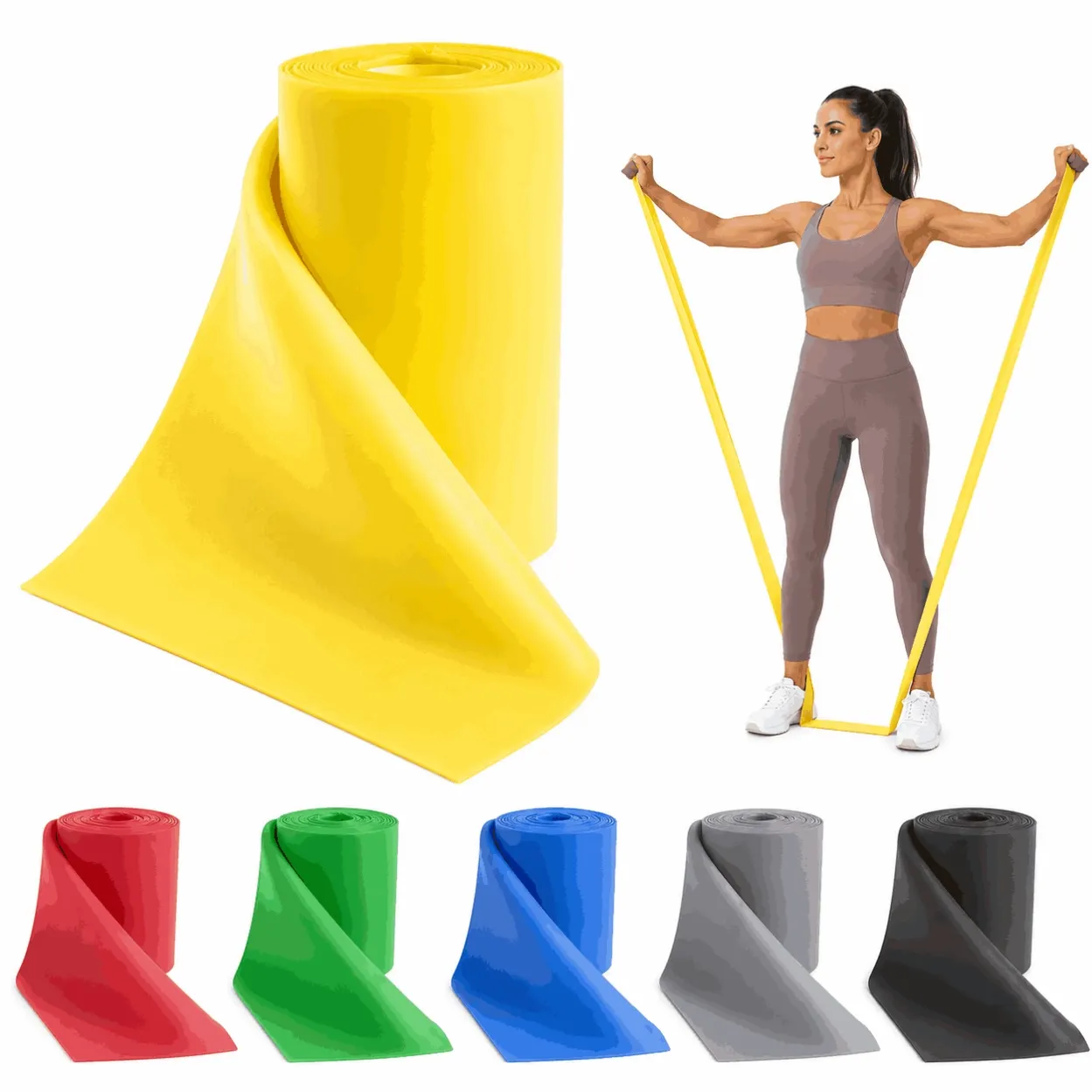
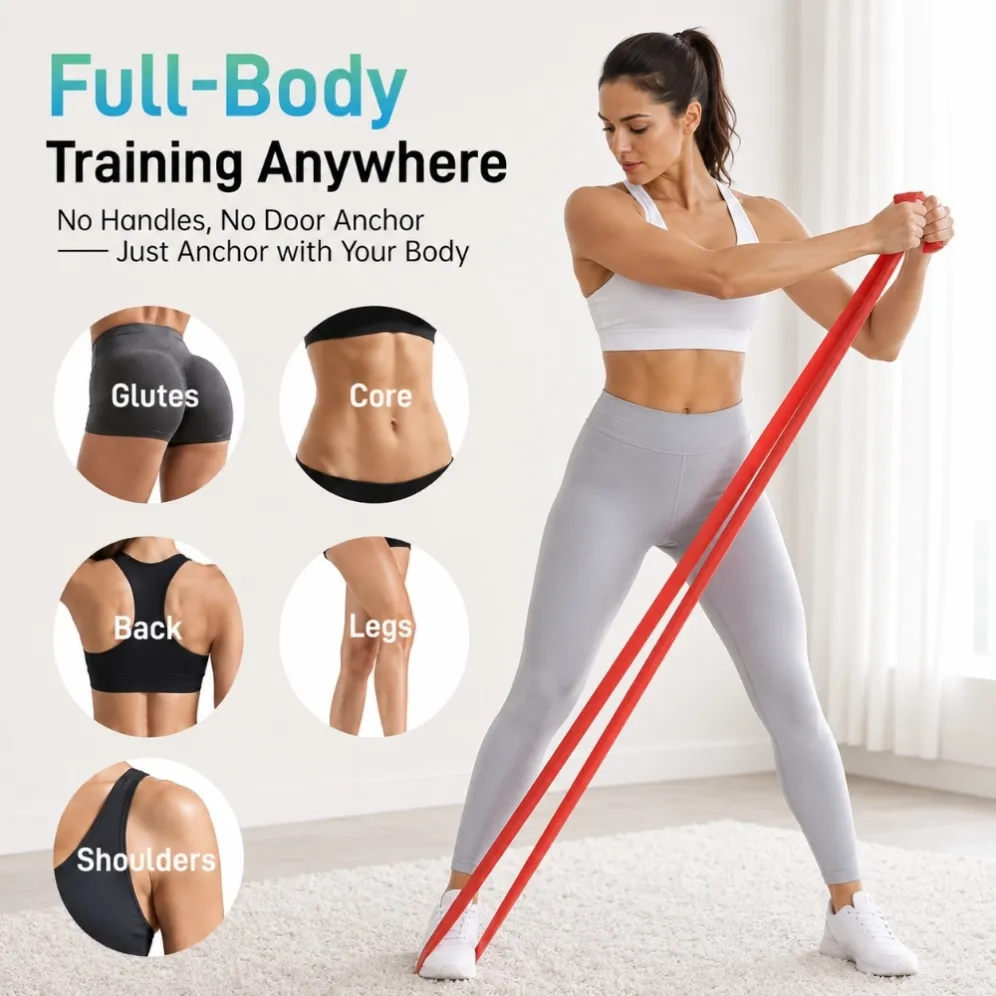
The long, flat construction works particularly well for physical therapy, rehabilitation exercises, Pilates, yoga, mobility work and stretching.
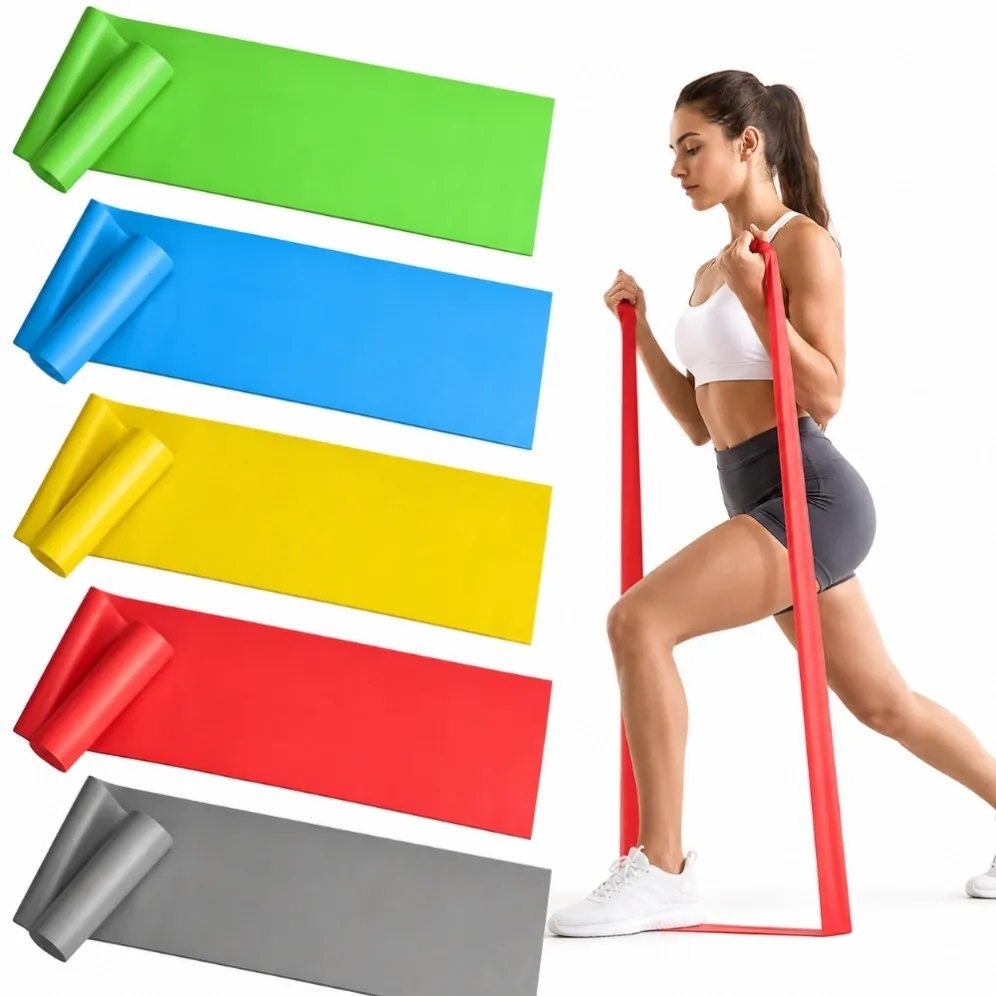
Unlike loop bands, these bands are not permanently closed. Users can change grip width, shorten the working length, wrap the band around the hands or use it with compatible accessories, giving therapists, trainers and individual users more control over exercise setup.
For B2B buyers, we manufacture the bands in different lengths, thicknesses and resistance levels, and can supply individual bands, 3-piece or 5-piece sets, and bulk configurations.
Why Choose TPE Non-Latex Resistance Bands?
Latex-Free Material
TPE does not rely on natural latex protein, making it an important material choice for product lines specifically looking for a non-latex resistance band alternative.
Low-Odor, Powder-Free User Experience
TPE does not have the characteristic natural-rubber odor associated with latex products.
The flat band can also be produced without surface powder, providing a cleaner handling experience for clinics, studios and home users.
Smooth Resistance for Controlled Exercise
TPE flat bands are particularly suitable for light-to-medium resistance exercises where controlled movement matters more than maximum elastic rebound.
That makes them useful for rehabilitation, mobility, stretching, Pilates and beginner resistance training.
Long Flat Design
Unlike mini loops or resistance tubes, the long flat band gives users freedom to:
- Change hand position
- Adjust working length
- Tie or wrap the band where appropriate
- Perform bilateral or unilateral movements
- Use the same band for upper- and lower-body exercises
Progressive Resistance Levels
Different thicknesses create a progressive resistance range, allowing one product family to cover warm-up, therapy, yoga, Pilates and general strength applications.
Lightweight & Easy to Pack
Flat TPE bands can be folded or rolled into compact packaging, making them suitable for home fitness sets, therapy kits, studio use and travel.
Non Latex Flat Resistance Band Specifications
Specification | Available Options |
|---|---|
Product Type | Non Latex Flat Resistance Band |
Material | TPE – Thermoplastic Elastomer |
Construction | Long Flat Exercise Band |
Standard Width | 150 mm / approx. 6 in |
Short Length | 1200 × 150 mm |
Standard Length | 1500 × 150 mm |
Extra Long | 1800 × 150 mm |
Extended Length | 2000 × 150 mm |
Thickness | 0.25–0.75 mm, depending on resistance |
Resistance Levels | X-Light / Light / Medium / Heavy / X-Heavy |
Colors | Color-Coded / Custom |
Logo | Screen Printing / Custom |
Sets | Single / 3-Piece / 5-Piece |
Packaging | OPP Bag / Mesh Bag / Color Box |
OEM / Private Label | Available |
Resistance Levels
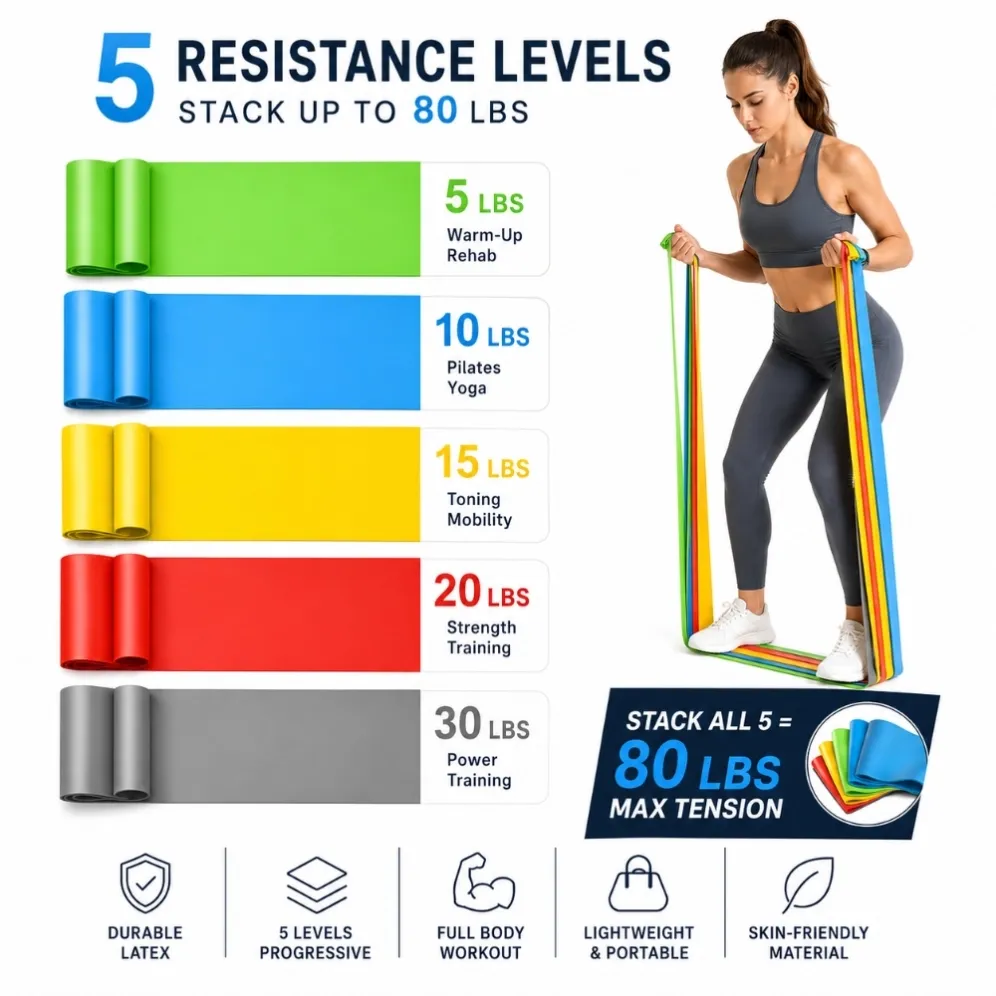
Five Progressive Resistance Levels
Level | Thickness | Reference Resistance | Typical Application |
|---|---|---|---|
X-Light | 0.25–0.35 mm | 5 lbs | Rehab, Warm-Up, Gentle Stretching |
Light | 0.35–0.45 mm | 10 lbs | Yoga, Beginner Pilates |
Medium | 0.45–0.55 mm | 15 lbs | Mobility, General Conditioning |
Heavy | 0.55–0.65 mm | 20 lbs | Strength & Core Training |
X-Heavy | 0.65–0.75 mm | 30 lbs | Advanced Resistance Exercise |
Resistance values are reference specifications. Actual resistance changes with band dimensions and stretch distance. OEM resistance levels can be developed against an agreed test method.
Where Are Non Latex Resistance Bands Used?
Physical Therapy & Rehabilitation
Resistance bands for physical therapy are commonly used where gradual, controllable resistance is required.
The flat format allows therapists and users to adjust working length and grip position according to the exercise.
Typical applications include controlled:
Shoulder • Arm • Hip • Leg • Mobility • Muscle Activation exercises
For clinical rehabilitation, resistance level and exercise selection should follow the relevant professional program.
Pilates
Flat resistance bands for Pilates can add light-to-medium resistance without requiring handles or large equipment.
The long band can be used for controlled upper-body, lower-body and core movements.
Yoga & Stretching
The 1500–1800 mm versions provide enough working length for many full-body stretching and flexibility exercises.
Users can change the grip position to adjust the effective working length.
Mobility & Warm-Up
X-Light and Light bands work particularly well for controlled mobility and pre-exercise activation.
Senior & Low-Impact Exercise
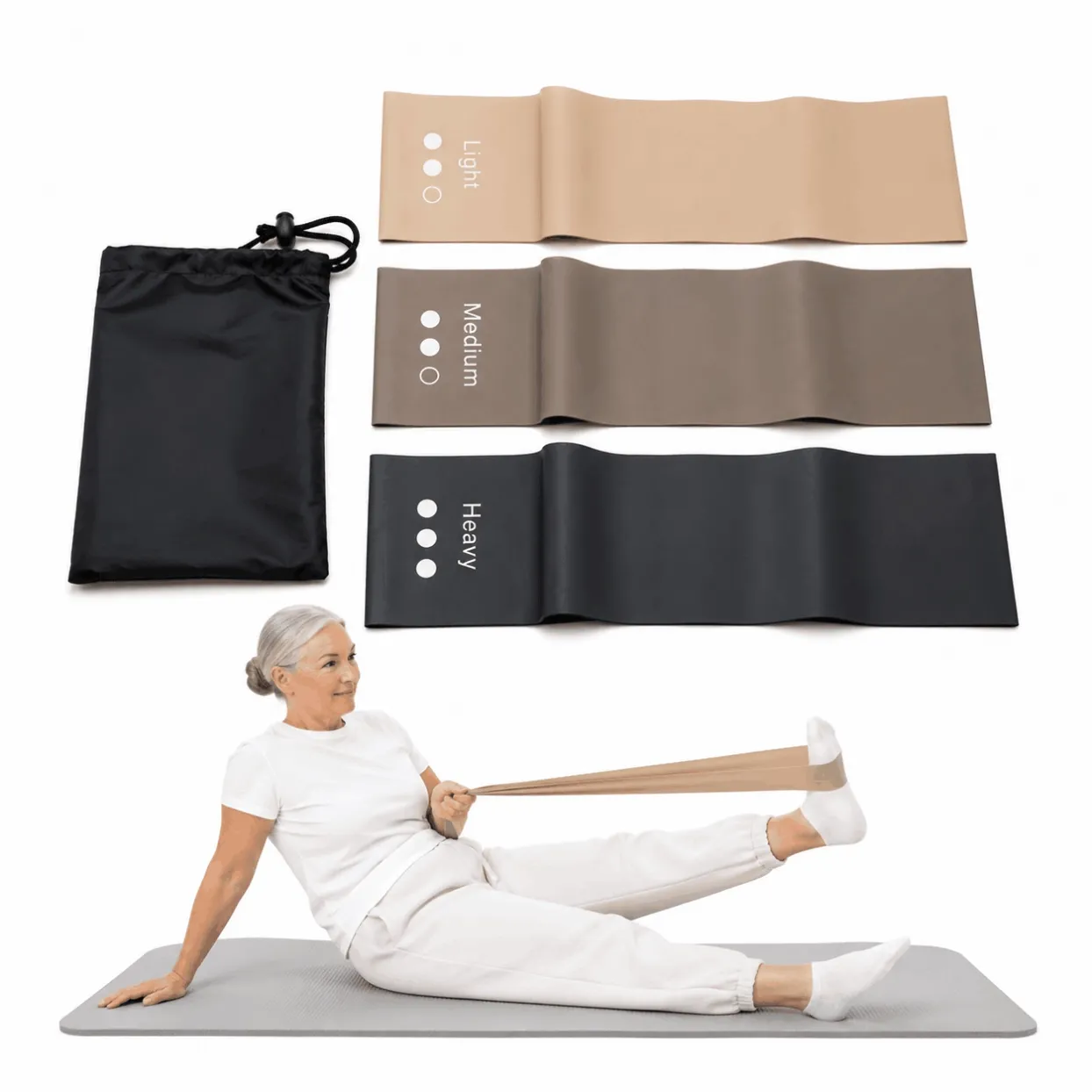
Light resistance levels can be incorporated into appropriately designed low-impact exercise programs.
Your source specifically identifies older users and light resistance training as an important audience.
Home Fitness
One long flat band can support multiple upper- and lower-body movements while requiring almost no storage space.
TPE vs Natural Latex Resistance Bands
Buyer Concern | TPE / Non-Latex | Natural Latex |
|---|---|---|
Natural Latex Protein | No | Yes |
Rubber Odor | Very Low / No Typical Latex Odor | Natural Rubber Odor Possible |
Powder-Free Option | Yes | Yes |
Light–Medium Controlled Resistance | Well Suited | Well Suited |
High Elastic Rebound | Moderate | Better |
Maximum Stretch Capability | Lower | Higher |
Tear Resistance | Lower | Generally Better |
Long-Term Deformation Resistance | Lower | Generally Better |
Heat Resistance | More Sensitive | Generally Better |
Physical Therapy | Strong Application | Strong Application |
Pilates / Yoga | Strong Application | Strong Application |
High-Intensity Strength Training | Limited by Specification | Better Choice |
When Should a Buyer Choose TPE?
Choose TPE when your product line prioritizes:
Non-latex material + Low odor + Controlled resistance + Therapy/Pilates applications + Lightweight construction
When Is Natural Latex a Better Choice?
Natural latex is usually the better direction when the product requires:
Higher rebound + Greater stretch range + Heavy resistance + More demanding strength training
How We Manufacture TPE Flat Resistance Bands
TPE bands and natural latex bands are produced using fundamentally different processes.
Our TPE flat resistance bands start from a thermoplastic elastomer compound rather than liquid natural latex.
Step 1 – TPE Material Preparation
Typical TPE formulations can include SEBS or SBS, PP, processing oil, fillers, stabilizers, antioxidants, pigments and other performance additives depending on the required specification.
Step 2 – Material Mixing
The ingredients are mixed according to the approved formulation to control hardness, elasticity, feel and processing characteristics.
Step 3 – Melt Compounding & Pelletizing
The blended material is melt-compounded through extrusion, cooled and pelletized into TPE raw material for subsequent production.
Step 4 – Flat Band Extrusion
Pre-dried TPE material is fed into an extruder and formed through a flat die into continuous sheet material.
Step 5 – Thickness Control & Cooling
Rollers control the sheet thickness while the material is cooled and stabilized.
This stage matters because thickness directly influences the resistance specification.
Step 6 – Slitting & Length Cutting
The continuous sheet is cut to the required width and finished length.
Standard options include:
1200 / 1500 / 1800 / 2000 mm × 150 mm
Step 7 – Logo & Resistance Marking
Brand logos, resistance levels and product markings can be screen printed onto the band surface.
Step 8 – Quality Inspection
Production samples are inspected for appearance, thickness, resistance behavior and permanent deformation.
Step 9 – Packaging
Bands can be folded or rolled and packed individually or as 3-piece and 5-piece sets.
OEM / ODM
OEM Non-Latex Resistance Bands
For an OEM project, we do not recommend choosing a band based only on color.
We first determine the intended application:
Rehabilitation? Pilates? Yoga? General Fitness?
Then we develop the appropriate combination of:
Resistance Level
Adjust thickness and material specification according to the required resistance.
Length
Choose from 1200 / 1500 / 1800 / 2000 mm or develop a custom length.
Color
Create a color-coded resistance system or use your brand's color palette.
Logo
Print your logo, resistance level or product information directly on the band where appropriate.
Set Configuration
Available configurations can include:
Single Band
3-Level Resistance Set
5-Level Progressive Resistance Set
Therapy Band Set
Pilates & Yoga Band Set
Resistance Band + Door Anchor Set
Packaging
Your source supports:
OPP Bag • Mesh Bag • Color Box • Instruction Guide
with 3-piece and 5-piece sets being common configurations.
What We Actually Check on a TPE Resistance Band
Thickness Consistency
Because thickness affects resistance, production samples should be checked against the approved specification.
Resistance Consistency
Bands are stretched to an agreed extension point to compare resistance between samples and batches.
Elongation
We evaluate whether the product performs within its intended stretch range.
Permanent Deformation
After stretching and recovery, samples can be checked for residual elongation.
This is particularly important for TPE because long-term overstretching can cause permanent deformation.
Edge Inspection
Edges are checked for cuts, notches or other damage because an edge defect can become a tear initiation point.
Surface & Color Inspection
We check for:
Bubbles • Contamination • Surface Defects • Color Difference
Your factory material specifically identifies bubbles, impurities, color differences, stretch ratio, tensile break strength and permanent deformation as inspection items.
Storage & Use Limitations
Danyang Zhenxing Latex Products Co.,Ltd Important Care Information for TPE Bands
To maintain product performance:
Avoid sharp objects.
Small edge cuts can develop into tears under tension.
Do not repeatedly overstretch the band.
TPE has a lower elastic stretch range than natural latex.
Avoid prolonged high-temperature storage.
Do not leave the bands for extended periods in hot vehicles or direct sunlight.
Inspect the band before use.
Replace a band showing cuts, tears or significant permanent deformation.
Who Buys Non-Latex Flat Resistance Bands?
Physical Therapy & Rehabilitation Suppliers
For therapy and controlled resistance exercise product lines.
Medical & Rehabilitation Institutions
For projects where non-latex material selection is an important procurement requirement.
Pilates & Yoga Brands
For light-to-medium resistance, stretching and controlled movement products.
Senior Fitness & Wellness Brands
For appropriately designed low-impact resistance programs.
Fitness Equipment Distributors
For standalone flat bands and progressive resistance sets.
E-Commerce Sellers
For 3-piece / 5-piece resistance sets, home workout kits and portable exercise products.
OEM & Private Label Fitness Brands
For custom colors, resistance levels, logo, instructions and retail packaging.
FAQ
Frequently Asked Questions About Non Latex Resistance Bands In Danyang Zhenxing Latex Products CO.,Ltd.
What are non latex resistance bands made of?
Our non latex resistance bands are made from TPE, or thermoplastic elastomer, rather than natural latex.
Are TPE resistance bands latex free?
TPE itself does not use natural latex protein. For projects requiring a formal latex-free claim, the complete formulation and production specification should be confirmed.
What are non latex resistance bands used for?
They are commonly used for physical therapy, rehabilitation, stretching, mobility, Pilates, yoga and light-to-medium resistance exercise.
What is the difference between TPE and latex resistance bands?
TPE provides a non-latex, low-odor option and works well for controlled resistance applications. Natural latex generally provides stronger rebound, greater stretch capability and better suitability for demanding high-resistance training.
Are TPE resistance bands suitable for physical therapy?
TPE flat bands can be configured in light progressive resistance levels suitable for many physical therapy exercise programs. The appropriate resistance and exercise should be selected by the relevant professional where required.
What length should I choose?
1200 mm works for shorter/light stretching applications.
1500 mm is a versatile general-purpose size.
1800 mm provides more length for full-body stretching.
2000 mm can be developed for specialized or professional applications.
How many resistance levels are available?
A typical set uses five levels: X-Light, Light, Medium, Heavy and X-Heavy.
Can I customize the resistance?
Yes. Resistance can be developed through material and dimensional specifications and should be confirmed against an agreed test method.
Can you customize colors and logos?
Yes. Color-coded resistance systems, custom colors and suitable printed branding can be developed for OEM projects.
Can you manufacture 3-piece and 5-piece sets?
Yes. Individual bands and multi-level sets can be configured with appropriate packaging and accessories.
Can TPE resistance bands tear?
Yes. Like any elastic product, TPE can be damaged. TPE is particularly sensitive to cuts or notches at the edge, so bands should be inspected before use and kept away from sharp surfaces.
Should I choose TPE or natural latex?
Choose TPE when non-latex material, low odor and controlled light-to-medium resistance are priorities. Consider natural latex when higher rebound, greater elongation and demanding strength applications are more important.
Need a Non-Latex Band for Your Therapy or Fitness Product Line? Contact Us here