Sep 9, 2026Buying Guides
5 Common Problems with Fabric Booty Bands and How OEM Buyers Can Prevent Them
Fabric booty bands VS glute bands
5 Common Problems with Fabric Booty Bands and How OEM Buyers Can Prevent Them
Fabric booty bands were introduced as a more comfortable alternative to thin latex mini bands. Their wider textile construction helps reduce rolling, skin pinching, and hair pulling during squats, lateral walks, and glute activation exercises.
However, a fabric-covered band is not automatically a well-designed band.
In our sample evaluations, the most common problems are not usually visible in product photos. They appear when the band is stretched, worn during a sweaty workout, washed repeatedly, or used for several weeks.
For fitness brands, wholesalers, and Amazon sellers, these problems can lead to complaints such as “too stiff,” “keeps sliding,” “doesn’t fit,” or “the seam is uncomfortable.”
Here are five common fabric booty band problems, their actual manufacturing causes, and the points B2B buyers should check before approving bulk production.
1. The Booty Band Feels Too Stiff and Has a Short Stretch Range
What users experience
Some fabric Glute Bands feel manageable at the beginning of a movement but quickly become difficult to stretch. Instead of building resistance gradually, the band appears to “lock” before the user completes a squat or hip-abduction movement.
Beginners may struggle to maintain proper form. Stronger users can experience the opposite problem: insufficient starting tension followed by an abrupt increase in resistance.
Why it happens
The woven fabric itself contributes relatively little elasticity. Most of the stretch comes from natural latex threads or spandex yarns integrated into the band.
The final feel depends on several connected factors:
- The number and thickness of the internal latex threads
- The density of the woven structure
- The polyester or nylon covering yarn
- The finished circumference
- Heat-setting conditions
- Resistance recovery after repeated stretching
If the woven structure is too dense or the elastic core is poorly matched to the fabric, the band may reach its practical extension limit too early.
How we control it
We do not determine resistance by color alone. During product development, we adjust the number and thickness of the internal latex threads while monitoring the fabric density and finished dimensions.
After weaving, the band passes through heat setting and preshrinking. This step helps release internal textile stress, control shrinkage, and stabilize the finished shape and elastic recovery.
Sample testing can include resistance measurement, recovery testing, and repeated stretching. Where the product specification requires it, samples may also be tested at extensions of up to 200% to check for broken elastic threads, seam damage, or permanent deformation.
The purpose is not simply to create a “harder” Heavy band. Each level should remain usable through the intended exercise range.
2. The Anti-Slip Lines Still Slide—or Irritate the Skin
What users experience
The anti-slip lines may work well when the band is dry but become less effective after sweat accumulates between the band and the skin or leggings.
Some users also experience pulling, redness, or irritation when the grip material rubs directly against bare skin.
Why it happens
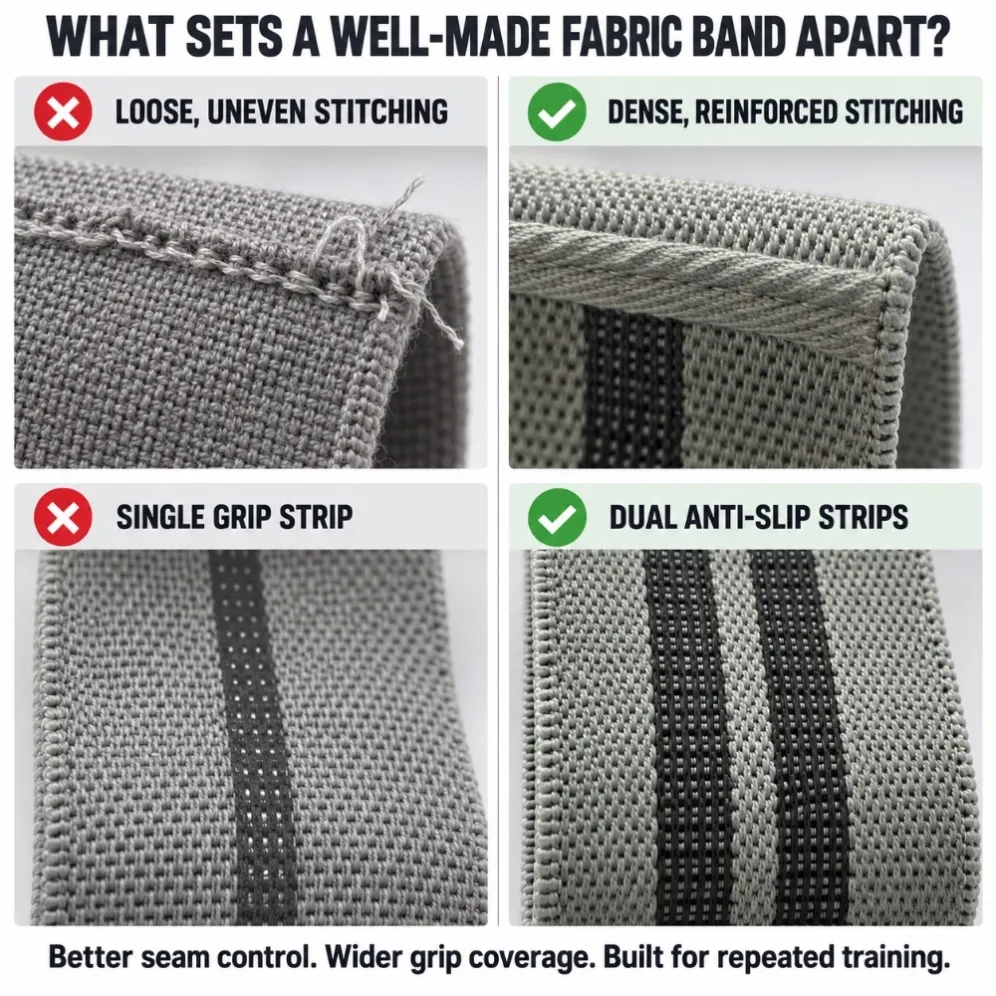
Fabric booty bands commonly use one or two lines of latex, rubber, or silicone-based grip material on the inner surface.
These grip lines can be integrated during weaving in several configurations, including:
- A wave pattern
- Two straight lines
- Other customized grip layouts
The performance depends on the material, pattern, coverage, and how securely the grip yarn is incorporated into the textile structure.
A very narrow grip area may not provide enough contact. A hard or aggressive grip material may improve friction but feel uncomfortable against bare skin. Sweat can also create a lubricating layer on the surface.
Latex-sensitive users should be informed when natural latex threads or exposed latex grip lines are present in the product.
How we control it
We select the anti-slip structure according to the intended application rather than using one configuration for every band.
For bands mainly worn over leggings, stronger grip coverage may be appropriate. For bands likely to contact bare skin, the texture and softness require more attention.
During inspection, we check:
- Whether the grip lines are evenly woven
- Whether the pattern is continuous
- Whether the grip material is loose or damaged
- Whether the band stays in position during common exercises
- Whether the inner surface feels excessively rough
The finished sample should be tested during squats, lateral walks, glute bridges, and hip abductions. Stretching the band by hand cannot accurately show how it will perform on the thigh.
3. Sweat Leads to Odor and Difficult Cleaning
What users experience
Fabric Resistance bands come into direct contact with sweat. If a damp band is placed inside a closed gym bag, moisture and odor can remain trapped in the woven structure.
Over time, poor drying and storage conditions may produce persistent odors or visible mildew.
Why it happens
The outer covering is commonly made from polyester or nylon yarn, while the internal elastic structure contains latex threads or spandex.
The dense woven construction can hold moisture between the yarns. Thicker Heavy bands generally contain more material and may take longer to dry than lighter versions.
Cleaning also requires care. Hot water, bleach, harsh detergent, machine drying, and prolonged exposure to heat or sunlight can damage the internal latex threads and reduce elastic performance.
How we reduce the risk
Material selection, fabric density, and finished weight are considered during product development. The band must be substantial enough to remain stable without becoming unnecessarily heavy or difficult to dry.
Clear care instructions should be included with the product:
- Hand-wash in cool water
- Use a small amount of mild detergent
- Do not use bleach
- Do not tumble-dry
- Dry the band completely before storage
- Keep it away from prolonged heat and direct sunlight
Brands should avoid making “antibacterial” or “anti-odor” claims unless the selected yarn treatment and finished product have supporting documentation or test results.
4. Cotton Booty Band Size and Resistance Are Incorrectly Combined
What users experience
Some suppliers create different resistance levels mainly by changing the band circumference.
This can create a confusing set. A shorter Light band may be difficult to place above the knees, while a longer Heavy band may provide insufficient starting tension for a user with smaller thighs.
The customer is then choosing between size and resistance, even though these should be treated as separate specifications.
Why it happens
Changing the cutting length is an easy way to alter how difficult a band feels. However, it does not produce a properly engineered resistance range.
A better approach is to maintain a consistent circumference within a resistance set and adjust the internal construction.
How we control it
For a standard three-piece set, Light, Medium, and Heavy bands can use the same finished circumference. Resistance is then adjusted through:
- The number of latex threads
- Latex-thread thickness
- Weaving density
- Fabric thickness
- Finished grammage
This allows the customer to change resistance without changing the basic fit.
Common factory dimensions include:
Finished circumference | Flat folded length | Approximate folded length |
|---|---|---|
66 cm | 33 cm | 13 in |
76 cm | 38 cm | 15 in |
86 cm | 43 cm | 17 in |
The 76 cm circumference, which measures approximately 30 inches around and 15 inches when folded flat, is a commonly selected general-purpose size.
Typical widths include:
- 8 cm for standard fabric booty bands
- 10 cm for wider or higher-resistance designs
Finished thickness commonly ranges from approximately 2.5 to 4.0 mm, depending on the textile structure and resistance specification.
These measurements should be confirmed during sampling. “One size fits all” should be treated as a marketing description rather than a guarantee that one circumference will suit every body type.
5. The Joining Seam Feels Rough or Opens Under Load
What users experience
The joining area may create a hard lump against the inner thigh. Loose thread ends, uneven stitching, or a raised seam can cause itching and chafing, particularly when the band is worn with shorts.
In more serious cases, the seam begins to open after repeated stretching.
Why it happens
After the woven webbing is cut to length, the two ends must be joined to form a closed loop.
The cut ends are normally sealed with a hot knife to reduce fraying. They are then sewn with high-strength thread using bar-tacking or reinforced flat-stitching equipment.
Problems arise when:
- The ends are not aligned correctly
- The seam contains insufficient stitches
- The sewing thread is too hard or coarse
- The reinforcement area is unnecessarily bulky
- Thread ends are not properly trimmed
- The finished seam is not tested under repeated extension
How we control it
Depending on the band construction, the joining area can use dense cross-stitching, repeated bar tacks, or a reinforced rectangular stitch pattern.
The objective is to distribute the load across the joint without creating an excessively thick or abrasive section.
During final inspection, we check:
- Seam alignment
- Stitch density
- Loose or broken threads
- Unfinished edges
- Seam thickness
- Comfort against the skin
- Joint stability during repeated stretching
The seam is a load-bearing part of the band. It should be included in performance testing rather than inspected only for appearance.
How Fabric Booty Bands Are Manufactured
A typical production process includes six main stages.
1. Material preparation
Natural latex threads or spandex yarns are selected as the elastic core. High-stretch polyester or nylon yarns are used as covering materials to provide abrasion resistance, color, and surface comfort.
2. Weaving
The elastic core and covering yarns are woven on a needle loom or jacquard loom. The latex threads run through the band as the principal elastic component, while the textile yarn covers and protects them.
Anti-slip rubber, latex, or silicone lines can be integrated into the inner surface during this stage. Custom patterns and jacquard logos can also be produced according to the buyer’s design.
3. Heat setting and preshrinking
The woven material passes through heat-setting equipment to reduce internal stress and control shrinkage. This helps stabilize the dimensions, surface appearance, and elastic recovery.
4. Cutting and resistance inspection
The continuous webbing is cut to the specified length with a hot knife. Heat-sealing the cut edges helps prevent the yarns from fraying.
Resistance levels are controlled by the elastic-core specification, weaving density, fabric thickness, and finished dimensions.
5. Joining and sewing
The cut ends are aligned and sewn together to form a loop. Bar-tacking or reinforced flat stitching is used to strengthen the joint.
6. Quality inspection and packaging
Finished bands are checked for resistance, recovery, dimensions, seam quality, loose yarns, grip-line condition, and visible defects. Approved products are packed in mesh bags, fabric pouches, boxes, or other customized packaging.
Typical Weight and Resistance References
A three-band set is commonly offered in Light, Medium, and Heavy resistance levels.
Approximate individual band weights may fall within the following ranges:
Resistance level | Approximate weight per band | Reference resistance |
|---|---|---|
Light | 100–115 g | 15–25 lb |
Medium | 120–135 g | 25–35 lb |
Heavy | 140–165 g | 40–50+ lb |
A complete three-piece set with a mesh bag may have an approximate gross weight of 380–450 g.
These figures are useful as development references, not universal standards. Actual resistance depends on the finished circumference, elastic-thread specification, fabric construction, and the extension point used for testing.
OEM buyers should always state whether the resistance value is measured at a fixed extension, such as 50%, 100%, or another agreed test length.
What Fitness Buyers Should Check Before Approving a Sample
A product photo cannot confirm how a fabric band will perform. Before bulk production, buyers should check:
- Finished circumference, width, and thickness
- Individual band weight
- Resistance at an agreed extension
- Smoothness of the stretching movement
- Recovery after repeated extension
- Grip on bare skin and leggings
- Seam comfort and strength
- Colorfastness after washing
- Drying and care requirements
- Consistency across several samples of the same level
It is better to approve multiple production-representative samples rather than relying on one specially prepared piece.
Developing a More Reliable OEM Cotton Elastic Glute Band
The performance of a fabric booty band depends on more than its color, logo, or resistance label. Its latex-thread structure, fabric density, heat setting, grip pattern, dimensions, seam construction, and testing method all affect the end-user experience.
Danyang Zhenxing Latex Products Co., Ltd. has manufactured latex booty resistance products since 1998. We provide OEM and private-label fabric booty bands for fitness brands, wholesalers, gyms, and online sellers.
Available customization options include:
- Light, Medium, and Heavy resistance development
- 66 cm, 76 cm, and 86 cm circumferences
- 8 cm and 10 cm widths
- Polyester or nylon covering yarn
- Natural latex thread or spandex elastic structures
- Wave-pattern or straight-line anti-slip designs
- Pantone color matching
- Jacquard patterns and woven logos
- Custom mesh bags, fabric pouches, and retail packaging
Before bulk production, we can prepare samples based on your required dimensions, resistance range, colors, branding, and target market.