Oct 12, 2026Buying Guides
How to Choose Resistance Bands: A Professional Procurement Guide for Fitness Brands
How to Choose Resistance Bands: A Professional Procurement Guide for Fitness Brands
How to Choose Resistance Bands: A Professional Procurement Guide for Fitness Brands
Resistance bands have evolved from basic accessories into a core category for home strength training, functional fitness, glute-focused programming, and rehabilitation. Market data from 2025–2026 shows sustained demand for fabric booty bands, multi-level power loop sets, tube bands with handles, and therapy flat bands. For fitness brands, selecting the right resistance bands directly impacts gross margins, return rates, customer lifetime value, and channel reputation.
This guide provides a practical, procurement-focused framework for evaluating and sourcing resistance bands. It prioritizes real-world use cases, measurable performance specifications, and total cost of ownership over superficial features or lowest unit price.
1. Start with Use Cases, Not Resistance Levels
The most common procurement mistake is organizing SKUs solely by “light / medium / heavy.” Effective selection begins with primary training scenarios:
- Full-body home strength and shaping (partial free-weight replacement)
- Lower-body and glute activation (high content and social-driven demand)
- Pull-up assistance and compound movement overload
- Rehabilitation and low-impact training
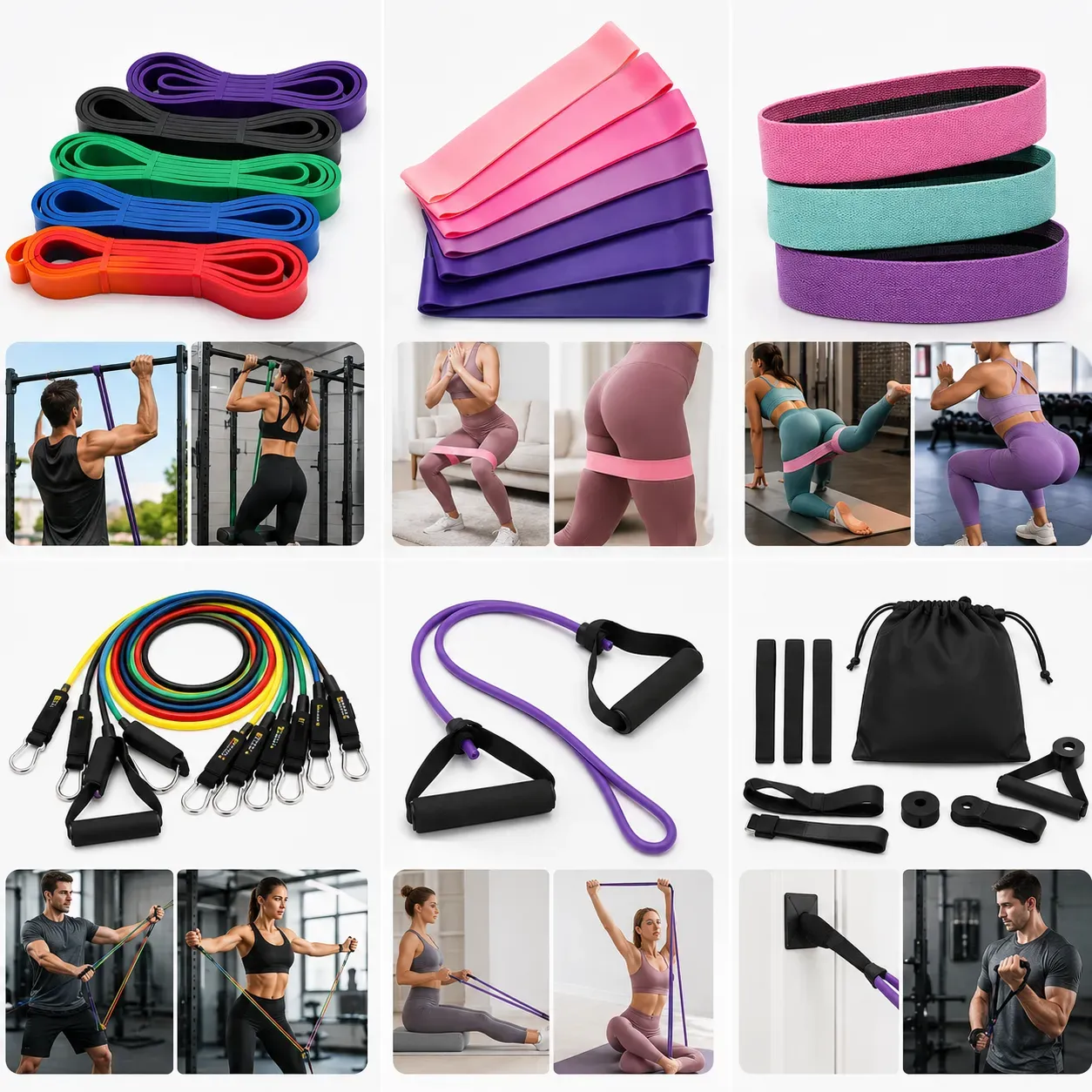
These scenarios map to five primary product types:
Power Loop Bands (Long Closed-Loop / Pull-Up Assist Bands)
The most versatile category. Suitable for pull-up assistance, adding variable resistance to squats and deadlifts, and multi-plane upper-body work.
Procurement priority: High. Recommend 3–4 resistance levels as a core set.
Key specs: Loop length and width determine exercise range; natural latex or high-elasticity fabric; verified rebound consistency and aging resistance.
Fabric Booty Bands / Hip Circles
Currently one of the highest-converting lower-body categories. Wide fabric construction with internal elastic core solves the rolling, pinching, and slipping issues common with traditional latex mini loops.
Procurement priority: Very high for female and home-sculpting channels. Typically sold as 3-level sets (light–medium–heavy).
Key specs: Fabric density, internal elastic core quality, anti-slip inner lining, and seam strength.
Tube Bands with Handles
Primary solution for upper-body machine-style movements at home. Completeness of accessories strongly influences user satisfaction and review scores.
Procurement priority: Medium-high. Prefer complete kits (multiple resistance levels + door anchor + ankle straps + handles).
Key specs: Wall-thickness uniformity, connector tensile strength, handle ergonomics and grip.
Flat Latex Therapy Bands
Standard for physical therapy, post-injury recovery, and low-impact work.
Procurement priority: Medium (stronger in medical/rehab channels or as a complementary SKU).
Key specs: Thickness precision, length consistency, and allergen control.
Mini Latex Loop Bands
Convenient for activation and travel but higher risk of rolling and breakage under heavy use.
Procurement priority: Low to medium. Suitable only as an entry-level or supplementary SKU.
2. Core Technical Evaluation Criteria
Professional procurement evaluates bands on quantifiable, testable metrics rather than color coding or marketing claims.
Material Performance
- Natural latex offers superior elasticity and rebound but requires verification of UV and oil resistance plus break strength. Request fatigue-test data (rebound retention after repeated stretching to specified multiples).
- Fabric composites (dense outer fabric + internal elastic core) dominate glute applications. Prioritize anti-roll performance and friction under sweaty conditions.
- Tube bands require uniform wall thickness and robust joint construction to avoid premature failure points.
Resistance Accuracy and Consistency
Inconsistent color coding and large deviations between labeled and actual resistance remain industry-wide problems. Require:
- Clear equivalent resistance ranges (not color alone).
- Sample testing of resistance curves at different stretch lengths.
- Clear progression steps within sets to support progressive overload.
Structural Durability Risks
- Fabric bands: Seam density, security of internal elastic strips, and edge finishing. High-repetition lateral movements and sweat are primary failure modes.
- Tube bands: Handle-to-tube connection strength (prefer metal or high-grade engineering plastic) and door-anchor load capacity.
- Latex bands: Edge quality, thickness uniformity, and risk of stickiness or brittleness after aging.
Compliance and Safety
Latex allergy labeling is baseline. For rehab or mixed-use channels, evaluate latex-free alternatives and relevant certifications. Packaging and instructions must clearly state inspection methods and usage limits to reduce liability exposure.
3. Supplier Qualification and Quality Control
Establish a standardized evaluation process:
- Sample protocol: Mandate real-world testing (high-rep lateral walks, extreme stretch rebound, prolonged handle grip, door-anchor load) rather than visual inspection alone.
- Quality agreement: Define AQL sampling standards, minimum break strength, rebound attenuation limits, and dimensional tolerances. Include clear non-conformance and traceability terms.
- Supply reliability: Assess MOQ flexibility, on-time delivery history, and ability to manage raw-material cost fluctuations. Resistance bands are high-turnover items; stockouts or quality swings disrupt channel sales.
- Total cost of ownership: Evaluate beyond unit price. Factor in expected returns, customer service costs, replacement logistics, and brand reputation impact. Low-priced, low-quality bands frequently carry higher full-lifecycle costs.
4. Portfolio and Channel Strategy
- Home and content-driven channels: Lead with fabric booty band sets + multi-level power loop sets. Emphasize anti-roll performance, portability, and clear use-case visuals.
- Strength and gym-assistance channels: Focus on power loop bands across multiple resistance levels, highlighting pull-up progression and compound-lift applications.
- Rehabilitation and professional channels: Prioritize flat therapy bands with emphasis on precision, low impact, and allergen control.
- Entry-level or gift markets: Mini loops or basic tube kits can serve as traffic drivers, but maintain strict quality floors to protect overall brand perception.
5. Key Procurement Takeaways
Successful resistance band sourcing rests on three pillars:
- Precise alignment between product type and primary use case.
- Measurable performance specifications backed by testing.
- Full-lifecycle cost control through supplier agreements and quality systems.
Treat resistance bands as components of a complete home and functional training solution rather than low-cost accessories. Maintain a decision sequence of “use case first → technical specifications second → price third.” Continuously refine the assortment using return and complaint data. Brands that follow this disciplined approach build stronger product differentiation, lower operational friction, and higher long-term customer trust.