Buying Guides
Are Resistance Bands as Effective as Free Weights? | 2026 Research
Are Resistance Bands as Effective as Free Weights? | 2026 Research

Resistance bands started out as something a physiotherapist handed you after a knee injury. They now turn up in hotel rooms, garage gyms, collegiate weight rooms and commercial studios, sometimes in the same program as barbells and dumbbells.
Which brings back the question, and it usually comes from buyers rather than lifters: can a band actually do the work of a dumbbell?
The research published in 2026 gives a more useful answer than the usual yes or no. Two studies and one set of updated guidelines, taken together, draw a fairly clear line between the jobs elastic resistance handles as well as conventional loading and the jobs it doesn't.
1. The 2026 ACSM guidelines put elastic resistance in the same bracket as iron
On March 17, 2026, the American College of Sports Medicine published its first major revision of resistance training guidance in 17 years. The recommendations rest on 137 systematic reviews covering more than 30,000 participants.
The line that got quoted most: you don't need a rack of iron to get stronger. ACSM lists elastic bands, bodyweight work and home-based programs alongside conventional gym equipment as valid ways to improve strength, muscle size and physical performance.
Worth being precise about that, because a lot of the coverage rounded it off. The guidelines place bands in the same category of effective. They don't call bands and barbells interchangeable, and they don't rank one above the other. That distinction is the whole argument, so the next section matters more than the headline.
2. Bands vs. free weights: what the trials measured
Schott, Straßer and Holfelder ran the comparison directly. Forty-eight community-dwelling older adults, twelve weeks of progressive resistance training, one group on elastic bands and one on free weights, functional performance tested before and after.
Both groups improved on the same battery: stair climbing, chair stands, a lifting and carrying task, timed mobility. Twelve weeks of band work moved the markers that twelve weeks of free-weight work moved.
The result is narrower than it sounds, and the authors are careful about it. Older adults, twelve weeks, functional outcomes. That answers a question about daily function and fall risk. It doesn't answer whether a 30-year-old can build a 180 kg squat out of bands, and nothing in the paper claims it can.
Where the two methods genuinely diverge is the loading curve. A band's resistance climbs as it stretches, so the hardest point of the rep comes at the end of the range. A dumbbell gives you the same load at the bottom of the rep as at the top. Most of the practical trade-offs follow from that one difference. Bands are gentler at the joint angle where you're weakest and hardest where you're strongest, which is why they work well for rehabilitation and for pressing variations. They're also harder to quantify session to session, because "the red band at chest height" isn't a number.
Free weights win on measurability and on maximal load. Bands win on portability, on horizontal and rotational pulling angles that a dumbbell makes awkward, and on cost for anyone training at home. Neither list is a compromise. They're different tools.
3. What elastic resistance actually does mechanically
In September 2026 the Journal of Clinical Medicine published a narrative review by Guzmán-Muñoz and colleagues on elastic bands in sports medicine and rehabilitation. It covers mechanical behavior, neuromuscular response and practical prescription.
Three of its findings matter to anyone selling or specifying the product.
The force a band produces depends on how far it is stretched and how the exercise is set up. That sounds obvious, but it means the same band is a different piece of equipment depending on anchor height, limb length and the range you work through.
When effort and setup are controlled, elastic resistance produces muscle activation and strength adaptation in the same range as conventional resistance training. The qualifier is doing real work there. Bands don't self-regulate. The session has to be prescribed with the same attention to load and progression as a barbell program, and most home users don't do that, which is a training problem rather than a product problem.
The applications also extend well past rehabilitation, into athletic conditioning and general performance work.
The review makes one more point that lands on manufacturers rather than coaches: resistance needs to be measured and stated, not just color-coded. A color is a marketing convention. Two "medium" bands from two factories can differ noticeably at the same elongation, and neither supplier is lying, because there is no shared definition of medium.
4. Why "resistance band" now means five different products
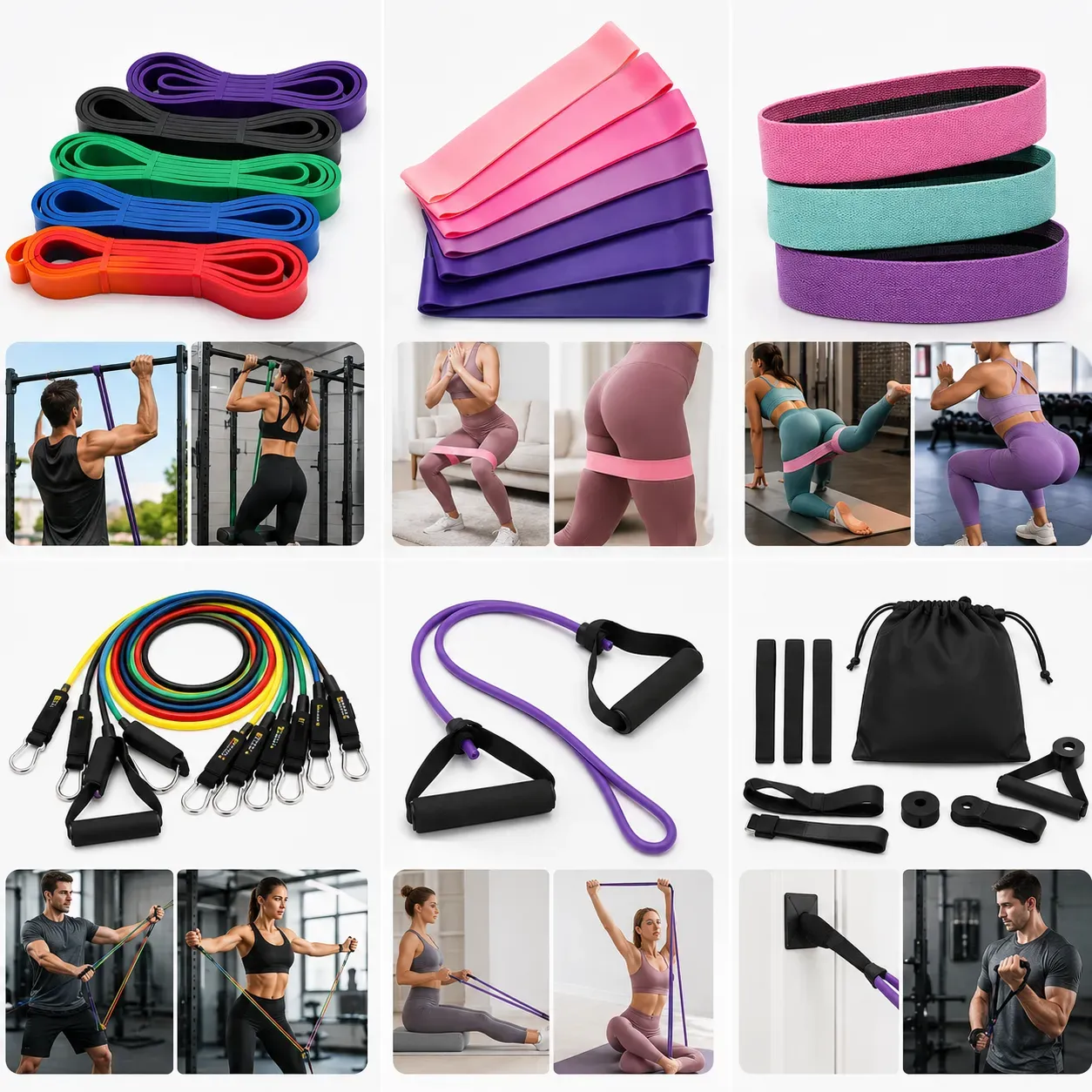
Ten years ago the category was one product in five colors. Buyers now ask for a range, and the range exists because the jobs are different.
Latex bands are still the default for strength work, stretching and rehab. They stretch further and recover better over repeated cycles than cheaper alternatives, which is why they hold rated resistance for longer. TPE bands are latex-free, which matters for a real share of the market, and cost less to produce, at some cost in elongation and feel.
Mini bands are loops, usually around 30 cm, used for glute activation, warm-ups and lateral work. Latex and fabric versions behave differently enough that they aren't interchangeable. Fabric doesn't roll or pinch. Latex gives more stretch resistance through the range.
Power bands are the thick ones, up to about 10 cm wide, used for pull-up assistance, banded barbell work and sled or sprint resistance. This is the category where rated resistance and break strength actually get tested by users, because the loads are high.
Tube bands with handles sit somewhere between a band and a cable machine, and they sell to a different customer than loop bands do.
The point for a brand isn't to list all five. It's that a set built as a progression, light to heavy with resistance printed on each band, sells differently from five loose bands in a bag and supports a higher price.
5. What buyers should check before placing an order
Most private-label band projects fail on the specification sheet, not in the factory. A few things are worth pinning down before samples get approved.
The material spec should name the compound and the wall thickness, not just "natural latex." Thickness and width together determine resistance far more reliably than color does, and both need tolerances.
Resistance should be measured at stated elongations, typically 100% and 200%, with an acceptable range. If a supplier can only tell you light, medium and heavy, you have no way to audit a shipment.
Durability needs a test method rather than a claim. Repeated stretch cycles to a defined elongation, with the band checked for permanent deformation and surface failure, is the minimum. Ask for the cycle count and the failure criterion.
Customization is usually the easy part. Resistance levels, lengths, widths, colors, printed logos, retail packaging and set composition are all routine. The thing to confirm early is minimum order quantity per SKU, because a five-band set in five custom colors is five SKUs whether it ships in one box or five.
Quality control should be written down: incoming material inspection, in-process checks on width and thickness, resistance sampling on finished goods, and a packaging check. A supplier who can't describe their inspection points in a sentence or two probably doesn't have them.
Price matters, obviously. It's just the least useful variable on its own, because the band that fails at 3,000 cycles costs more than the one that runs to 30,000.
6. What this means on the product side
None of this is a prediction, but it points somewhere.
The bands that are easiest to sell on price are the hardest to defend on quality, and the 2026 research gives brands a reason to talk about performance instead: stated resistance, tested durability, documented cycle counts. That's a harder conversation than a color chart and a lower price, but it's a defensible one.
We'd expect to see more sets sold as progressions rather than assortments, resistance values printed on the band itself, and some of the sub-$10 gift-channel volume moving toward fabric and heavier latex, simply because returns get expensive.
The research hasn't changed what a band is. It has changed what a buyer can reasonably ask a supplier to prove.
Conclusion
So, are resistance bands as effective as free weights?
For functional strength, rehabilitation and most home training, the 2026 evidence says yes, provided the program is designed with the same care as a weight-training program. For maximal strength and precise load progression, free weights still do things bands can't, and no careful reading of the research claims otherwise.
The more useful conclusion for anyone selling the product is about specification. Elastic resistance is now treated as legitimate training equipment, and legitimate equipment gets held to a standard. Colors and marketing copy don't meet it. Measured resistance, tested durability and consistent production do.
At OEMResistanceBands.com we manufacture latex and TPE resistance bands, mini bands, fabric hip bands, power bands and pull-up assistance bands for fitness brands and distributors, including custom resistance levels, printed branding and retail packaging.
If you're sourcing, send us your spec and we'll tell you what's realistic to produce at your target price.
Frequently asked questions
Are resistance bands as effective as free weights?
Partly, and it depends on the job. For functional strength, rehabilitation and general training, trials show bands producing improvements comparable to free weights when the program is set up properly. For maximal strength and precise load progression, free weights remain the better tool.
Can resistance bands build muscle?
Yes, if the training provides enough resistance and progresses over time. The constraint is load. A band's resistance caps out at its elongation range, so building size in larger muscle groups usually means stacking bands or moving to a heavier category, which is why power bands exist.
What types of resistance bands are available?
Latex loop bands, TPE bands, fabric hip loops, mini bands, tube bands with handles, and heavy power or pull-up assistance bands.
What should I consider when buying resistance bands in bulk?
The material specification and tolerances, resistance measured at stated elongations, a defined cycle test, minimum order quantity per SKU and color, and a written quality control procedure.
Can resistance bands be customized for private-label brands?
Yes. Depending on the manufacturer, customization covers dimensions, resistance levels, colors, printed logos, packaging and set composition. MOQ usually depends on how many colors and SKUs the set involves.
References
- American College of Sports Medicine (2026). ACSM Unveils Landmark 2026 Resistance Training Guidelines. March 17, 2026.
- Guzmán-Muñoz et al. (2026). Elastic Resistance Bands in Sports Medicine and Rehabilitation: A Narrative Review of Neuromuscular Mechanisms, Prescription, and Functional Applications. Journal of Clinical Medicine, 15(18), 7086.
- Schott, N., Straßer, P., & Holfelder, B. (2026). Effects of elastic band training versus free weight training in community-dwelling older adults: A randomized controlled trial. Experimental Gerontology, 221, 113182.