Aug 7, 2026Buying Guides
Are tube resistance bands used like flat bands
Learn whether tube resistance bands can be used like flat resistance bands. Compare resistance, training applications, rehabilitation, Pilates, and strength exercises to choose the bands
Are Tube Resistance Bands Used Like Flat Bands?
The short answer is not exactly.
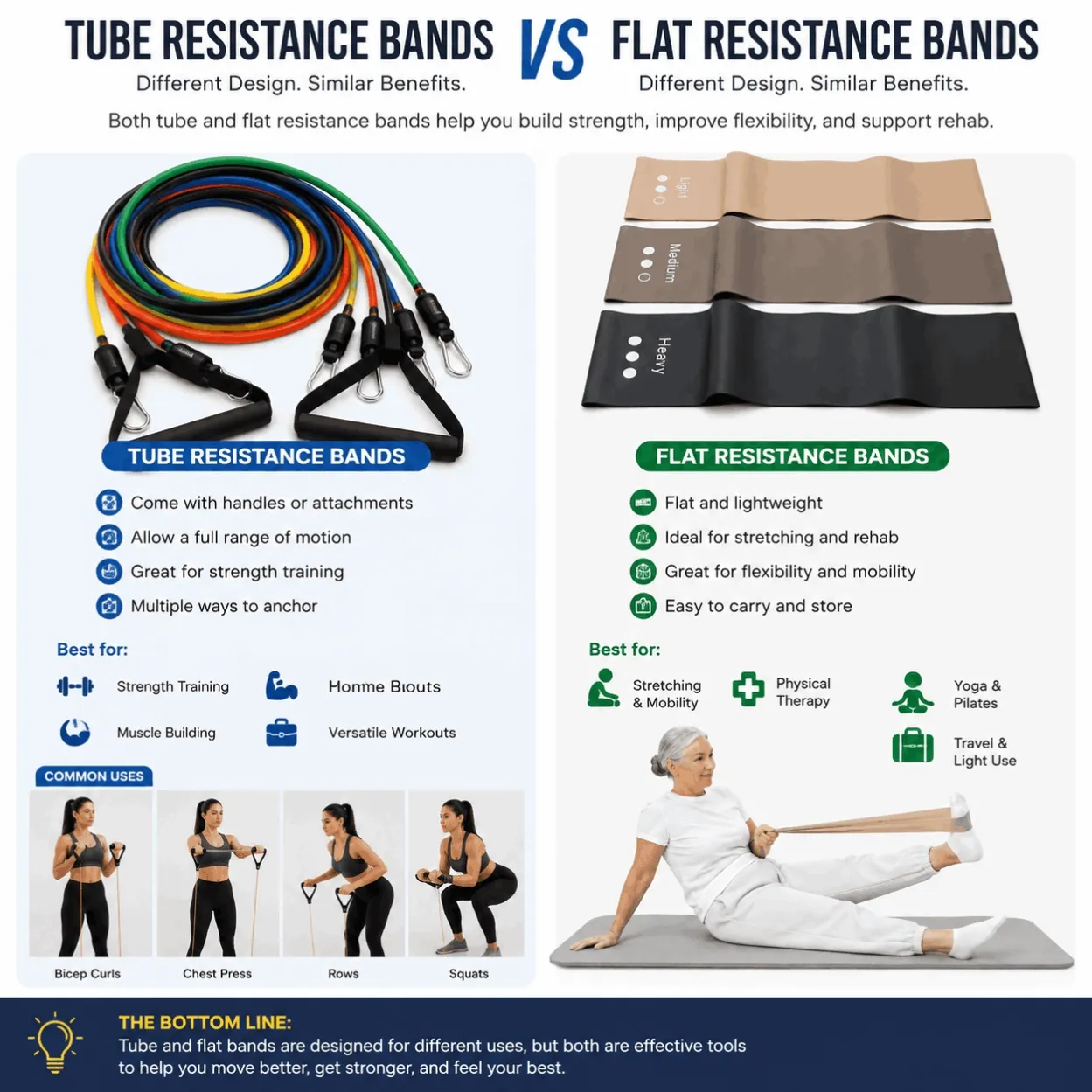
Although tube resistance bands and flat resistance bands both provide elastic resistance, they are designed for different training purposes. In many exercises they can achieve similar results, but their construction, resistance characteristics, and ideal applications are different.
Understanding these differences helps fitness brands, distributors, therapists, and consumers choose the right product for specific training goals.
What Are Tube Resistance Bands?
Tube resistance bands are cylindrical elastic tubes, usually made from natural latex. They are commonly used together with:
- Foam handles
- Door anchors
- Ankle straps
- Carabiners
Because they can be connected to multiple accessories, tube bands offer excellent versatility for full-body strength training.
Typical applications include:
- Home gym workouts
- Personal training
- Strength development
- Functional fitness
- Sports conditioning
What Are Flat Resistance Bands?
Flat resistance bands are wide, flat elastic bands without handles or connectors.
They are popular in:
- Pilates
- Yoga
- Physical therapy
- Rehabilitation
- Stretching
- Mobility training
Their flat surface distributes pressure more evenly across the body, making them comfortable for controlled movements and therapeutic exercises.
Tube Bands vs Flat Bands: What's the Difference?
Feature | Tube Resistance Bands | Flat Resistance Bands |
|---|---|---|
Shape | Round Tube | Flat Sheet |
Handles | Usually Included | No Handles |
Resistance | Strong Linear Pull | Smooth Progressive Stretch |
Best For | Strength Training | Pilates & Rehabilitation |
Accessories | Yes | No |
Portability | High | Very High |
Beginner Friendly | Yes | Excellent |
Physical Therapy | Good | Excellent |
Can Tube Resistance Bands Replace Flat Resistance Bands?
In some situations, yes.
For example:
- Bicep curls
- Shoulder presses
- Chest presses
- Row exercises
- Squats
Both products can provide effective resistance for these movements.
However, flat bands remain the preferred option for exercises that require wrapping the band around the body or maintaining continuous contact with the skin.
When Flat Resistance Bands Perform Better
Flat resistance bands are ideal for movements that emphasize flexibility, rehabilitation, and controlled muscle activation.
Typical applications include:
Pilates
- Core activation
- Controlled movements
- Posture correction
Physical Therapy
- Shoulder rehabilitation
- Knee rehabilitation
- Hip mobility
- Joint recovery
Stretching
- Hamstring stretches
- Hip flexibility
- Spine mobility
- Shoulder mobility
Muscle Activation
- Glute activation
- Rotator cuff exercises
- Scapular stability
- Core engagement
When Tube Resistance Bands Are Better
Tube resistance bands excel in exercises that simulate traditional weight training.
Ideal uses include:
Upper Body Strength
- Chest Press
- Shoulder Press
- Lat Pulldown
- Bent Over Row
Lower Body Training
- Squats
- Lunges
- Deadlifts
- Hip Extensions
Functional Training
- Athletic conditioning
- Speed training
- Stability exercises
- Balance training
Home Gym Replacement
Many users replace dumbbells with resistance tube sets because resistance can be adjusted by combining multiple tubes.
Which Band Is Better for Rehabilitation?
For rehabilitation professionals, flat resistance bands are generally the first choice.
Reasons include:
- Gentle resistance progression
- Comfortable against the skin
- Better control during slow movements
- Easy to adjust resistance by grip position
Tube bands are often introduced later in rehabilitation when patients begin rebuilding strength.
Which Product Is Better for Pilates?
Pilates instructors usually recommend flat resistance bands because they:
- Wrap easily around hands and feet
- Provide smooth resistance
- Improve flexibility
- Support controlled movement patterns
- Increase body awareness
Tube bands are less commonly used in traditional Pilates classes.
Which Product Is Better for Muscle Building?
If the primary goal is increasing muscular strength, tube resistance bands often provide a better experience.
Advantages include:
- Compatible with handles
- More exercise variations
- Greater resistance combinations
- Easier to mimic cable machines
Can Fitness Brands Sell Both Products?
Absolutely.
Many successful fitness brands include both tube resistance bands and flat resistance bands in their product lineup because they serve different customer needs.
A typical product range includes:
- Tube Resistance Bands
- Flat Resistance Bands
- Mini Loop Bands
- Pull-Up Bands
- Fabric Hip Bands
Offering multiple resistance band types helps brands cover rehabilitation, home fitness, strength training, Pilates, yoga, and professional gym markets.
How to Choose Between Tube and Flat Resistance Bands
Choose Flat Resistance Bands if you need:
- Pilates
- Yoga
- Rehabilitation
- Stretching
- Physical therapy
- Mobility training
Choose Tube Resistance Bands if you need:
- Home gym workouts
- Strength training
- Muscle building
- Functional fitness
- Full-body workouts
- Adjustable resistance systems
OEM Manufacturing Options
As a professional resistance band manufacturer, we supply both flat resistance bands and tube resistance bands for fitness brands worldwide.
OEM services include:
- Custom colors
- Pantone color matching
- Logo printing
- Resistance customization
- Retail packaging
- Instruction manuals
- Amazon FBA packaging
- Private label manufacturing
Frequently Asked Questions
Are tube resistance bands stronger than flat bands?
Not necessarily. Both can be manufactured with different resistance levels. Tube bands often feel stronger because they are commonly paired with handles and accessories for strength training.
Can beginners use tube resistance bands?
Yes. Beginners can start with lighter resistance levels and gradually increase intensity as strength improves.
Which band lasts longer?
High-quality natural latex tube bands and flat bands are both highly durable when manufactured correctly and used as intended. Proper storage away from direct sunlight and excessive heat will help extend their lifespan.
Are flat resistance bands better for physical therapy?
Yes. Flat resistance bands are widely used by physical therapists because they provide smooth, controlled resistance and are comfortable for rehabilitation exercises.
Can I offer both products under my own brand?
Absolutely. We provide OEM and private label manufacturing for tube resistance bands, flat resistance bands, mini loop bands, pull-up bands, and other resistance band products.
Conclusion
Tube resistance bands and flat resistance bands are not direct replacements for one another—they are complementary tools designed for different training objectives. Flat bands are ideal for rehabilitation, Pilates, yoga, and flexibility, while tube bands excel in strength training, functional fitness, and home gym workouts. For fitness brands and distributors, offering both types creates a more complete product portfolio that meets the needs of a wider range of customers.