Sep 1, 2026Manufacturing Guide
How Are Fabric Resistance Bands Made? | Booty Band Manufacturing Process
How Booty Bands Make ?
How Are Fabric Resistance Bands Made? | Booty Band Manufacturing Process
Fabric resistance bands, commonly known as booty bands, hip bands, or fabric exercise bands, are widely used for glute activation, hip training, leg workouts, warm-ups, and strength training.
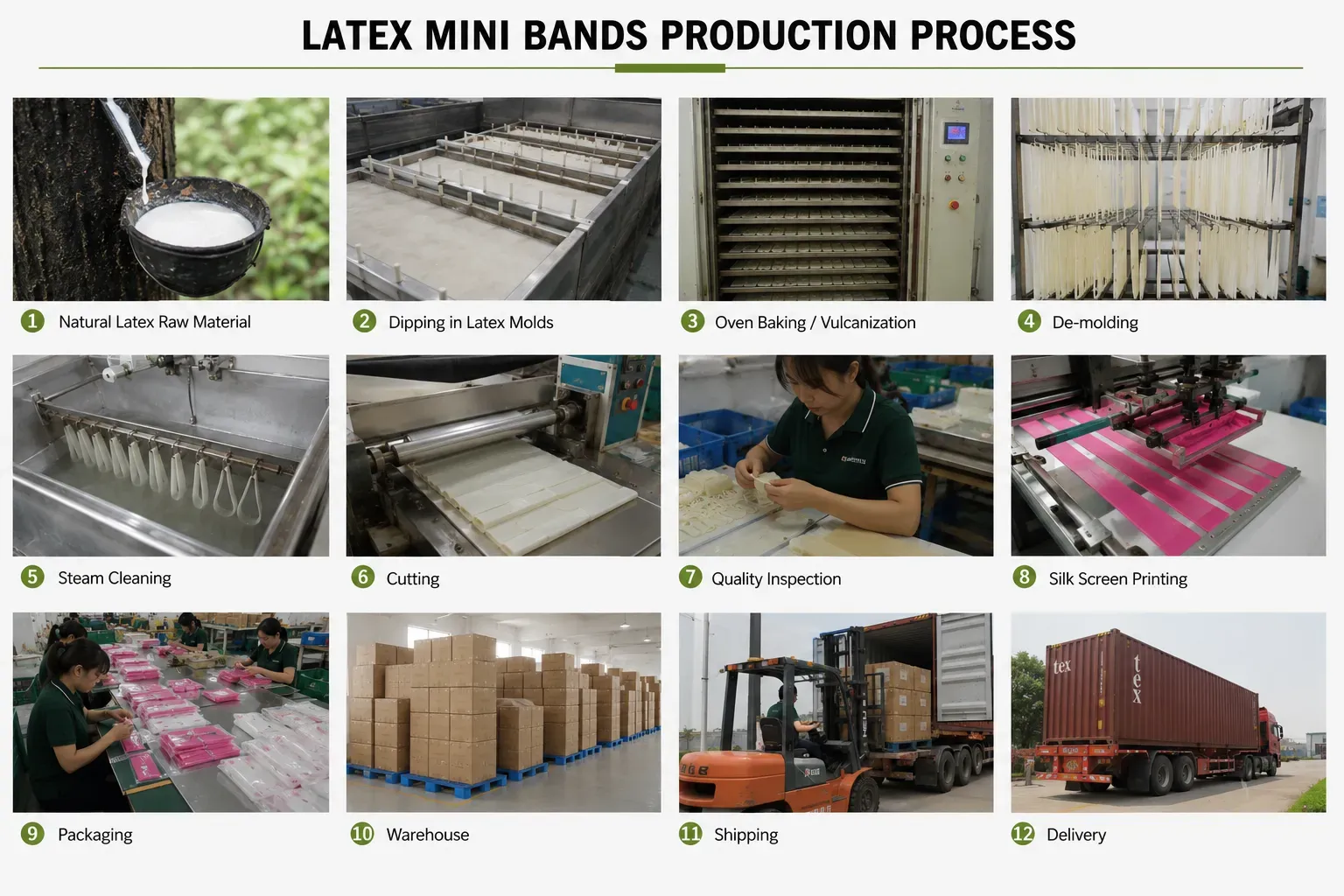
Unlike traditional latex mini bands, fabric resistance bands are not simply molded rubber loops. They are engineered textile products made by combining fabric yarns with elastic materials, followed by weaving, cutting, sewing, resistance testing, quality inspection, and packaging.
So, how are fabric resistance bands made?
A typical manufacturing process includes:
Raw Material Selection → Elastic Fabric Weaving → Anti-Slip Design → Dyeing & Color Control → Cutting → Loop Sewing → Logo Customization → Resistance Testing → Stretch & Recovery Testing → Final Inspection → Packaging
This guide explains each stage of the booty band manufacturing process and highlights what fitness brands, wholesalers, and private-label buyers should consider when sourcing fabric resistance bands.
What Are Fabric Resistance Bands Made Of?
A fabric resistance band is not simply a piece of ordinary fabric.
The material normally combines textile fibers with elastic components to provide both comfort and resistance.
Depending on the product design, materials may include:
- Polyester
- Cotton
- Spandex / elastane
- Latex or rubber elastic yarn
The exact material composition varies depending on the required resistance, stretch ratio, surface feel, durability, and target price.
The textile fibers provide structure, strength, appearance, and comfort, while the elastic components allow the band to stretch and recover.
This combination is one of the main differences between fabric resistance bands and traditional latex resistance bands.
Fabric Resistance Bands vs Latex Mini Bands: How Are They Different?
Although both products can be used for glute and leg exercises, their manufacturing methods are very different.
Feature | Fabric Resistance Bands | Latex Mini Bands |
|---|---|---|
Main Structure | Textile + elastic materials | Latex/rubber |
Manufacturing | Weaving + cutting + sewing | Rubber forming process |
Surface Feel | Soft textile surface | Rubber surface |
Anti-Slip Design | Can be integrated into the band | Mainly depends on rubber friction |
Resistance Adjustment | Yarn, elastic structure and weaving design | Dimensions and rubber formulation |
Logo Options | Woven label, jacquard, heat transfer, patch | Printing |
Common Products | Booty bands / hip bands | Mini loop bands |
This difference is important for buyers because resistance, comfort, durability, and customization options are controlled differently during production.
Step 1: Raw Material Selection
The manufacturing process starts with selecting the appropriate yarns and elastic materials.
Depending on the design, manufacturers may combine:
Polyester / Cotton + Spandex or Elastic Yarn
The exact combination depends on the required product characteristics.
For example, buyers may request:
- Softer surface feel
- Higher resistance
- Greater stretch
- Stronger recovery
- Thicker construction
- Reduced rolling during exercise
- Specific colors
- Different price levels
Material selection therefore affects much more than appearance.
It influences the band's:
Resistance → Stretch → Recovery → Comfort → Durability
For private-label fitness brands, the material specification should be confirmed during product development rather than choosing a product based only on color and size.
Step 2: Elastic Fabric Weaving
After the raw materials are prepared, textile and elastic yarns are woven into a continuous elastic band.
This is one of the most important stages of the fabric resistance band manufacturing process.
Manufacturers can adjust factors such as:
- Band width
- Weaving density
- Yarn construction
- Number of elastic yarns
- Elastic yarn specifications
- Fabric thickness
- Stretch ratio
These parameters directly affect the final resistance and feel of the booty band.
For example, two bands with the same dimensions may still provide different resistance if their internal elastic construction or weaving density is different.
This is why resistance should not be determined by band size or color alone.
Step 3: Anti-Slip Design
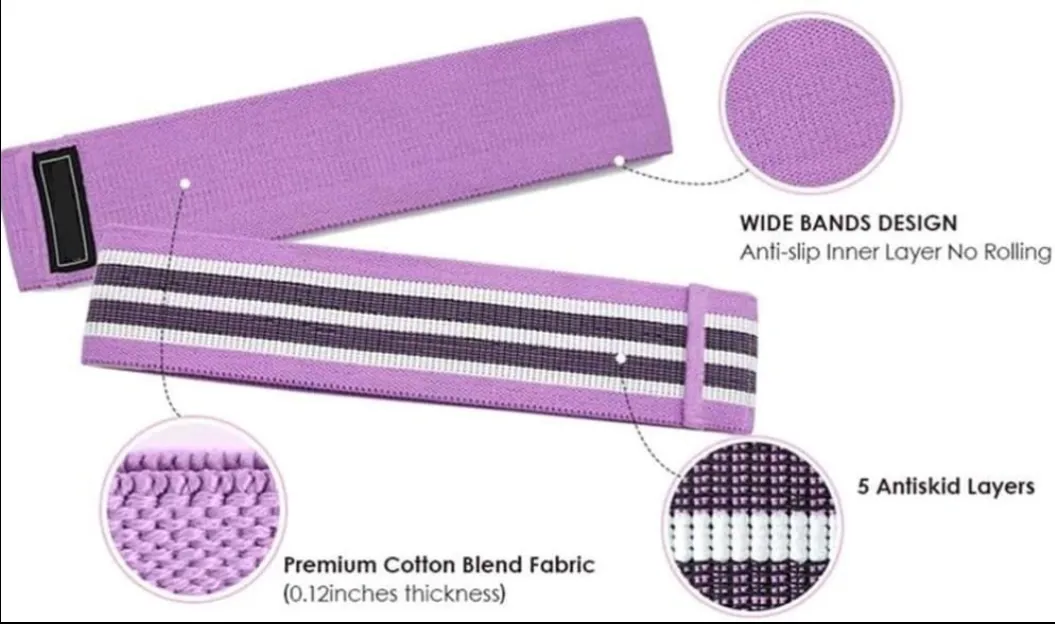
One of the biggest advantages of many fabric booty bands is their anti-slip design.
During squats, hip thrusts, lateral band walks, clamshells, and hip abduction exercises, a poorly designed band may slide or roll.
To improve stability, manufacturers can incorporate an anti-slip grip into the inner surface of the band.
Depending on the product construction, this may be achieved through:
- Integrated anti-slip yarn or rubber structure
- Inner grip stripes
- Additional anti-slip treatment
The actual grip material should be confirmed with the manufacturer because different products may use different materials.
For B2B buyers, an effective anti-slip design can significantly improve the end-user experience.
Step 4: Dyeing and Color Control
Color is particularly important for fitness brands.
Fabric resistance bands are often sold as 3-piece sets with progressive resistance levels, for example:
Light → Medium → Heavy
Brands may differentiate these levels using different colors or different shades within the same color family.
During production, color consistency should be controlled between batches.
For OEM and private-label orders, custom colors can be developed according to the buyer's branding requirements.
When discussing custom colors with a fabric resistance bands manufacturer, buyers should consider:
- Pantone color reference
- Fabric material
- Color tolerance
- Sample approval
- Batch-to-batch consistency
A physical pre-production sample is especially useful when exact brand colors are important.
Step 5: Cutting the Fabric Bands to Length
After the elastic fabric is produced, the long woven material needs to be cut according to the required dimensions.
At this stage, manufacturers control:
- Band length
- Band width
- Cutting accuracy
- Edge condition
- Size consistency
The final dimensions should be selected according to the intended application and resistance design.
For example, a booty band designed for heavy hip training may use different dimensions and construction from a lighter activation band.
Accurate cutting also helps maintain consistency across a multi-band set.
Step 6: Sewing the Band Into a Loop
After cutting, the two ends of the fabric strip are joined to create a continuous loop.
This is one of the most important structural areas of a fabric resistance band.
The connection must withstand repeated tension during exercises such as:
- Squats
- Glute bridges
- Hip thrusts
- Lateral walks
- Leg abduction
- Clamshells
Manufacturers typically use reinforced stitching to increase seam strength.
During product evaluation, buyers should inspect:
- Stitching density
- Seam alignment
- Loose threads
- Connection strength
- Appearance of the joint
A strong fabric material alone is not enough if the seam becomes the weakest part of the product.
For this reason, reinforced stitching and seam strength should be included in the quality-control process.
Step 7: Custom Logo and Private Label Branding
Once the basic booty band is completed, branding can be added according to the customer's requirements.
Common customization methods include:
- Woven logo labels
- Sewn brand labels
- Heat-transfer logos
- Rubber or PVC logo patches
- Jacquard woven logos
The best method depends on the band's material, design, order quantity, budget, and desired appearance.
For brands looking for a more integrated design, a woven or jacquard logo can create a more premium appearance.
Private-label customization can extend beyond the band itself.
Brands can also customize:
- Resistance level markings
- Colors
- Sizes
- Carry bags
- Instruction cards
- Product boxes
- Barcode labels
- Retail packaging
This allows a standard resistance band concept to become a complete branded retail product.
Step 8: Resistance Testing
The terms Light, Medium and Heavy should represent measurable resistance differences rather than simply different colors.
A resistance test can be performed by stretching the band to a defined extension and measuring the force required.
A simplified testing concept is:
Original Length → Specified Extension → Measure Force
The manufacturer can then compare the measured results with the required product specification.
Resistance is influenced by several factors, including:
- Elastic material
- Yarn structure
- Weaving density
- Band dimensions
- Stretch ratio
For a 3-piece booty band set, the manufacturer should be able to create clearly differentiated resistance levels.
For B2B buyers, asking how resistance is measured is more useful than relying only on labels such as Light, Medium, and Heavy.
Step 9: Stretch and Recovery Testing
Resistance alone does not determine product quality.
A fabric resistance band also needs to maintain its performance after repeated use.
During stretch and recovery testing, the band can be repeatedly stretched and released to evaluate how well it maintains its original dimensions and elastic properties.
Manufacturers may inspect for:
- Permanent elongation
- Loss of resistance
- Fabric deformation
- Seam damage
- Loose stitching
- Anti-slip deterioration
- Edge curling
- Elastic recovery
This type of testing is particularly important for products intended for gyms, fitness studios, and frequent home training.
A good booty band should not only feel strong when it is new—it should maintain reasonable performance throughout repeated workouts.
Step 10: Final Quality Inspection
Before packaging, finished fabric resistance bands should undergo final inspection.
Typical inspection points may include:
Dimensions
Check whether the length and width meet the required specifications.
Resistance
Verify that each resistance level falls within the defined product specification.
Color
Check for noticeable color differences or inconsistent dyeing.
Stitching
Inspect seams, loose threads, and structural integrity.
Logo
Confirm logo position, appearance, and branding accuracy.
Anti-Slip Grip
Check the consistency and condition of the anti-slip structure.
Surface Appearance
Inspect for stains, weaving defects, damaged edges, or other visible problems.
For private-label orders, packaging and labeling should also be checked against the approved artwork.
Step 11: Packaging
After passing inspection, the finished bands are prepared for retail or bulk packaging.
A common 3-pack booty band set may include:
- Light Resistance Band
- Medium Resistance Band
- Heavy Resistance Band
- Carry Bag
- Exercise Guide
- Custom Retail Box
For OEM orders, packaging can be customized according to the brand's sales channel.
For example:
Amazon Sellers
May require retail packaging, barcode labels, set packaging, and shipping preparation.
Fitness Brands
May prefer fully customized boxes, bags, inserts, and branded labels.
Wholesalers and Distributors
May prioritize efficient bulk packaging and carton specifications.
Packaging should therefore be discussed as part of product development rather than as an afterthought.
How Is the Resistance of a Booty Band Controlled?
This is one of the most important questions for buyers.
The resistance of a fabric booty band is not controlled by one factor alone.
It can be influenced by:
Elastic Yarn Specification + Elastic Yarn Quantity + Weaving Density + Fabric Construction + Band Dimensions + Stretch Ratio
Changing one or several of these variables can create different resistance levels.
This is also why two booty bands that look almost identical can feel very different during exercise.
For OEM projects, manufacturers should develop the resistance according to measurable specifications whenever possible.
What Should Buyers Check When Choosing a Fabric Resistance Band Manufacturer?
If you are sourcing custom fabric resistance bands, price should not be the only consideration.
Before placing a bulk order, consider asking the manufacturer about:
- What materials are used in the fabric?
- What provides the elastic resistance?
- How is resistance measured?
- How is the seam reinforced?
- Is the inner grip latex, rubber, silicone, or another material?
- Can the resistance level be customized?
- Can the band size and width be customized?
- Can Pantone colors be matched?
- What logo methods are available?
- Can packaging be customized?
- Are stretch and recovery tests performed?
- How is final inspection handled?
These questions help buyers compare manufacturing capability rather than simply comparing quotations.
OEM & Private Label Fabric Resistance Bands
For fitness brands, gyms, wholesalers, distributors, and online retailers, fabric resistance bands can be developed into a fully customized product.
Typical OEM options include:
- Custom resistance levels
- Custom length and width
- Custom fabric colors
- Pantone color matching
- Custom woven labels
- Jacquard logos
- Heat-transfer logos
- Private-label carry bags
- Custom instruction cards
- Custom retail boxes
- 3-pack or multi-band sets
Before bulk production, buyers can confirm the product specifications and approve samples to reduce differences between the intended design and final production.
FAQ About Fabric Resistance Band Manufacturing
What are booty bands made of?
Fabric booty bands are typically made from a combination of textile fibers and elastic materials. Depending on the design, these may include polyester, cotton, spandex, latex elastic yarn, or other rubber-based elastic components.
How are fabric resistance bands made?
Fabric resistance bands are generally produced through material preparation, elastic fabric weaving, anti-slip design, color processing, cutting, loop sewing, branding, resistance testing, quality inspection, and packaging.
How do manufacturers make different resistance levels?
Resistance can be adjusted through elastic yarn specifications, elastic yarn quantity, weaving density, fabric structure, band dimensions, and stretch characteristics.
Are fabric resistance bands latex-free?
Not necessarily.
A fabric outer surface does not automatically mean that the product is latex-free. Some fabric resistance bands may contain latex elastic yarn or rubber components inside the woven structure.
If latex-free products are required, buyers should confirm the exact material composition with the manufacturer.
Why do booty bands have anti-slip strips?
The anti-slip structure helps reduce sliding and rolling during exercises such as squats, hip thrusts, lateral walks, and hip abduction.
Can fabric resistance bands be customized?
Yes. Depending on manufacturing capabilities and order requirements, brands can customize resistance, dimensions, colors, logos, labels, sets, carry bags, and retail packaging.
How should the quality of a booty band be tested?
Important quality checks include resistance testing, repeated stretch and recovery testing, seam inspection, dimensional inspection, color inspection, anti-slip inspection, and visual inspection.
Conclusion
So, how are fabric resistance bands made?
The process involves much more than simply sewing a piece of fabric into a loop.
A complete booty band manufacturing process may include:
Raw Material Selection → Elastic Fabric Weaving → Anti-Slip Design → Dyeing & Color Control → Cutting → Reinforced Sewing → Logo Customization → Resistance Testing → Stretch & Recovery Testing → Final Inspection → Packaging
Each stage can affect the final product's resistance, comfort, durability, appearance, and consistency.
For fitness brands and B2B buyers, understanding this process makes it easier to evaluate a fabric resistance band manufacturer based on manufacturing capability and quality control—not simply unit price.
Looking for a Fabric Resistance Bands Manufacturer?
We provide OEM and private-label fabric resistance bands for fitness brands, wholesalers, distributors, gyms, and online retailers.
Customization options can include:
- Custom resistance levels
- Custom band sizes
- Custom colors
- Logo and label customization
- Anti-slip designs
- 3-pack and multi-band sets
- Carry bags
- Private-label packaging
- Sample development
- Bulk production
Whether you are developing booty bands, hip resistance bands, glute bands, or fabric exercise band sets, we can develop the product according to your brand positioning and target market.