Sep 15, 2026Buying Guides
Why Do Latex Resistance Bands Suddenly Break?
Why Can a Latex Resistance Band Break Suddenly? There is no single reason why a latex resistance band fails. Several factors can contribute to breakage
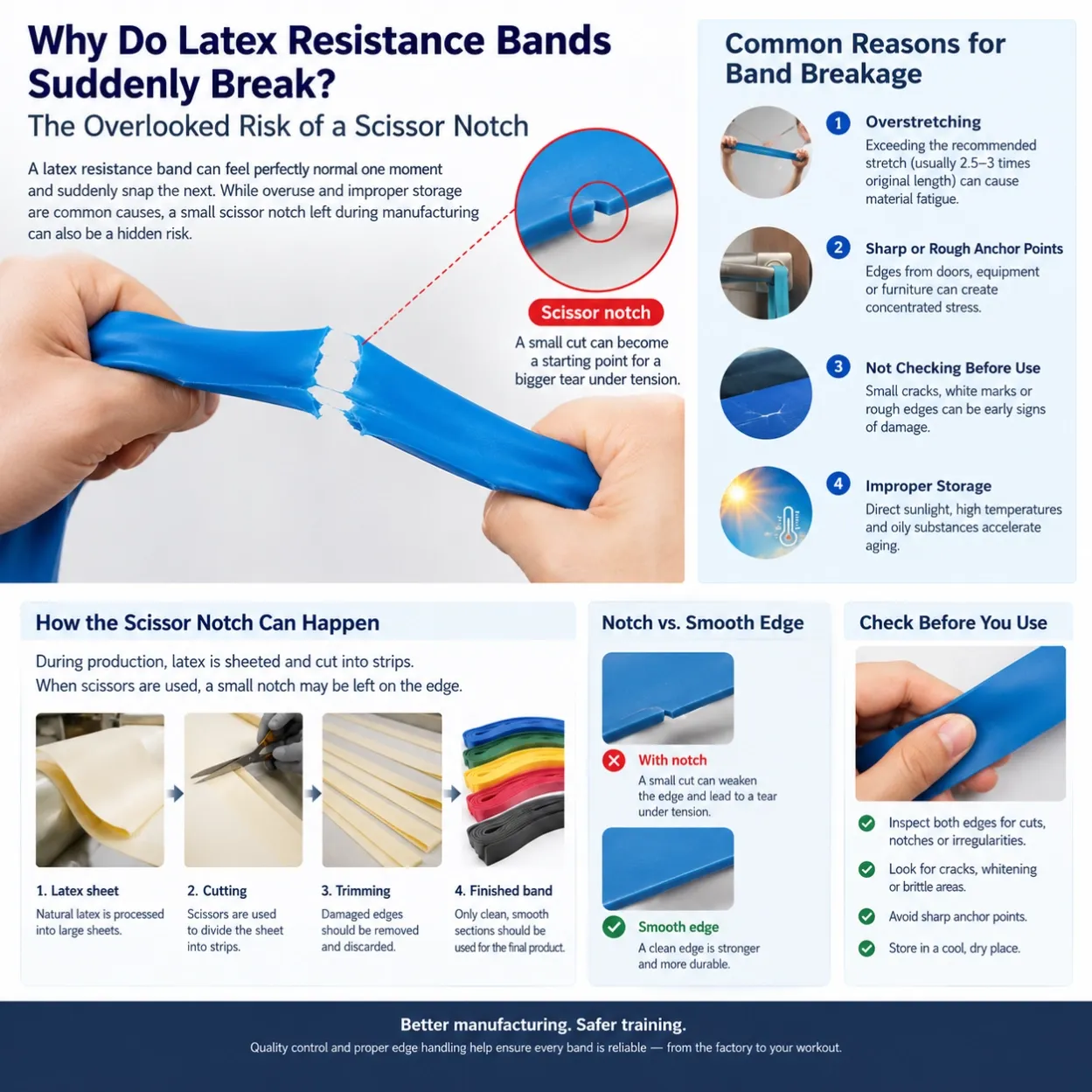
Why Do Latex Resistance Bands Suddenly Break? The Overlooked Risk of a Scissor Notch
A resistance band can feel perfectly normal one moment and suddenly snap the next.
“Crack!”
The band breaks under tension, sometimes whipping back toward the user's body. In a worst-case situation, it can hit the face or eyes.
When this happens, people usually blame one of two things: the band was poor quality, or it was stretched too far.
Those can certainly be causes. But they are not the whole story.
There is another problem that can start before the resistance band ever reaches the customer: a small cut or notch left on the edge during manufacturing.
It may look insignificant. Under tension, it can become the starting point of a much larger tear.
Why Can a Latex Resistance Band Break Suddenly?
There is no single reason why a latex resistance band fails. Several factors can contribute to breakage.
1. Overstretching
Natural latex is highly elastic, but it still has a working range.
If a resistance band is repeatedly stretched beyond its recommended extension—commonly around 2.5–3 times its original length depending on the product and construction—the material is placed under excessive stress.
Repeated overloading can accelerate material fatigue and eventually lead to failure.
For users, the important point is simple:
More stretching does not always mean better training.
The resistance level should match the exercise and the user's strength rather than forcing a light band to perform like a much heavier one.
2. Sharp or Rough Anchor Points
A resistance band can also be damaged by the equipment it is attached to.
Door handles, sharp furniture edges, rough metal surfaces, or the edges of weight plates can create concentrated stress in one small area.
Instead of distributing the tension across the band, the sharp point can act like a cutting edge.
A small surface injury can then develop into a larger tear when the band is stretched.
3. Not Checking the Band Before Use
Latex can show early signs of damage before it actually breaks.
Look for:
- Small cracks
- White or chalky areas
- Cuts or nicks
- Uneven edges
- Brittle or hardened sections
- Surface damage
A band showing these signs should not be used simply because it still "looks usable."
4. Improper Storage
Natural latex is affected by its surrounding environment.
Long-term exposure to direct sunlight, excessive heat, or oily substances can accelerate material aging.
A resistance band stored properly can have a much longer useful life than one left in a hot car, next to a window, or exposed to unsuitable chemicals.
But these are mostly user-side factors.
There is another issue that deserves more attention.
The Manufacturing Risk: A Small Scissor Notch
One of the easiest defects to overlook is a small scissor notch on the edge of the latex.
During production, latex material is processed into large sheets or sections before individual resistance bands are cut from the material.
When the sheet is opened or separated manually, scissors may be used.
This cutting action can leave a small notch or cut on the edge.
The notch itself may be tiny.
The problem is what happens when that damaged section becomes a load-bearing point.
Why Is a Small Notch a Problem?
Think about tearing a piece of paper.
If you start with a completely smooth edge, it takes more force to initiate a tear.
But if there is already a small cut in the edge, the tear has a starting point.
Latex behaves differently from paper, of course, but the basic mechanical concern is similar:
An existing edge defect can create a local stress concentration.
When the resistance band is stretched, the damaged area may experience much higher localized stress than the surrounding material.
If the defect is large enough, or if the material has already been weakened, the crack can propagate quickly.
That is when a band that appeared normal can suddenly fail.
Why Can a New Resistance Band Break on Its First Few Uses?
This is one of the most frustrating situations for a customer.
The band is new.
It has barely been used.
There are no obvious signs of aging.
Yet it breaks during the first or second workout.
In some cases, the problem may not have started with the customer's workout at all.
A small manufacturing defect could have already existed in the edge of the band when it left the factory.
This is why edge inspection matters just as much as material selection.
A resistance band can be made from natural latex and still have a manufacturing-related weakness if damaged sections are not properly removed.
What Should a Resistance Band Factory Do?
This is where manufacturing quality control becomes important.
A responsible production process should not simply cut the material and assume every section is acceptable.
When a damaged edge or scissor notch is identified, the affected section should be removed rather than allowing it to enter the finished product.
The basic principle is:
Do not turn a known damaged edge into a finished resistance band.
A practical quality-control process should include:
1. Remove Damaged Edge Sections
Any section containing visible scissor marks, cuts, notches, or other edge damage should be discarded.
The usable material should come from the clean, undamaged section.
2. Inspect the Finished Edges
After cutting, the edges should be checked for:
- Cuts
- Notches
- Irregular edges
- Surface damage
- Visible cracks
- Other defects that could affect durability
3. Conduct Stretch Testing
Visual inspection alone is not enough.
Finished resistance bands should also be subjected to appropriate stretching and durability checks to identify potential weaknesses.
The exact test method should match the product construction and intended application.
4. Do Not Let Production Speed Replace Quality Control
This is particularly important in high-volume manufacturing.
When production workers are under pressure to increase output, small edge defects can be overlooked.
A few seconds saved during cutting or inspection are not worth the cost of a customer receiving a band that fails during use.
What Can Consumers Check Before Using a Latex Resistance Band?
You do not need special equipment to perform a basic inspection.
Check the edges first.
Unroll the resistance band completely and inspect both edges under good lighting.
Look for:
- Small notches
- Tiny cuts
- Jagged or irregular edges
- White stress marks
- Cracks
- Areas that look thinner or damaged
Dark-colored bands can make small defects particularly difficult to notice, so good lighting is important.
Check the surface.
Run your eyes over the entire band.
If you see cracking, unusual whitening, hardening, or obvious damage, do not continue using it.
Check the anchor point.
Even a good resistance band can be damaged by a sharp attachment point.
Avoid using the band against rough metal, sharp furniture corners, or other surfaces that can cut into the latex.
Do not deliberately test it by overstretching.
If you suspect the band is damaged, pulling it harder to "see whether it will break" is not a useful safety test.
Replace it.
What Should B2B Buyers Ask Their Resistance Band Supplier?
For brands, distributors, and importers, the question is slightly different.
You are not only buying a resistance band.
You are buying the manufacturing process behind it.
When evaluating a latex resistance band supplier, ask how the factory controls:
- Edge defects
- Cutting and trimming
- Surface inspection
- Stretch testing
- Final inspection
- Defective material rejection
It is also worth asking what happens to material with visible edge damage.
A good answer should not simply be:
"Our products are high quality."
You want to understand what the factory actually does on the production line.
That difference matters.
A Cheap Resistance Band Is Not Always a Cheap Product
Price is important in B2B purchasing.
But comparing resistance bands only by unit price can hide manufacturing differences that are impossible to see in a product listing.
Two bands may look almost identical in a product photo.
Both may be made from natural latex.
Both may have the same length and resistance level.
But one factory may have much tighter control over edge defects, material handling, inspection, and testing.
Those differences only become obvious when something goes wrong.
For brands selling resistance bands under their own name, that can become much more expensive than the small amount saved on the original purchase price.
A returned order is one problem.
A customer injury complaint is another.
A damaged brand reputation is harder to recover from.
Final Thoughts
Natural latex resistance bands are excellent training tools. They offer high elasticity, good rebound, and a wide range of resistance levels for strength training, mobility, rehabilitation, and home workouts.
But a good raw material alone does not guarantee a reliable finished product.
Manufacturing details matter.
Overstretching, sharp anchor points, aging, and improper storage can all contribute to breakage.
But when a new resistance band fails unexpectedly, it is also worth asking a different question:
Was there a small defect in the band before it ever reached the customer?
A tiny scissor notch may not look serious during production.
Under tension, however, a small edge defect can become the starting point of a much larger tear.
That is why proper edge handling, rejection of damaged sections, final inspection, and stretch testing should be treated as part of resistance band quality control—not as optional extras.
For resistance band manufacturers, the goal should not simply be to make a band that looks good when it leaves the factory.
The goal is to make sure there is no avoidable weak point waiting to fail when the customer puts it under tension.