Sep 22, 2026Buying Guides
How Resistance Bands Help Preserve Muscle While on GLP-1 Weight-Loss Medications
LP-1 drugs cause significant weight loss but often 25–40% comes from muscle. Resistance bands enable effective home strength training with progressive resistance comparable to weights.
How Resistance Bands Help Preserve Muscle While on GLP-1 Weight-Loss Medications (A Practical Home Strength Training Guide)
GLP-1 medications like Ozempic, Wegovy, Mounjaro, and Zepbound work well for weight loss. Many people lose a significant amount of fat relatively quickly. Clinical data show, however, that roughly 25–40% of the total weight lost often comes from lean tissue (muscle and related soft tissue). This is not a unique side effect of these drugs—similar lean mass loss happens with almost any large calorie deficit. The issue is that when weight drops fast, losing too much muscle can slow your metabolism, make everyday movement feel harder, and leave you looking “deflated” even after the fat is gone.
The good news is you can actively push back against that loss through home strength training. A set of resistance bands (also called exercise bands or elastic bands) is currently one of the lowest-barrier, most practical tools for doing it.
Why Resistance Bands Work Especially Well for GLP-1 Users at Home
Many people still think resistance bands are only for rehab or light stretching. Research doesn’t support that view. When training intensity is high enough, strength gains from elastic resistance bands come out very close to those from free weights or machines. Several systematic reviews have compared the two approaches directly and found no clear winner when effort levels are similar.
For people taking GLP-1 medications, bands offer several practical advantages:
- Low impact on joints, suitable for those with low energy or joint sensitivity
- Fully doable at home—no gym required
- Portable and lightweight, easy to take when traveling
- Adjustable resistance (different colors/thicknesses of mini loops, long loops, and tube bands with handles cover light to heavy needs)
- Suitable for beginners, older adults, postpartum recovery, and anyone focusing on glute activation or lower-body strength
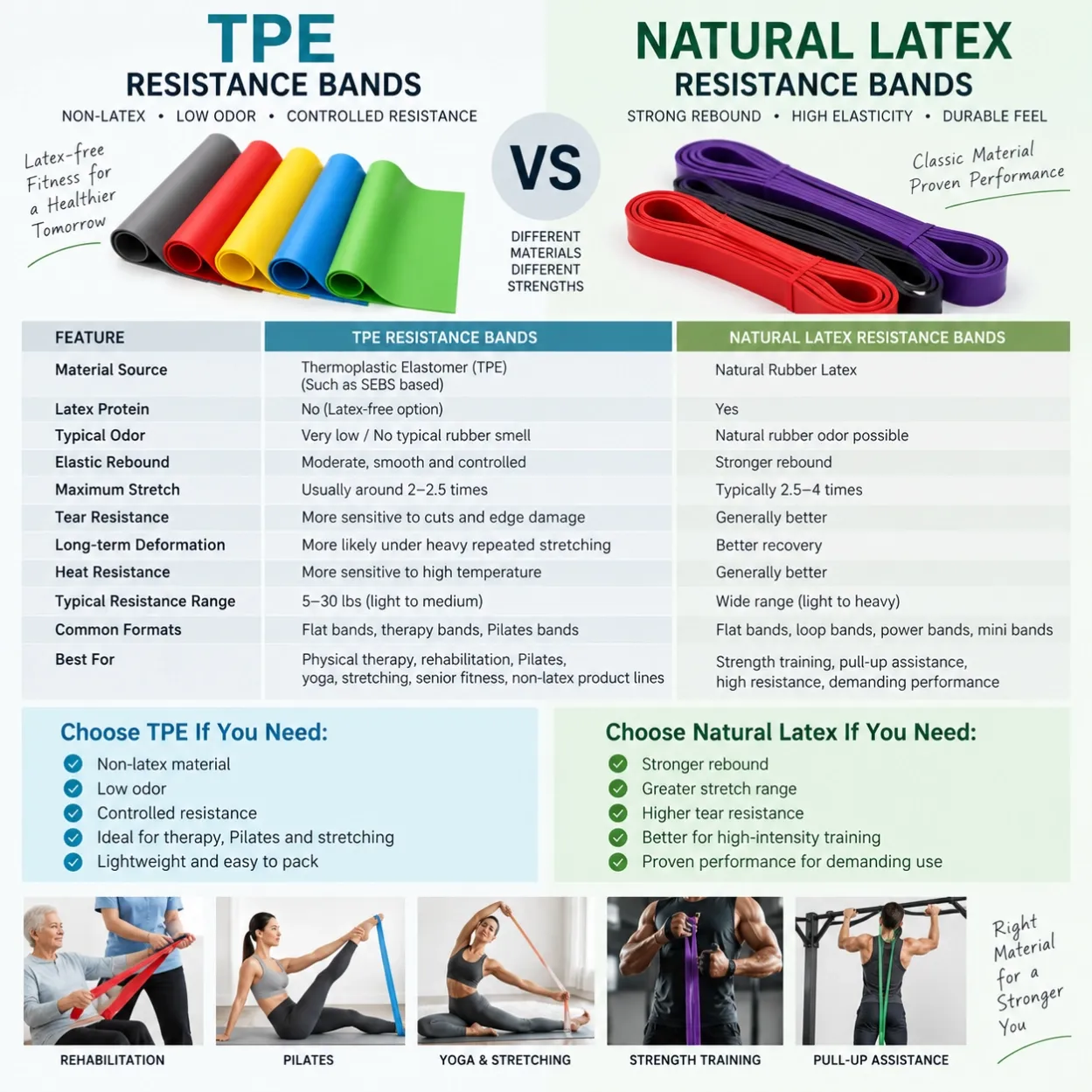
Whether you use fabric resistance bands (non-slip, less rolling—great for glute bridges and lateral walks), latex loop bands, or longer tube bands with handles, most home training scenarios are covered.
How to Use Resistance Bands for Home Strength Training
You don’t need to train like a bodybuilder. Two to three full-body sessions per week is enough for most people. If recovery feels good, you can go up to four sessions. Focus on compound movements that recruit multiple large muscle groups.
Recommended home exercise combination (ready to use):
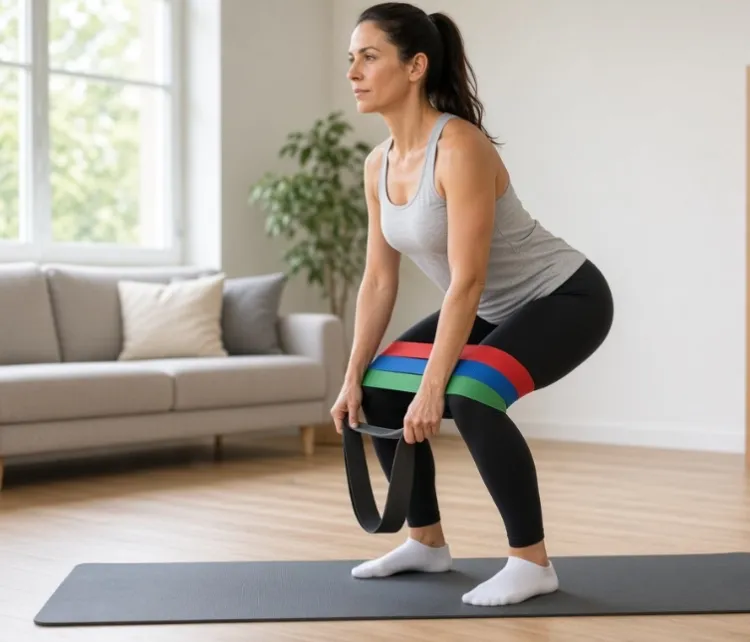
- Banded squats or sit-to-stand (mini loop above the knees, or long band under the feet)
- Banded Romanian deadlift / hip hinge (long band or tube band with handles)
- Banded glute bridge + lateral band walks (fabric or latex mini loops—excellent for glute and hip activation)
- Banded rows (seated or standing, for the back)
- Banded chest press or assisted/resisted push-ups
- Banded overhead press
- Banded anti-rotation (Pallof Press) or plank variations (core stability)
Do 2–3 sets of 8–12 reps per exercise. Choose a band that makes the last few reps challenging while keeping good form. Rest about 60–90 seconds between sets. When the movement starts feeling easy, move to a stronger band or slow down the lowering phase (eccentric control).
Leave at least one day between sessions that heavily target the same muscle groups. If you feel especially drained the day or two after an injection, schedule the harder sessions later in the week. The whole routine fits on a yoga mat at home and takes up very little space.
Protein Matters as Much as the Training
Resistance band training alone isn’t enough. Most experts recommend aiming for roughly 1.2–1.6 grams of protein per kilogram of body weight daily while on these medications. That’s higher than most people normally eat, and reduced appetite makes it harder. Spreading protein across meals helps. If you can’t eat much after training, a protein shake or high-protein snack can close the gap.
A Realistic Starting Point
If you’ve been mostly sedentary or feel low on energy right now, start lighter than you think you need. Two sessions a week of the movements above is already useful. Simply note which band you used and how the sets felt. After a few weeks you’ll notice you can handle more resistance—that progressive challenge is exactly the signal that tells your body to keep the muscle.
Resistance bands won’t turn you into a power lifter overnight, and they won’t completely eliminate lean mass loss for everyone. But they give you a low-barrier way to deliver the right stimulus to your muscles while the medication handles the fat loss. Whether you’re a beginner, an older adult, someone who needs joint-friendly options, or just looking for effective home full-body and glute-focused training, a multi-resistance band set is a practical place to start.
If you have joint issues, significant fatigue, or other medical concerns, check with your doctor first. Then grab a few bands of different strengths (a mix of mini loops + longer loops or tube bands with handles is the most versatile), clear a bit of floor space, and begin. Consistency matters more than perfection here.
Body Part / Goal | Best Band Type | Why It Works Best | Common Exercises |
|---|---|---|---|
Lower Body & Glutes (hips, glutes, thighs) | Stay in place, less rolling, good for activation | Squats, glute bridges, lateral walks, hip abductions | |
Full-Body Strength & Heavy Compounds | High resistance, continuous tension, versatile | Banded squats, deadlifts, pull-up assistance, overhead press | |
Upper Body (chest, back, shoulders, arms) | Comfortable grip, stable for pushing & pulling | Rows, chest press, overhead press, curls, tricep extensions | |
Core & Anti-Rotation | Tube bands with handles or long loops | Easy to anchor, good for rotational control | Pallof press, woodchops, anti-rotation holds |
Rehab, Mobility & Beginners | Gentle, progressive resistance, joint-friendly | Controlled mobility, light activation, recovery |