Sep 28, 2026Buying Guides
How to Choose the Right Resistance Level for Latex Power Bands
read to see How to Choose the Right Resistance Level for Latex Power Bands
How to Choose the Right Resistance Level for Latex Power Bands
For pull up assistance bands, the “right resistance” is not only about the number printed on the band. A professional power band should be selected based on the user’s body weight, training purpose, band width, stretch distance, and real tested resistance.
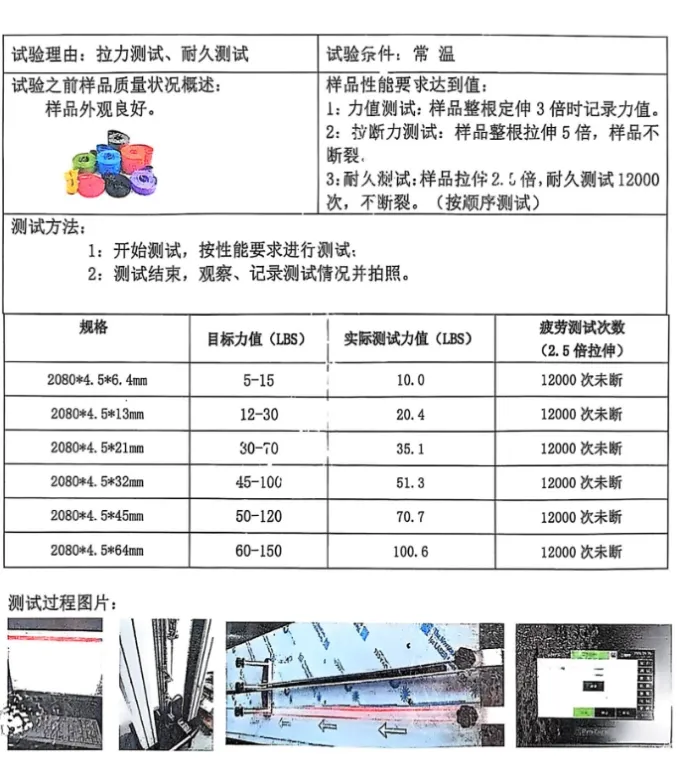
In our factory test, we measured latex power bands under room temperature conditions. Each band was tested at 3 times its original length for resistance value, pulled to 5 times its original length for tensile performance, and tested for 12,000 fatigue cycles at 2.5 times stretch. The samples did not break during the fatigue test.
Real Resistance Test Data
Band Size | Target Resistance | Actual Tested Resistance | Fatigue Test |
|---|---|---|---|
2080 × 4.5 × 6.4 mm | 5–15 lbs | 10.0 lbs | 12,000 cycles, no break |
2080 × 4.5 × 13 mm | 12–30 lbs | 20.4 lbs | 12,000 cycles, no break |
2080 × 4.5 × 21 mm | 30–70 lbs | 35.1 lbs | 12,000 cycles, no break |
2080 × 4.5 × 32 mm | 45–100 lbs | 51.3 lbs | 12,000 cycles, no break |
2080 × 4.5 × 45 mm | 50–120 lbs | 70.7 lbs | 12,000 cycles, no break |
2080 × 4.5 × 64 mm | 60–150 lbs | 100.6 lbs | 12,000 cycles, no break |
What These Numbers Mean
Many buyers only look at the resistance range, such as 30–70 lbs or 50–120 lbs. But in real use, the actual resistance depends on how far the band is stretched.
For example, our 21 mm band has a target resistance range of 30–70 lbs, and the measured value at 3 times stretch is 35.1 lbs. This makes it suitable for general pull up assistance, mobility work, and moderate strength training.
The 64 mm band tested at 100.6 lbs under the same condition, making it more suitable for heavier users, beginners who need strong pull up assistance, or lower-body strength exercises.
How to Choose by Training Purpose
Training Purpose | Recommended Band Width | Why |
|---|---|---|
Mobility warm-up | 6.4 mm / 13 mm | Light resistance, easier to control |
Shoulder rehab and stretching | 6.4 mm / 13 mm | Lower tension, safer for small joints |
General pull up assistance | 21 mm / 32 mm | Balanced support for most users |
Beginner pull up training | 32 mm / 45 mm | More assistance for body weight support |
Heavy pull up assistance | 45 mm / 64 mm | Stronger support for heavier users |
Squats, hip training, power work | 32 mm / 45 mm / 64 mm | Higher tension and better durability |
How to Choose by Body Weight and Pull Up Ability
If the user can already do several pull ups, a lighter band is usually enough. If the user cannot complete one pull up, a wider and stronger band is needed.
User Situation | Suggested Band |
|---|---|
Can do 5+ pull ups | 13 mm or 21 mm |
Can do 1–3 pull ups | 21 mm or 32 mm |
Cannot do a pull up yet | 32 mm or 45 mm |
Heavier beginner | 45 mm or 64 mm |
Mobility only | 6.4 mm or 13 mm |
Why Actual Test Data Matters for B2B Buyers
For fitness brands, Amazon sellers, gyms, and wholesalers, resistance consistency is more important than simply printing a high resistance number.
If the resistance is too weak, customers feel the band does not provide enough support. If it is too strong, the band may feel stiff and hard to control. If the material is unstable, the resistance may change after repeated stretching.
That is why we test power bands by:
- Measuring resistance at 3 times stretch
- Checking tensile performance at 5 times stretch
- Running 12,000 fatigue cycles at 2.5 times stretch
- Recording whether the band breaks, cracks, or loses function
This gives buyers a more realistic understanding of how the band performs in daily training.
Recommended Power Band Set for B2B Brands
For most fitness brands and retail sets, we recommend a 5-level or 6-level latex power band set:
Level | Size | Actual Tested Resistance |
|---|---|---|
Light | 6.4 mm | 10.0 lbs |
Medium-Light | 13 mm | 20.4 lbs |
Medium | 21 mm | 35.1 lbs |
Heavy | 32 mm | 51.3 lbs |
X-Heavy | 45 mm | 70.7 lbs |
XX-Heavy | 64 mm | 100.6 lbs |
This structure covers warm-up, stretching, pull up assistance, strength training, and heavier users. It is also easier for brands to explain the product to customers.
Final Advice
When choosing latex power bands, do not only compare color or printed resistance range. Ask for the real tested resistance value, testing stretch ratio, material thickness, fatigue test result, and whether the band has passed repeated stretch testing.
A reliable latex power band should feel smooth during stretching, return well after use, and remain stable after repeated training. For B2B buyers, real test data is the best way to reduce complaints, returns, and product uncertainty.
Latex Power Bands Test Report
Test Purpose:
Resistance test and durability test.
Test Condition:
Room temperature.
Sample Condition Before Testing:
The sample appearance was good.
Required Sample Performance
- Resistance Test:The resistance value is recorded when the full sample is stretched to 3 times its original length.
- Tensile Strength Test:The sample is stretched to 5 times its original length. The sample should not break.
- Durability Test:The sample is tested for 12,000 cycles at 2.5 times stretch. The sample should not break. Testing is carried out in sequence.
Test Method
- Start testing according to the required performance standards.
- After testing, observe the sample condition, record the test result, and take photos.
Test Results
Specification | Target Resistance (lbs) | Actual Tested Resistance (lbs) | Fatigue Test Cycles at 2.5x Stretch |
|---|---|---|---|
2080 × 4.5 × 6.4 mm | 5–15 | 10.0 | 12,000 cycles, no break |
2080 × 4.5 × 13 mm | 12–30 | 20.4 | 12,000 cycles, no break |
2080 × 4.5 × 21 mm | 30–70 | 35.1 | 12,000 cycles, no break |
2080 × 4.5 × 32 mm | 45–100 | 51.3 | 12,000 cycles, no break |
2080 × 4.5 × 45 mm | 50–120 | 70.7 | 12,000 cycles, no break |
2080 × 4.5 × 64 mm | 60–150 | 100.6 | 12,000 cycles, no break |
Conclusion:
All tested latex power band samples met the required resistance and durability performance. Under the tested conditions, the samples completed 12,000 fatigue cycles at 2.5 times stretch without breaking.