Aug 9, 2026Buying Guides
How to Use Exercise Bands: Beginner's Guide to Resistance Band Workouts
Learn how to use exercise bands for strength training, leg and glute workouts, arm exercises, mobility, warm-ups and home fitness. Explore band types, resistance levels and safety tips.
How to Use Exercise Bands: A Practical Guide for Beginners and Fitness Brands
Exercise bands, also known as resistance bands, are versatile fitness tools that can be used for strength training, mobility, warm-ups, rehabilitation exercises, and full-body workouts.
Unlike traditional weights, exercise bands create resistance through elastic tension. The resistance generally increases as the band is stretched, allowing users to adjust exercise intensity by changing the band's stretch distance, body position, or resistance level.
Whether you are new to resistance training or already familiar with fitness equipment, learning how to use exercise bands correctly can help you build a more effective and controlled workout routine.
What Are Exercise Bands?
Exercise bands are elastic training tools designed to provide external resistance during movement.
Depending on their construction, exercise bands can include:
- Flat resistance bands
- Mini loop bands
- Fabric resistance bands
- Pull-up resistance bands
- Resistance tubes
- Resistance bands with handles
- Pilates resistance bands
Different band designs are intended for different types of training.
For example, mini loop bands are commonly used around the legs for lower-body activation, while long resistance bands and tubes can provide a greater range of movement for upper-body and full-body exercises.
How Do Exercise Bands Work?
Exercise bands work by creating elastic tension when they are stretched.
When you stretch a resistance band farther, the band generates greater pulling force. This provides progressive resistance throughout the movement.
The actual resistance experienced by the user depends on several factors:
- Band material
- Band thickness
- Band width
- Band length
- Resistance level
- Stretch distance
- Body position
- Exercise technique
This is why the same exercise band can feel different depending on how it is positioned and stretched.
How to Use Exercise Bands Correctly
Using exercise bands is relatively simple, but proper setup and control are important.
1. Choose the Right Resistance Level
Start by selecting a band that allows you to perform the exercise with controlled movement.
A useful starting point is:
Light resistance → technique and warm-up
Medium resistance → general fitness and strength training
Heavy resistance → advanced resistance training
The appropriate resistance depends on the exercise and the user's training level.
You should be able to complete the intended repetitions without losing control of the band.
2. Check the Band Before Exercise
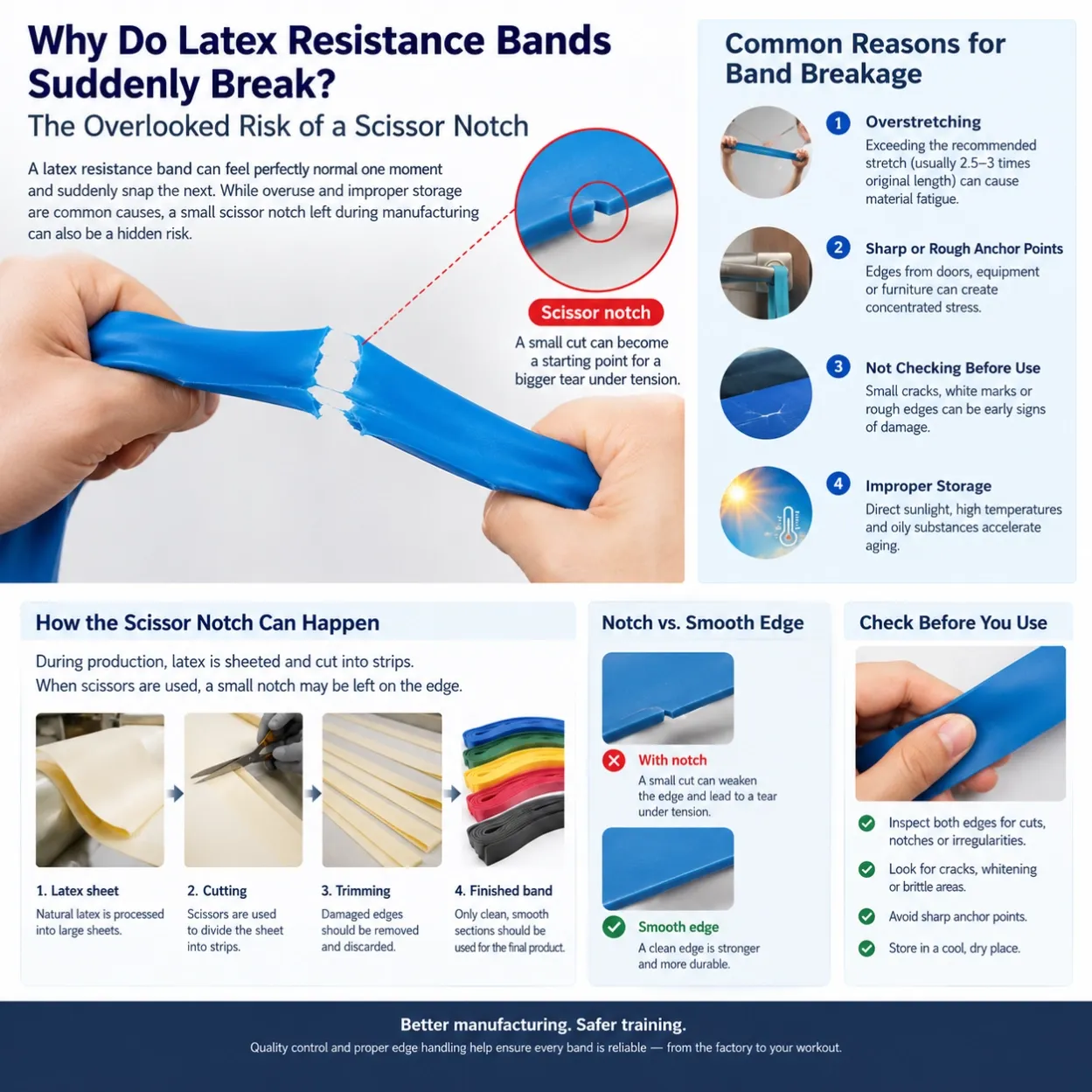
Before every workout, inspect the band carefully.
Look for:
- Cuts
- Cracks
- Tears
- Excessive surface wear
- Permanent deformation
- Damaged connection points
- Signs of deterioration
Do not use a resistance band if it shows significant damage.
For latex bands, proper storage away from excessive heat, direct sunlight, and damaging chemicals can help maintain the material over time.
3. Secure the Band Properly
How you secure the band depends on the type of exercise band.
Mini Loop Bands
Mini loop bands can usually be placed around:
- Thighs
- Knees
- Ankles
- Feet
The exact position depends on the exercise.
Long Resistance Bands
Long bands can be held with the hands, placed around the body, or anchored to a suitable fixed point.
Resistance Tubes
Resistance tubes are often combined with handles, ankle straps, door anchors, or other accessories.
Always make sure the attachment point is secure before applying significant tension.
How to Use Mini Loop Resistance Bands
Mini loop bands are particularly useful for lower-body training.
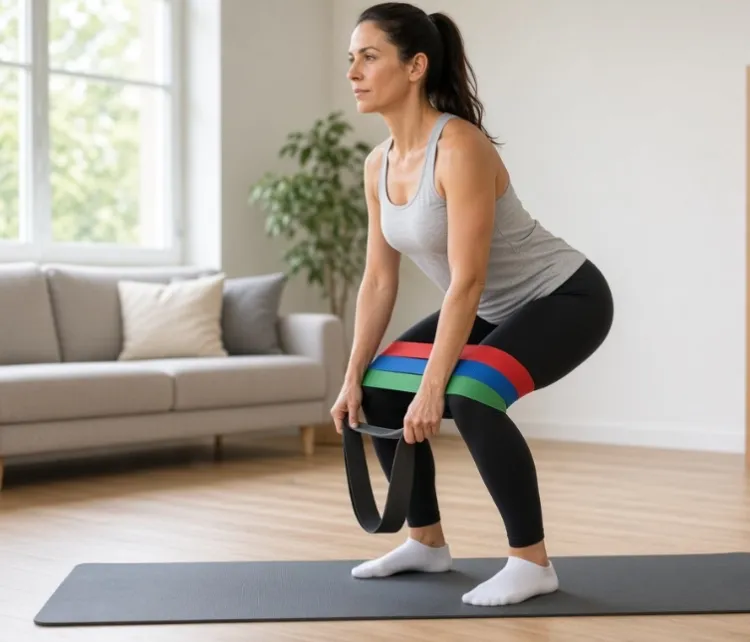
Place the band around the thighs, above the knees, or around the ankles depending on the exercise.
The band should remain controlled during movement rather than rolling excessively or losing tension.
Common Applications
Mini loop bands can be used for:
- Glute activation
- Hip abduction
- Leg strengthening
- Lower-body warm-ups
- Mobility training
- Functional fitness
They are also compact enough for home workouts, fitness studios, personal training, and travel.
How to Use Long Resistance Bands
Long resistance bands provide a larger range of movement than mini loop bands.
They can be used for both upper- and lower-body training.
Common applications include:
- Back training
- Shoulder training
- Chest exercises
- Arm training
- Leg exercises
- Full-body resistance training
- Stretching and mobility
Because the band can be anchored or held in different ways, one long resistance band can support many types of exercises.
How to Use Resistance Tubes
Resistance tubes are often used with handles or attachment accessories.
The user can hold the handles while performing pulling, pressing, curling, or rotational movements.
Resistance tubes are particularly suitable for:
- Upper-body strength training
- Functional fitness
- Home gym workouts
- Full-body training
- Portable exercise equipment
The tube length and resistance level should be appropriate for the intended movement.
Exercise Bands for Different Body Parts
One advantage of resistance bands is that they can be adapted to different training areas.
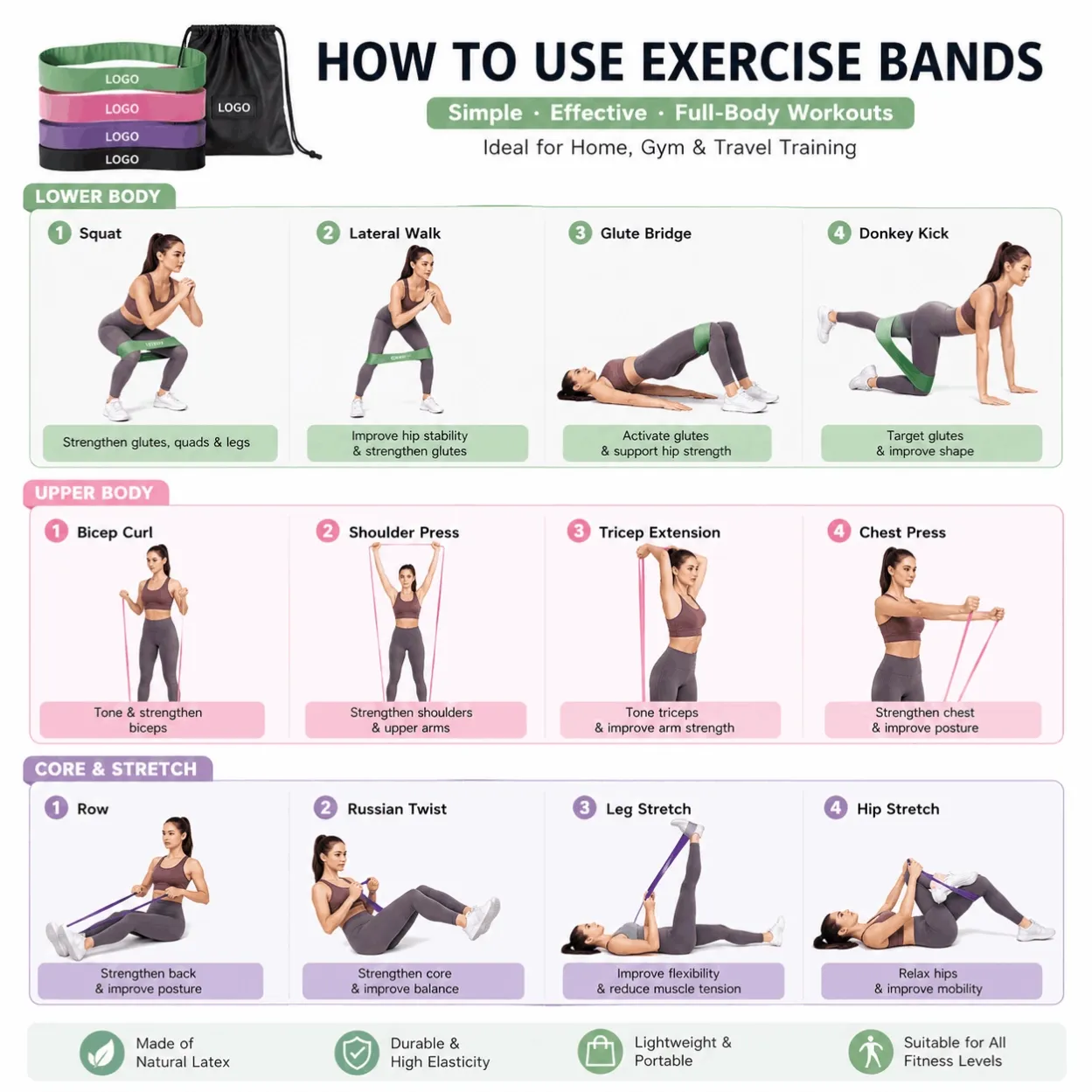
H2: Legs and Glutes
Resistance bands can be used to train and activate:
- Glutes
- Quadriceps
- Hamstrings
- Calves
- Inner thighs
- Outer thighs
- Hip muscles
Mini loop bands are particularly suitable for lower-body training because they can provide lateral resistance around the legs.
H2: Back
Long resistance bands and tubes can be used for pulling movements that target the back.
The resistance can be adjusted by changing the band's stretch distance or starting position.
H2: Shoulders and Arms
Exercise bands can provide controlled resistance for:
- Shoulders
- Biceps
- Triceps
- Forearms
They can be used for both strength training and warm-up routines.
H2: Chest
Long resistance bands and tubes can be used for pressing and chest-focused movements when properly anchored.
The user should ensure that the anchor point is stable before applying resistance.
H2: Core
Resistance bands can add external resistance to various core and functional training movements.
Instead of simply moving through a large range of motion, users can focus on maintaining controlled posture while resisting the band's pulling force.
How to Adjust Exercise Band Resistance
One of the most useful characteristics of resistance bands is that users can modify the training difficulty without changing the exercise itself.
Increase Resistance
You can generally increase difficulty by:
- Stretching the band farther
- Shortening the starting length
- Using a thicker or stronger band
- Combining multiple bands
- Moving farther from an anchor point
Reduce Resistance
To make an exercise easier:
- Use a lighter band
- Reduce the stretch distance
- Increase the starting length
- Choose a lower-resistance band
This makes resistance bands suitable for users with different fitness levels.
How Many Repetitions Should You Do With Exercise Bands?
There is no single repetition range that works for every exercise or user.
A general approach is:
Beginner Training
Focus on controlled movement and learning proper technique.
General Fitness
Moderate repetitions can be used for strength and conditioning routines.
Muscle Endurance
Higher repetitions with suitable resistance may be appropriate.
Mobility & Warm-Up
Use lighter resistance and controlled repetitions rather than focusing on maximum resistance.
The correct resistance should allow you to maintain good technique throughout the set.
Exercise Bands vs. Free Weights
Exercise bands and free weights create resistance in different ways.
Feature | Exercise Bands | Free Weights |
|---|---|---|
Resistance | Elastic tension | Gravitational load |
Portability | Excellent | Limited |
Storage | Compact | Requires more space |
Resistance Adjustment | Stretch, band level or combination | Weight selection |
Home Use | Very convenient | Depends on equipment |
Travel | Easy to carry | Less convenient |
Training Variety | High | High |
Exercise bands do not necessarily replace free weights. Instead, they provide another resistance-training option that can complement dumbbells, machines, and bodyweight exercises.
How to Use Exercise Bands at Home
A complete home resistance band workout does not require a large amount of equipment.
A basic setup can include:
- One or more resistance bands
- A mini loop band
- A resistance tube
- A suitable anchor or attachment
- Enough open space to move safely
Because resistance bands are lightweight and compact, they are particularly useful for people with limited home workout space.
How to Use Exercise Bands for Warm-Ups
Exercise bands can also be used before strength workouts.
The goal of a warm-up is not necessarily to create maximum resistance.
Instead, users can choose lighter resistance and perform controlled movements to prepare the body for the upcoming workout.
Possible applications include:
- Shoulder activation
- Hip activation
- Leg preparation
- Mobility routines
- Movement preparation
How to Use Exercise Bands Safely
Safety should always be part of resistance band training.
Inspect the Band
Check the band for visible damage before use.
Avoid Excessive Stretching
Do not stretch a band beyond its intended working range.
Use Stable Anchors
When using an anchor point, make sure it is strong and properly secured.
Maintain Control
Avoid letting the band snap back suddenly after stretching.
Select Appropriate Resistance
Using a resistance level that is too strong can make it difficult to maintain proper form.
Replace Damaged Bands
If a band develops serious cracks, cuts, tears, or other damage, discontinue use.
How to Choose the Right Exercise Band
The best exercise band depends on your training purpose.
For Glute and Leg Training
Mini loop bands are often a practical option.
For Full-Body Training
Long resistance bands provide greater movement flexibility.
For Pulling Exercises
Resistance tubes with handles are useful for controlled pulling movements.
For Assisted Pull-Ups
Long pull-up resistance bands can provide assistance during bodyweight training.
For Pilates and Mobility
Flat resistance bands are suitable for controlled stretching and resistance exercises.
Are Natural Latex Exercise Bands a Good Choice?
Natural latex is widely used in resistance band manufacturing because of its elasticity and ability to provide progressive resistance.
For manufacturers and fitness brands, material selection can influence:
- Elasticity
- Resistance consistency
- Stretch performance
- Product feel
- Durability
- Manufacturing specifications
For brands developing resistance band products, it is important to consider not only the material but also thickness, width, length, resistance level, manufacturing process, and quality control.
How Manufacturers Control Exercise Band Quality
For resistance band manufacturers, product quality involves more than simply selecting an elastic material.
A professional manufacturing process may include:
Raw Material Control
Natural latex and other raw materials are checked according to production requirements.
Material Mixing
The material is prepared to achieve the required product characteristics.
Compression Molding
For molded natural latex products, the material is formed according to the required dimensions.
Vulcanization
Controlled vulcanization develops the required elasticity and physical properties.
Surface Treatment
Finished products are cleaned and processed according to product requirements.
Cutting & Dimension Inspection
Product dimensions are checked to maintain consistency between batches.
Resistance Testing
Resistance and elastic performance can be tested according to defined specifications.
H3: Repeated-Use Testing
Selected products can undergo repeated stretching tests to evaluate performance and durability.
H3: Final Inspection
Products are inspected for appearance, dimensions, surface condition, printing and other specifications before packaging.
Exercise Bands for Fitness Brands
Exercise bands are not only consumer fitness products. They are also widely used as products for:
- Fitness brands
- Gym equipment suppliers
- Personal training businesses
- Physical therapy and wellness programs
- Sports retailers
- E-commerce sellers
- Private-label brands
- Home fitness product companies
For businesses purchasing resistance bands in bulk, important factors include material, resistance levels, dimensions, logo customization, packaging, MOQ, lead time and quality control.
Frequently Asked Questions About Exercise Bands
How do you use exercise bands?
Exercise bands can be held, placed around the legs or attached to a secure anchor point. Users create resistance by stretching the band while performing controlled movements.
What are exercise bands good for?
Exercise bands can be used for strength training, muscle activation, warm-ups, mobility, stretching, functional fitness and home workouts.
Can exercise bands build muscle?
Yes. Resistance bands can provide external resistance during strength exercises. Training effectiveness depends on resistance level, exercise selection, training volume and progression.
Can beginners use resistance bands?
Yes. Beginners can start with lighter resistance and focus on learning controlled movement and proper technique.
Can resistance bands replace weights?
Resistance bands can be used as an alternative or complement to free weights. They are particularly useful when portability, compact storage and flexible resistance are important.
How long should a resistance band workout be?
Workout duration depends on the user's goals, training program and fitness level. A resistance band session can be short and focused or incorporated into a longer full-body workout.
Are resistance bands suitable for home workouts?
Yes. Their compact size makes them convenient for home gyms, apartments, travel workouts and other environments where space is limited.
How do I know which resistance band to use?
Choose a resistance level that allows you to perform the intended movement with controlled technique. Start lighter when learning a new exercise and increase resistance progressively.
Final Thoughts: How to Use Exercise Bands Effectively
Exercise bands are versatile resistance-training tools that can be used for far more than a single type of workout.
From glute and leg training to arm, shoulder, back, chest, core, mobility and warm-up exercises, different band designs can serve different training purposes.
The key to using exercise bands effectively is to select the appropriate band type, resistance level, setup and range of motion, while maintaining controlled movement throughout the exercise.
For fitness brands and commercial buyers, the same principles apply when selecting products for a resistance band collection: material, dimensions, resistance, manufacturing consistency, customization and quality control all contribute to the final product.