Sep 10, 2026Buying Guides
TPE vs Natural Latex Resistance Bands: Which Material Should Buyers Choose?
Compare TPE vs natural latex resistance bands for rebound, stretch, tear resistance, odor, rehab, Pilates and strength training. A practical buying guide for fitness brands and distributors
TPE vs Natural Latex Resistance Bands: Which Material Should Buyers Choose?
When buyers compare TPE resistance bands with natural latex resistance bands, the discussion often gets reduced to a simple question:
Which material is better?
That is usually the wrong question.
We manufacture resistance bands for different markets, and the more useful question is:
Which material is better for this product, this customer and this training application?
A physical therapy supplier and a strength-training brand may both be buying resistance bands, but they are not necessarily looking for the same material behavior.
TPE and natural latex can both work well. They simply solve different product requirements.
This guide explains the differences we look at when discussing material selection with OEM and wholesale buyers.
What Is TPE?
TPE stands for thermoplastic elastomer.
Unlike natural latex, which comes from natural rubber latex, TPE is a thermoplastic material system that can be formulated with components such as SEBS or SBS, polypropylene, processing oil, fillers, stabilizers, antioxidants and pigments.
The exact formulation affects hardness, flexibility, resistance feel and processing performance.
For flat exercise bands, TPE is commonly processed through extrusion into sheet material, followed by thickness control, cooling, slitting and cutting.
This makes TPE particularly suitable for:
flat therapy bands, Pilates bands, yoga bands and light-to-medium resistance products.
What Is Natural Latex?
Natural latex resistance bands are made from natural rubber latex and are chosen when elastic performance is a major part of the product.
In practical use, natural latex usually offers:
- Stronger rebound
- Greater elongation
- More elastic feel
- Better suitability for demanding resistance training
- Better resistance to permanent deformation under repeated stretching
For products such as pull-up bands, mini loops and higher-performance resistance bands, these characteristics are often more important than being latex-free.
TPE vs Natural Latex Resistance Bands at a Glance
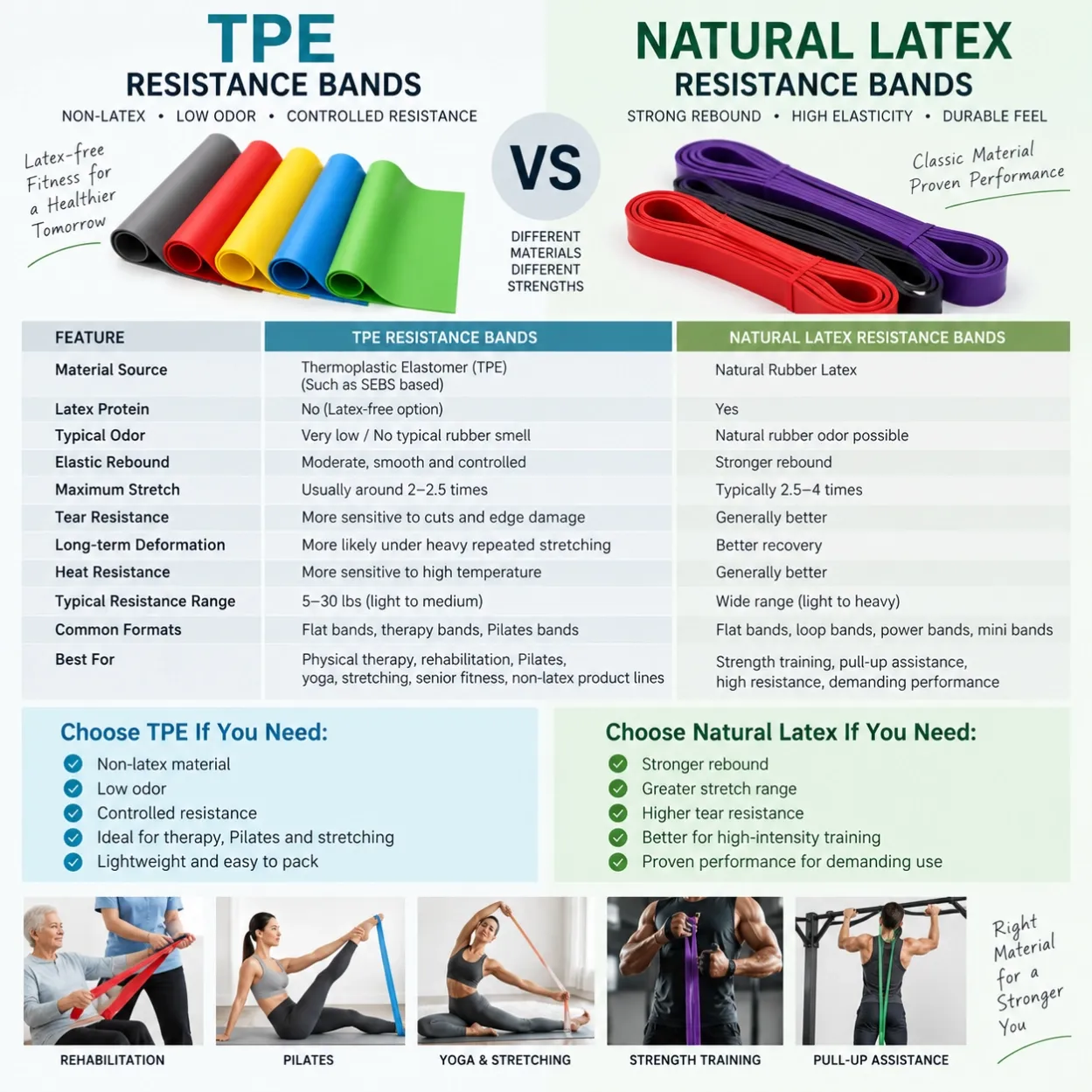
Buyer Concern | TPE Resistance Bands | Natural Latex Resistance Bands |
|---|---|---|
Latex-Free Material | Yes, when formulation is confirmed | No |
Typical Natural Rubber Odor | Very Low / None | Possible |
Elastic Rebound | Moderate | Stronger |
Maximum Stretch Range | More Limited | Higher |
Tear Resistance | More Sensitive to Edge Damage | Generally Better |
Permanent Deformation | More Likely Under Heavy Repeated Stretching | Generally Better Recovery |
Light Resistance Exercise | Very Suitable | Very Suitable |
Physical Therapy | Very Suitable | Suitable |
Pilates & Yoga | Very Suitable | Suitable |
High-Intensity Strength Training | More Limited | Better Choice |
Heat Sensitivity | More Sensitive | Generally Better |
OEM Color Flexibility | High | High |
Typical Product Format | Flat Therapy / Pilates Bands | Mini Bands / Pull-Up Bands / Loops / Flat Bands |
The most important point is that material selection should follow the application, not the marketing claim.
1. Elastic Rebound: Natural Latex Has the Advantage
One of the biggest differences a user can feel is rebound.
Natural latex tends to recover more strongly after stretching. This creates the responsive elastic feel that many users associate with premium resistance bands.
That matters when the band is used for:
- Strength training
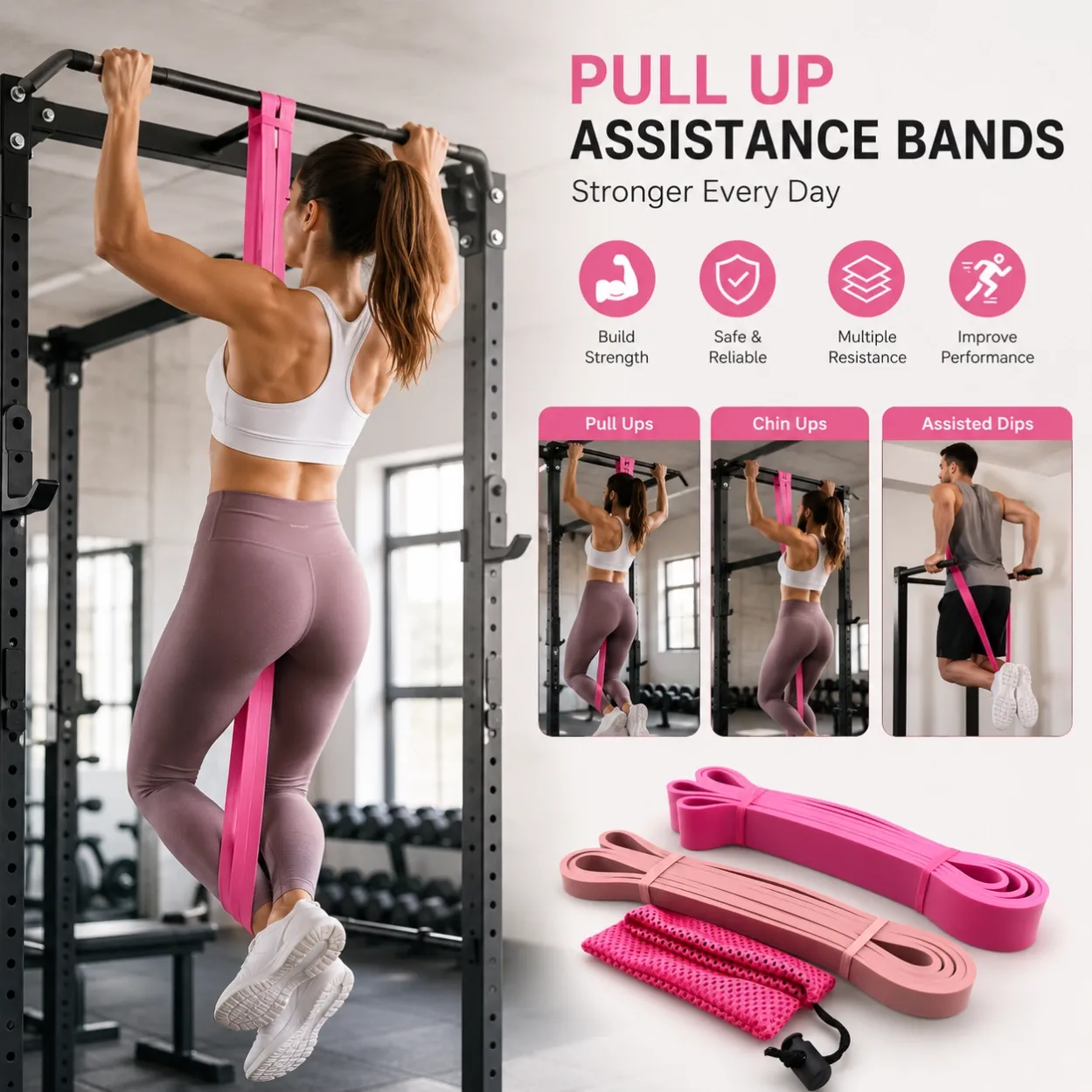
- Pull-up assistance
- Repeated dynamic exercise
- Heavy resistance
- Higher stretch ratios
TPE can still provide useful resistance, but its rebound usually feels more controlled and less elastic at the upper end of its stretch range.
Your product data also notes that TPE has a lower elastic stretch limit than natural latex and can feel harder as it approaches that limit.
Buyer takeaway
If your product depends on a strong elastic response, natural latex is usually the better material.
If the product is designed for controlled movement rather than maximum rebound, TPE can be a very practical choice.
2. Stretch Range: Natural Latex Handles More Elongation
Stretch range matters more than many buyers realize.
TPE flat bands are typically better suited to moderate elongation. According to your actual product data, the safe stretch range is usually around 2 to 2.5 times, while natural latex can typically tolerate a greater stretch range.
This does not mean TPE is weak.
It means the product should be designed around a realistic working range.
For physical therapy, stretching and Pilates, extreme elongation is usually unnecessary.
For pull-up assistance or high-resistance strength work, greater elastic range becomes much more important.
3. Tear Resistance: Edge Damage Matters More with TPE
This is one difference buyers often discover only after customer complaints.
TPE is more sensitive to cuts and edge damage.
A small notch in the edge of a flat band may look harmless when the product is lying on a table.
Under tension, however, that notch can become the starting point for a tear.
Your internal product data specifically identifies lower tear and puncture resistance as a limitation of TPE compared with natural latex.
This makes edge quality control especially important.
For TPE flat bands, we pay attention to:
- Cutting quality
- Edge smoothness
- Surface defects
- Small tears or notches
- Damage during packing
Buyer takeaway
If the intended product will be exposed to rough handling, sharp equipment or high pulling forces, natural latex may offer a more forgiving material choice.
4. Permanent Deformation: TPE Needs More Realistic Loading
A resistance band should not stay permanently stretched after normal use.
But all elastic materials have limits.
TPE is more likely to develop permanent elongation when repeatedly used at high loads or stretched too aggressively over time.
This is one reason we do not recommend positioning a light TPE therapy band as a heavy-duty strength product.
A well-designed TPE band should be matched to:
- Correct thickness
- Correct resistance level
- Realistic stretch distance
- Appropriate training application
Natural latex generally performs better when repeated high elongation and strong rebound are core requirements.
5. Odor: TPE Has a Clear Advantage
Natural rubber has a characteristic smell.
The intensity depends on formulation, vulcanization, washing, storage and packaging, but natural latex products can still retain a recognizable rubber odor.
TPE does not have the same natural-rubber smell.
Your product information identifies low odor as one of the main practical advantages of TPE flat bands.
This matters more in some markets than others.
For example:
- Physical therapy clinics
- Rehabilitation centers
- Senior fitness programs
- Yoga studios
- Home users sensitive to odor
may place more value on this characteristic than a user buying a heavy pull-up band.
6. Latex-Free Applications: TPE Has a Different Role
The strongest reason to choose TPE is not price.
It is often material positioning.
For buyers developing a non-latex product line, TPE provides an alternative to natural latex.
Your product资料 specifically identifies this as a core reason TPE flat bands are used in rehabilitation and sensitivity-conscious markets.
That makes TPE particularly relevant for:
physical therapy, rehabilitation, Pilates, yoga, senior fitness and general wellness products.
For any formal allergy-related or medical claim, however, the finished formulation and relevant documentation should still be confirmed before marketing the product.
7. Which Material Is Better for Physical Therapy?
For many physical therapy applications, TPE is a very logical material choice.
Why?
Because therapy programs often need:
- Light resistance
- Progressive resistance levels
- Controlled movement
- Long flat bands
- Easy grip adjustment
- Low odor
- Non-latex positioning
The standard TPE flat band range you provided is well aligned with this use case:
Level | Thickness | Reference Resistance |
|---|---|---|
X-Light | 0.25–0.35 mm | 5 lbs |
Light | 0.35–0.45 mm | 10 lbs |
Medium | 0.45–0.55 mm | 15 lbs |
Heavy | 0.55–0.65 mm | 20 lbs |
X-Heavy | 0.65–0.75 mm | 30 lbs |
These are the actual reference specifications in your product data.
The lighter levels can support controlled mobility and exercise progression without requiring a high-stretch elastic material.
Recommendation
For a therapy band line, TPE is often worth considering first.
For a rehabilitation product requiring stronger rebound or greater elongation, natural latex may still be appropriate.
8. Which Material Is Better for Pilates and Yoga?
Pilates and yoga usually do not require the same resistance profile as pull-up training.
Users often need:
- Light-to-medium resistance
- Controlled tension
- Long working length
- Easy grip adjustment
- Lightweight equipment
- Compact storage
This fits TPE flat bands well.
Your standard lengths of:
1200 mm, 1500 mm, 1800 mm and 2000 mm
allow buyers to create different products for light stretching, general Pilates, full-body movement and specialized applications.
The 1500 × 150 mm version is a practical general-purpose specification, while the 1800 mm version offers more working length for full-body stretching.
Recommendation
For Pilates, yoga and mobility, TPE is often the more commercially logical choice when non-latex and low odor matter.
9. Which Material Is Better for Strength Training?
This is where natural latex usually has the stronger case.
Strength products may require:
- Higher resistance
- Strong rebound
- Greater elongation
- Repeated dynamic loading
- Better recovery after heavy stretching
These are exactly the areas where TPE is more limited.
For products such as:
- Pull-up assistance bands
- Heavy loop bands
- Strength bands
- Power bands
- High-resistance mini bands
we would generally look at natural latex first.
That does not mean TPE cannot be used for strength exercise.
It means the product should not be pushed beyond the material behavior it was designed for.
10. Heat and Storage: TPE Needs More Care
Another difference buyers should understand is heat sensitivity.
Your product data notes that prolonged exposure to high temperatures can soften TPE and affect its shape or resistance performance.
This matters for:
- Hot warehouses
- Cars in summer
- Direct sunlight
- Long-term outdoor storage
For either material, correct storage is important, but TPE deserves particular attention when products may spend long periods in high-temperature environments.
11. Manufacturing Is Also Different
TPE and natural latex should not be treated as the same manufacturing process with different raw materials.
TPE Flat Bands
Your actual TPE process is:
Material preparation → compounding → pelletizing → extrusion → thickness control → cooling → slitting → cutting → printing → inspection → packaging.
Thickness control is especially important because it influences the resistance level of the finished flat band.
Natural Latex Bands
Natural latex bands use a rubber vulcanization process rather than thermoplastic extrusion.
For a buyer, this matters because the two materials also require different process control, testing and product design.
12. How We Recommend Buyers Choose
When an OEM customer asks:
“Should we use TPE or latex?”
we would not start with the material.
We would start with four questions.
What will the band be used for?
Therapy and Pilates are different from pull-up assistance.
How far will the user stretch it?
A band designed for moderate movement does not need the same elongation performance as a heavy strength band.
How important is non-latex positioning?
For some buyers, this is the deciding factor.
What resistance feel does the customer expect?
Some customers want smooth, controlled tension.
Others specifically want the stronger rebound and substantial elastic feel associated with natural latex.
That tells us much more than simply asking which material is cheaper.
TPE vs Natural Latex: Buyer Selection Table
Your Product | Recommended Starting Material | Why |
|---|---|---|
Physical Therapy Flat Band | TPE | Non-latex, low odor, controlled resistance |
Rehabilitation Set | TPE | Progressive light resistance |
Pilates Resistance Band | TPE | Long format, controlled tension |
Yoga Stretch Band | TPE | Lightweight, easy grip adjustment |
Senior Fitness Band | TPE | Light resistance and low odor |
General Home Exercise Band | TPE or Latex | Depends on resistance level |
Heavy Mini Band | Natural Latex | Better rebound |
Pull-Up Assistance Band | Natural Latex | Higher elongation and resistance |
Power / Strength Band | Natural Latex | Better suited to demanding loading |
High-Rebound Fitness Product | Natural Latex | Stronger elastic recovery |
Non-Latex Product Collection | TPE | Material positioning |
Heavy Repeated Stretching | Natural Latex | Better long-term elastic recovery |
Common Buying Mistake: Choosing Material by Price Alone
TPE can often be commercially attractive because thermoplastic processing is efficient.
But choosing material only by unit cost can create a more expensive problem later.
If a brand uses TPE for an application that really needs higher elongation and rebound, the result may be:
- Poor user feel
- Permanent stretching
- Edge tearing
- Shorter useful life
- Negative reviews
- Returns
The same applies in reverse.
Using natural latex for a product where the buyer specifically needs non-latex, low odor and controlled light resistance may also be the wrong choice.
A good OEM decision starts with the intended use.
FAQ: TPE vs Natural Latex Resistance Bands
Is TPE the same as latex?
No. TPE is a thermoplastic elastomer material, while natural latex comes from natural rubber latex.
Are TPE resistance bands latex-free?
TPE does not rely on natural latex protein. For formal latex-free claims, the complete formulation and finished product specification should be confirmed.
Which material has better rebound?
Natural latex generally provides stronger elastic rebound.
Which material stretches further?
Natural latex generally supports greater elongation than TPE.
Which material is better for physical therapy?
TPE is often a strong option for physical therapy because it supports non-latex positioning, low odor and progressive light resistance.
Which material is better for Pilates?
TPE works very well for long flat Pilates bands where controlled resistance and lightweight construction are important.
Which material is better for pull-up bands?
Natural latex is generally the better choice because pull-up assistance requires higher resistance, stronger rebound and greater elongation.
Does TPE tear easily?
TPE can be more sensitive to edge cuts and punctures than natural latex. Good cutting quality, edge inspection and correct use are important.
Does TPE permanently stretch?
It can if repeatedly overstretched or used under high load beyond its intended range.
Does natural latex smell?
Natural rubber has a characteristic odor. Proper vulcanization, cleaning and processing can reduce strong residual odor, but it is still a natural rubber material.
Can TPE and natural latex use the same resistance levels?
The labels may look similar, but resistance should be tested according to actual dimensions and stretch distance. A color or thickness alone does not fully define resistance.
Which material should an OEM buyer choose?
Choose TPE when non-latex material, low odor and controlled resistance are priorities. Choose natural latex when rebound, greater elongation and demanding strength performance are more important.
Final Recommendation for Buyers
There is no single “best resistance band material.”
There is only a material that is more suitable for the product you are trying to build.
For physical therapy, rehab, Pilates, yoga and non-latex product lines, TPE deserves serious consideration. Find TPE bands Here
For pull-up assistance, heavy resistance, strong rebound and demanding strength training, natural latex is usually the more appropriate choice. Find Pull UP bands Here
As a manufacturer, we Danyang Zhenxing Latex Products Co.,Ltd would rather recommend the material that fits the application than sell the same material for every project.
If you are developing a new resistance band line, send us:
Application + Target Resistance + Band Size + User Group + Material Requirement + Packaging
and we can compare a TPE specification with a natural latex option before sampling.