Sep 5, 2026Buying Guides
Why Standing Workouts Are Expanding the Market for Mini Resistance Bands
Standing core, mobility, and balance routines are expanding the market for mini resistance bands. Here is what OEM buyers must evaluate before manufacturing.
Why Standing Workouts Are Expanding the Market for Mini Resistance Bands
Glute bridges, clamshells, and heavy squats dominated mini loop band marketing for years, but that positioning misses a rapidly growing segment of the market. Standing core routines, running warm-ups, and mobility-focused home workouts have shifted mini resistance bands from a niche lower-body accessory to a core functional fitness tool.
If you are a purchasing manager or private-label brand owner, this shift changes how you should specify, sample, and source your inventory. Designing a set for standing movements requires different dimensions, elasticity profiles, and quality control metrics than designing one strictly for heavy hip activation.
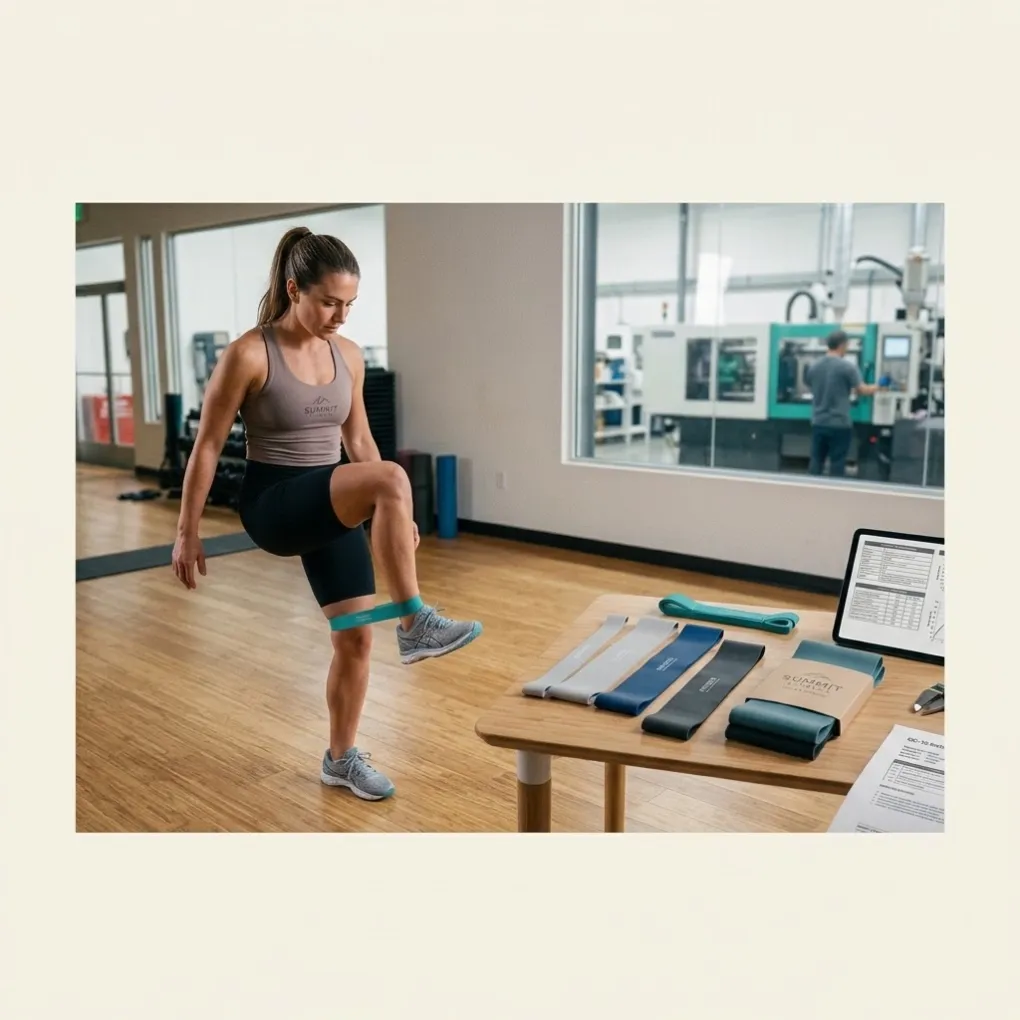
[Image Placeholder: A fitness trainer performing a standing banded hip march with a natural latex loop band positioned around the feet. Alt Text: Standing banded hip march using mini resistance bands for standing workouts]
Why Are Standing Resistance Band Workouts Gaining Traction?
Standing resistance band workouts eliminate the need for floor mats while challenging core stability, hip flexors, and balance simultaneously. Exercises like standing hip marches, lateral movement drills, and single-leg balance holds create targeted tension that floor-based glute exercises cannot replicate.
When a user places a loop around their feet to execute a standing march, the force vector changes completely. The band experiences concentrated stretching at the edges rather than even distribution across a flat thigh. For fitness brands, this single shift unlocks multiple content marketing angles—from runner prep to Pilates-inspired mobility—using a single product SKU.
What Key Specifications Differentiate a High-Performing Standing Band?
Selecting the right dimensions, material formulation, and resistance progression determines whether your band lays flat during a workout or rolls up into a painful cord.
Here’s how standard 10-inch and 12-inch natural latex bands stack up across key manufacturing parameters:
Parameter | 10-Inch Loops (10" x 2") | 12-Inch Loops (12" x 2") |
Primary Movement Fit | Ankle abduction, high-tension glute activation | Standing foot marches, mobility drills, wider stances |
Edge Loading Risk | Higher risk of rolling if stretched past 300% elongation | Lower shear stress, smoother progressive tension |
Target User Base | Advanced strength, targeted hip isolation | General fitness, running warm-ups, active aging |
Recommended Thickness | Light (0.4mm) to Extra Heavy (1.2mm) | Extra Light (0.35mm) to Heavy (1.0mm) |
In practice, our engineering team prefers 12-inch loops for standing functional sets. The additional circumference reduces the initial snappy tension when wrapping around shoes, giving the user a smoother movement arc during foot-level exercises.
How Does Natural Latex Manufacturing Impact Resistance Consistency?
Natural latex provides superior rebound and linear elasticity compared to synthetic TPE, but consistent performance depends on precise raw material processing and vulcanization control.
A common pitfall in budget sourcing is using bands cut from uncalibrated latex sheets or rushed through compression molding. Poorly controlled vulcanization leaves unreacted sulfur bonds, causing the bands to develop a tacky surface, emit a harsh chemical odor, and lose tension within a few hundred cycles.
We manufacture our natural latex loop bands using 100% Thai latex concentrate with strict temperature-controlled vulcanization. This keeps thickness tolerances within ±0.03mm across a production batch, ensuring that a "Medium" band from batch A delivers identical resistance to a "Medium" band from batch B.
Note on Safety: Natural latex contains soluble proteins that can trigger reactions in sensitive individuals. Brands targeting clinical or broad consumer markets should offer a clear latex sensitivity warning or co-develop a dedicated, hypoallergenic TPE/fabric alternative.
What Quality Control Checks Prevent Common Field Failures?
Visual inspection alone will not catch internal micro-tears or premature degradation. A reliable B2B inspection protocol must stress the product under conditions that mimic real-world wear around athletic footwear.
[Image Placeholder: Quality control technician testing latex loop bands on a mechanical tensile machine in a factory lab. Alt Text: Automated tensile test machine measuring resistance bands for core workouts]
- Edge Integrity & Die-Cut Inspection: Micro-burrs along the edge are the starting point for 90% of field snapping. Edges must be smooth under 5x magnification.
- Repeated-Stretch Fatigue Testing: Samples are pulled to 300% elongation for 5,000 continuous cycles at 25°C. The band must retain at least 92% of its original tensile force without structural deformation.
- Chemical Migration & Odor Audit: Products are stored in sealed packaging at 40°C for 48 hours to confirm zero bloom (white surface powdering) and no heavy off-gassing.
- REACH & RoHS Compliance: Heavy metals, phthalates, and PAH levels are verified by third-party testing labs to meet EU/US import regulations.
How Can Brands Configure a Custom Private Label Band Set?
Customizing a successful mini resistance band set requires aligning your resistance progression with the actual exercises in your workout guide.
- Pantone Color Matching: Match your band colors to your studio branding or seasonal color palettes using exact Pantone PMS codes.
- Custom Branding & Screen Printing: Logos are applied using flexible, high-stretch inks formulated specifically for latex so the print does not flake or crack when extended.
- Retail Packaging & Add-Ons: Choose between breathable mesh carry bags, custom printed rigid boxes, or eco-friendly kraft paper sleeves. Include a QR code on the packaging directing customers to your digital standing-workout video library.
How Should Purchasing Teams Test Supplier Samples?
Do not rely on a factory datasheet to judge band performance. When you receive sample sets, distribute them to your testing team or trainers and execute this 5-minute practical evaluation:
- Perform 20 Reps of Standing Banded Marches: Check if the band rolls into a narrow string around sneakers or stays flat across the instep.
- Test Initial Snap: Pull the band slowly from rest to 100% elongation. Resistance should feel predictable and progressive, not stiff or sudden.
- Check Surface Tackiness: Rub the band against itself. If it sticks or feels gummy right out of the bag, the vulcanization or anti-tack powder application was insufficient.
- Sniff Test: Open the sealed sample bag immediately. A faint rubber scent is normal; a pungent chemical smell indicates substandard compounding agents.
Selecting the right manufacturing partner comes down to consistency. A slightly cheaper unit cost quickly turns into a net loss if high return rates destroy your marketplace listing rank.
FAQ
Are mini resistance bands only for glute workouts?
No, mini resistance bands are widely used for standing core activation, dynamic hip marches, athletic warm-ups, shoulder stability, and balance training.
Is a 10-inch or 12-inch mini band better for standing exercises?
A 12-inch band is generally better for standing exercises because the extra circumference accommodates shoes and wider stances while reducing the tendency to roll during movement.
Why do mini resistance bands roll up during exercise?
Bands roll when uneven shear forces pull on the edges, often caused by incorrect band thickness, improper placement around shoes, or low-grade materials that lack structural memory.
Can custom resistance levels and colors be manufactured?
Yes, factories adjust resistance by altering wall thickness, loop width, and latex compounding, while custom colors are produced using precise Pantone matching.
How do I verify if natural latex bands pass safety standards?
Request current REACH, RoHS, and SVHC test reports from your OEM manufacturer to confirm the bands are free from restricted heavy metals and phthalates.
ooking to expand your functional product line? Explore our [Custom OEM Latex Loop Bands Product Page] to review technical specifications, sample options, and factory-direct volume pricing.