Material Notes
Your New Resistance Bands Smell Terrible? Natural Latex Odor or a Warning Sign?
You open a brand-new resistance band package, and suddenly your room smells like rubber, sulfur, or something strangely unpleasant. Is this normal? Should you be worried about your health? Or could it

YOUR NEW RESISTANCE BANDS SMELL TERRIBLE? NATURAL LATEX ODOR OR A WARNING SIGN?
You open a brand-new set of resistance bands, and suddenly the room smells like rubber. Or sulfur. Or something you can't quite put your finger on. Is this normal? Is it a health concern? Or a sign of sloppy manufacturing?
If you've ever bought natural latex resistance bands, you've probably been there.
A rubbery smell in newly made latex products is common. Not every unpleasant odor should be written off as normal, though.
Below we cover the three most common reasons new bands smell, the odors that deserve a second look, and what to do before your first workout with them.
1. WHY NEW LATEX RESISTANCE BANDS SMELL
1.1 Natural latex has its own smell
Natural latex is the sap of rubber trees. It contains proteins and other organic compounds that give it that characteristic rubber odor.
People describe it in a few ways: a mild rubber or tire-like smell; something slightly earthy or milky; a rubber smell that's strongest when the product is brand new.
Fresh out of the factory, the smell can be quite strong. That doesn't automatically mean the bands are bad.
With ventilation, the odor usually fades over several days. Depending on the formulation and how the product was processed, it can take one to two weeks or longer to really die down.
1.2 Vulcanization and manufacturing residues
Why do latex bands stretch so well? Vulcanization has a lot to do with it.
During production, latex compounds go through a curing process that gives them the elasticity, strength and durability a resistance band needs. Sulfur-based vulcanization is standard in rubber manufacturing, and depending on the formulation and curing conditions, some of these compounds carry an odor into the finished product.
Good manufacturers control their formulations, watch curing conditions, wash or post-process where the process calls for it, and inspect finished goods. Sloppy process control tends to show up in the smell.
One caveat: smell on its own won't tell you which chemical is present or whether a product passed its safety tests. Only lab testing can do that.
1.3 Sealed packaging traps the smell
Ever opened a package and the smell was far stronger than you expected?
Bands usually ship in individual plastic bags to protect them in transit. When a product sits sealed for months, odor compounds build up inside the bag. Warm warehouses and shipping containers make this worse.
Open the bag and all of that trapped odor hits you at once. It's one reason a band smells much stronger on day one than the same band after a week of airing out.
1. FOUR SMELLS AND SIGNS THAT DESERVE ATTENTION
A natural rubber smell is one thing. A chemical or material-breakdown smell is another. Watch for these four situations.
2.1 A sharp chemical or solvent-like smell
A normal latex smell and a sharp plastic or solvent smell are easy to tell apart. A harsh chemical odor can point to processing residues, additives, contamination or something from the packaging.
You can't measure chemical levels with your nose. If the smell is unusually strong or irritating, stop using the band and ask the manufacturer for an explanation and test documentation.
2.2 A rotten, sour or putrid smell
A rotten or sour odor is not what natural latex normally smells like. Material breakdown, contamination or bad storage could be behind it. Your nose can't confirm microbial contamination, though. Check the band's appearance and storage history, and contact the supplier if the smell sticks around.
2.3 The smell makes you dizzy or sick
This one matters most.
If opening or using a band leaves you dizzy or headachy, nauseous, or with irritated eyes, throat or airways, stop. Get to fresh air. Don't keep using the product just because the listing said the smell is normal. If symptoms are severe or don't pass, see a doctor.
2.4 The surface turns sticky, oily or starts breaking down
Smell isn't the only clue. Check the band itself:
- An unusually sticky surface.
- Oily or greasy deposits.
- Unexpected powder or surface deterioration.
- Cracks, discoloration, or lost elasticity.
These point to material instability, aging or poor storage. A good band keeps its physical properties under normal storage and use conditions.
1. HOW TO REDUCE THE SMELL OF NEW BANDS
If your bands smell like normal rubber and show none of the warning signs above, a few simple steps usually help.
Take them out of the packaging.
Remove the bands from their sealed plastic bags, and don't put them straight back into airtight packaging.
Let them air out.
Hang or lay them somewhere clean and well ventilated so air can move around them. A few days often cuts the smell noticeably; some products need longer.
Wipe them down if needed.
If the manufacturer's care instructions allow it, wipe the band with a damp cloth and a little mild soap, then let it dry completely.
Keep heat and harsh chemicals away.
No solvents, bleach, alcohol or high-heat drying. These can damage latex and hurt performance.
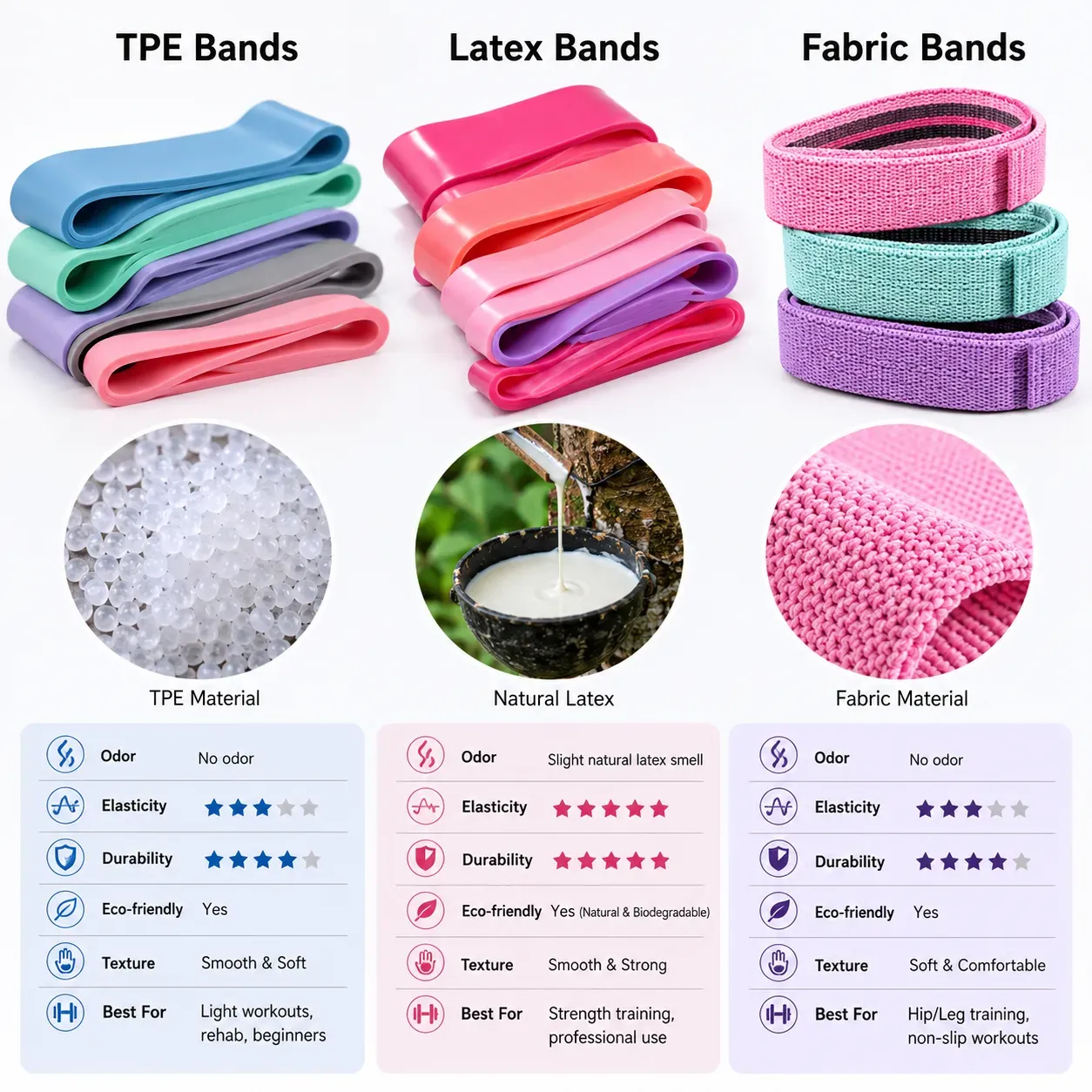
1. NATURAL LATEX VS. TPE: WHICH SMELLS LESS?
If rubber smell bothers you, the material choice matters.
Natural latex:
- Typical odor is a characteristic rubber smell.
- Made from natural rubber latex.
- Elasticity is excellent.
- Contains natural latex proteins.
- Common uses: power bands, pull-up bands, resistance loops.
- Odor control depends on latex formulation and processing.
TPE:
- Typical odor is generally milder.
- Made from thermoplastic elastomer.
- Elasticity depends on formulation.
- No natural rubber latex proteins by design.
- Common uses: physical therapy and exercise bands.
- Odor control depends on material grade and processing.
Which should you pick?
Natural latex is the standard for products that need serious stretch and recovery, like power bands and pull-up assistance bands. TPE suits buyers who want to avoid natural rubber latex proteins or prefer a different feel. Just don't assume TPE means zero odor; its smell and performance still depend on the compound and the process.
1. QUESTIONS TO ASK A MANUFACTURER ABOUT ODOR CONTROL
For brands, wholesalers, importers and distributors, odor control is easier to solve before a bulk order than after. Four questions worth asking:
- What raw materials do you use? Ask for material specs and how consistent they are between batches.
- What happens after production? How do you control curing, washing where applicable, handling and storage?
- Do you inspect for odor? Is smell part of your QC routine, and under what conditions?
- Can you share lab reports? Depending on your target market, ask for documentation on material composition, restricted substances or VOC emissions.
A professional supplier should be able to explain what their tests cover and which products or batches the results apply to.
1. FAQ
Is it normal for new latex resistance bands to smell like rubber?
Yes. Natural latex has a rubbery smell, and a mild odor is common in newly made products.
How long does the smell take to go away?
No fixed timeline. Ventilation often helps within days, but some products need one to two weeks or longer.
Why does my band still smell after a week?
Could be the latex itself, manufacturing compounds, or months sealed in a bag. If the smell is strong or irritating, contact the manufacturer.
Does a strong rubber smell mean the band is toxic?
Not necessarily. Odor intensity tells you nothing definitive about toxicity. Lab testing is what gives you a reliable answer.
Do TPE bands smell less than latex ones?
Usually the odor is milder, but it still depends on the compound and the manufacturing process.
Can people with latex allergies use latex resistance bands?
Anyone with a known natural rubber latex allergy should avoid direct contact unless a doctor says otherwise. TPE is a common alternative.
FINAL VERDICT: NORMAL SMELL OR QUALITY PROBLEM?
A quick way to judge:
- Mild rubber or earthy smell, and the surface looks and feels fine: that's normal for natural latex. Air it out and train.
- Sharp chemical or rotten smell, physical deterioration, or any dizziness, nausea or eye irritation: treat it as a warning. Stop using the band, and get answers and test reports from the supplier before using it again, or before placing that next bulk order.
-
- Looking for non-odor latex mini bands and Latex Pull Up bands China supplier ?
- what'sapp: +8615105286496
- www.oemresistancebands.com
-