Jul 10, 2026Material Notes
Natural Latex vs TPE vs Fabric Resistance Bands: Which Material Is Best?
resistance bands 3 material comparing
Natural Latex vs TPE vs Fabric Resistance Bands: Which Material Is Best?
Natural Latex vs TPE vs Fabric Resistance Bands | Complete Material Comparison Guide
Compare natural latex, TPE, and fabric resistance bands in terms of elasticity, durability, comfort, manufacturing, cost, and applications. Learn how to choose the right resistance band material for your fitness brand or business.
Introduction
Choosing the right resistance band material is one of the most important decisions for fitness brands, wholesalers, distributors, and online retailers.
Today, the global market mainly offers three types of resistance bands:
- Natural Latex Resistance Bands
- TPE Resistance Bands
- Fabric Resistance Bands
Although they all provide resistance during exercise, they differ significantly in elasticity, durability, comfort, manufacturing methods, target markets, and product lifespan.
As a professional resistance band manufacturer with more than 25 years of manufacturing experience, we help customers choose the most suitable material according to their product positioning and target market.
This guide explains the advantages, disadvantages, manufacturing differences, and ideal applications of each material to help you make an informed purchasing decision.
Why Material Selection Matters
The Material Determines Product Performance
The material directly affects:
- Elasticity
- Resistance consistency
- Product lifespan
- User comfort
- Manufacturing cost
- Environmental sustainability
- Customer satisfaction
Choosing the wrong material may result in higher return rates, lower customer reviews, and reduced brand reputation.
What Is Natural Latex?
Premium Material for Professional Resistance Bands
Natural latex is harvested from rubber trees and is widely recognized as the highest-quality material for manufacturing resistance bands.
Because of its unique molecular structure, natural latex offers exceptional elasticity and excellent recovery after repeated stretching.
Manufacturers commonly use natural latex for:
- Mini Resistance Bands
- Pull Up Resistance Bands
- Power Bands
- Resistance Tubes
Advantages of Natural Latex
- Outstanding elasticity
- Smooth progressive resistance
- Excellent tensile strength
- Long service life
- High resistance consistency
- Eco-friendly renewable material
- Comfortable stretching experience
Considerations
Natural latex may not be suitable for users with latex allergies, although high-quality manufacturing processes significantly reduce surface protein residue.
What Is TPE?
A Cost-Effective Alternative
TPE (Thermoplastic Elastomer) is a synthetic material widely used in entry-level fitness products.
Unlike natural latex, TPE is produced through thermoplastic processing rather than natural rubber harvesting.
TPE resistance bands are commonly used for:
- Beginner exercise
- Physical therapy
- Promotional fitness products
- Budget retail markets
Advantages of TPE
- Latex-free
- Lower manufacturing cost
- Lightweight
- Available in multiple colors
- Suitable for allergy-sensitive markets
Limitations
Compared with natural latex, TPE generally provides:
- Lower elasticity
- Faster aging
- Reduced tensile strength
- Less consistent resistance
- Shorter service life
What Are Fabric Resistance Bands?
Comfortable Training with Textile Construction
Fabric resistance bands are manufactured using polyester, cotton, and woven elastic yarn instead of solid latex sheets.
Many fabric bands still contain latex yarn inside the woven structure to generate resistance.
Fabric bands are especially popular for:
- Glute training
- Pilates
- Home fitness
- Women's fitness
- Boutique fitness studios
Advantages of Fabric Bands
- Soft surface
- Non-slip during exercise
- Comfortable against skin
- No rolling during workouts
- Premium appearance
Limitations
Fabric bands generally provide less stretch distance than latex bands and are mainly suitable for lower-body exercises rather than full-body strength training.
Material Comparison
Comparison Table
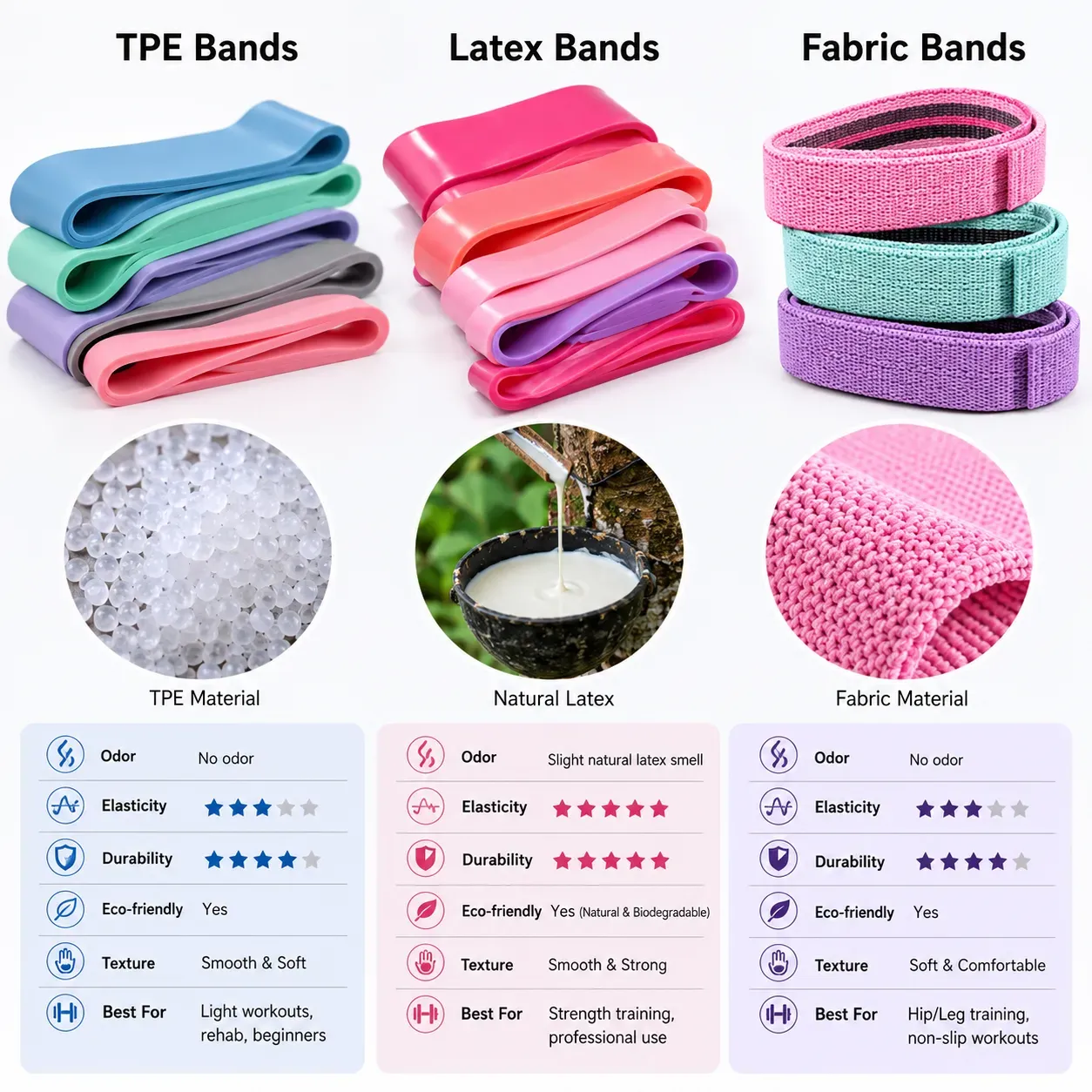
Feature | Natural Latex | TPE | Fabric |
|---|---|---|---|
Elasticity | ★★★★★ | ★★★☆☆ | ★★★★☆ |
Durability | ★★★★★ | ★★☆☆☆ | ★★★★★ |
Comfort | ★★★★☆ | ★★★☆☆ | ★★★★★ |
Resistance Consistency | ★★★★★ | ★★☆☆☆ | ★★★★☆ |
Stretch Distance | ★★★★★ | ★★★☆☆ | ★★☆☆☆ |
Tear Resistance | ★★★★★ | ★★☆☆☆ | ★★★★★ |
Eco-Friendliness | ★★★★★ | ★★★☆☆ | ★★★★☆ |
Professional Training | ★★★★★ | ★★☆☆☆ | ★★★★☆ |
Home Fitness | ★★★★★ | ★★★★☆ | ★★★★★ |
OEM Customization | ★★★★★ | ★★★★☆ | ★★★★★ |
Manufacturing Differences
Natural Latex Resistance Bands
Manufactured through:
- Natural Latex Preparation
- Precision Mold Forming
- High-Temperature Vulcanization
- Demolding
- Surface Cleaning
- Edge Trimming
- Logo Printing
- Quality Inspection
- Packaging
This process produces highly elastic, durable resistance bands suitable for professional fitness equipment.
TPE Resistance Bands
Typical manufacturing process:
- Material Extrusion
- Sheet Forming
- Cooling
- Cutting
- Printing
- Packaging
Production is relatively simple but does not provide the same elasticity as natural latex.
Fabric Resistance Bands
Typical manufacturing process:
- Yarn Preparation
- Knitting & Weaving
- Fabric Cutting
- Reinforced Sewing
- Logo Application
- Inspection
- Packaging
This process focuses on textile durability and user comfort.
Which Material Lasts Longer?
Durability Comparison
Natural latex resistance bands generally provide the longest lifespan because they maintain elasticity after thousands of stretching cycles.
Fabric resistance bands also offer excellent durability due to reinforced stitching and woven construction.
TPE bands usually have the shortest lifespan because synthetic materials gradually lose elasticity under repeated use.
Which Material Provides Better Resistance?
Resistance Performance
Natural latex provides the smoothest progressive resistance, making it ideal for:
- Strength Training
- Pull-Up Assistance
- CrossFit
- Powerlifting
- Athletic Performance
Fabric bands are better suited for controlled lower-body exercises and glute activation.
TPE is suitable for light resistance and beginner exercise.
Which Material Is More Comfortable?
User Experience
Comfort depends on workout type.
Natural latex offers the smoothest stretching sensation.
Fabric bands provide excellent comfort against the skin and reduce slipping during lower-body workouts.
TPE performs adequately for casual users but lacks the premium feel of natural latex.
Which Material Is Best for Different Applications?
Strength Training
Recommended Material:
Natural Latex
Pull-Up Assistance
Recommended Material:
Natural Latex
Pilates
Recommended Material:
Fabric
Natural Latex is also suitable depending on the training program.
Rehabilitation
Recommended Material:
Natural Latex or TPE
Choice depends on required resistance and user sensitivity.
Glute Training
Recommended Material:
Fabric
Natural Latex Mini Bands remain an excellent option for activation exercises.
Commercial Gyms
Recommended Material:
Natural Latex
Its durability and consistent resistance make it suitable for heavy daily use.
Which Material Should Fitness Brands Choose?
Recommendations for Different Businesses
Fitness Brands
Natural Latex
Professional quality enhances brand reputation and customer satisfaction.
Amazon Sellers
Natural Latex
Higher-quality products generally receive better customer reviews and lower return rates.
Boutique Fitness Studios
Fabric
Excellent comfort and attractive appearance suit studio environments.
Rehabilitation Clinics
Natural Latex or TPE
Selection depends on rehabilitation protocols and latex sensitivity.
Wholesalers
Offer both Natural Latex and Fabric products to cover different market segments.
Frequently Asked Questions
Which resistance band material lasts the longest?
Natural latex generally offers the best durability and elasticity retention.
Are fabric resistance bands stronger than latex bands?
Fabric bands are more stable during lower-body workouts, while natural latex provides greater stretch and broader exercise versatility.
Is TPE better than natural latex?
TPE is suitable for budget-friendly products and latex-sensitive users, but natural latex provides superior elasticity and durability.
Why do premium fitness brands prefer natural latex?
Because it delivers smoother resistance, longer lifespan, and better overall workout performance.
Can manufacturers customize all three materials?
Yes. OEM services are available for natural latex, TPE, and fabric resistance bands, including custom colors, logo printing, packaging, and private label branding.
Conclusion
Each resistance band material serves a different purpose.
Natural latex remains the preferred choice for professional fitness equipment because of its exceptional elasticity, durability, and consistent performance.
TPE provides an economical solution for entry-level products and latex-sensitive markets.
Fabric resistance bands offer superior comfort and stability, making them ideal for glute training, Pilates, and home fitness.
For fitness brands and distributors, selecting the right material should be based on your target customers, product positioning, and long-term business strategy.
Working with an experienced manufacturer can help you choose the most suitable material while ensuring consistent quality and reliable OEM production.
-
- OEM Resistance Band Manufacturing Guide
Contact Our OEM Team
Looking for a reliable resistance band manufacturer?
Danyang Zhenxing Latex Products Co.,Ltd specializes in manufacturing premium Natural Latex Resistance Bands, Pull Up Bands, Mini Bands, Power Bands, Resistance Tubes, and Fabric Booty Bands for fitness brands, wholesalers, and global distributors.
Contact our team today to discuss your OEM or private label project.