Aug 19, 2026Buying Guides
Best Leg Workouts with Resistance Bands: 12 Moves for Stronger Legs
Resistance bands are one of the simplest ways to train the legs, glutes, hips, and supporting muscles without relying on heavy gym equipment.
Best Leg Workouts with Resistance Bands: 12 Moves for Stronger Legs
Resistance bands are one of the simplest ways to train the legs, glutes, hips, and supporting muscles without relying on heavy gym equipment. A well-designed leg workout with bands can add resistance to squats, hip extension, lateral movement, hamstring exercises, and inner-thigh training while remaining compact enough for home, gym, or travel use.
Whether you are looking for an elastic bands workout for legs, a short home routine, or additional resistance for your existing strength program, the key is choosing the right band type, resistance level, and exercise setup.
This guide covers 12 practical leg workouts with resistance bands, how to perform them correctly, which muscles they target, and how to build a simple 15-minute lower-body routine.
Are Resistance Bands Effective for Leg Workouts?
Yes. Resistance bands for leg workouts create elastic tension that increases as the band stretches.
This allows the muscles to work against resistance during movements involving the knees, hips, and ankles.
A legs workout with elastic bands can target major lower-body muscle groups including:
- Quadriceps
- Hamstrings
- Gluteus maximus
- Gluteus medius
- Gluteus minimus
- Hip abductors
- Hip adductors
- Calves
Resistance bands are especially useful for exercises involving lateral movement and hip abduction because they can create resistance in directions that are sometimes difficult to reproduce with bodyweight alone.
They are also portable, easy to store, and available in multiple resistance levels.
Why Use Resistance Bands for Leg Exercises?
Progressive Resistance
The farther an elastic band is stretched, the greater the resistance generally becomes.
This allows users to change exercise difficulty through band selection, starting position, and stretch distance.
Glute and Hip Activation
Mini loops, booty bands, and hip bands are commonly positioned around the thighs to add resistance during lateral and outward leg movements.
Portable Lower-Body Training
A complete resistance bands legs workout can be performed in a small training space without a squat rack or large machine.
Multiple Resistance Levels
Light resistance can be used for activation and mobility, while heavier bands can make strength exercises more challenging.
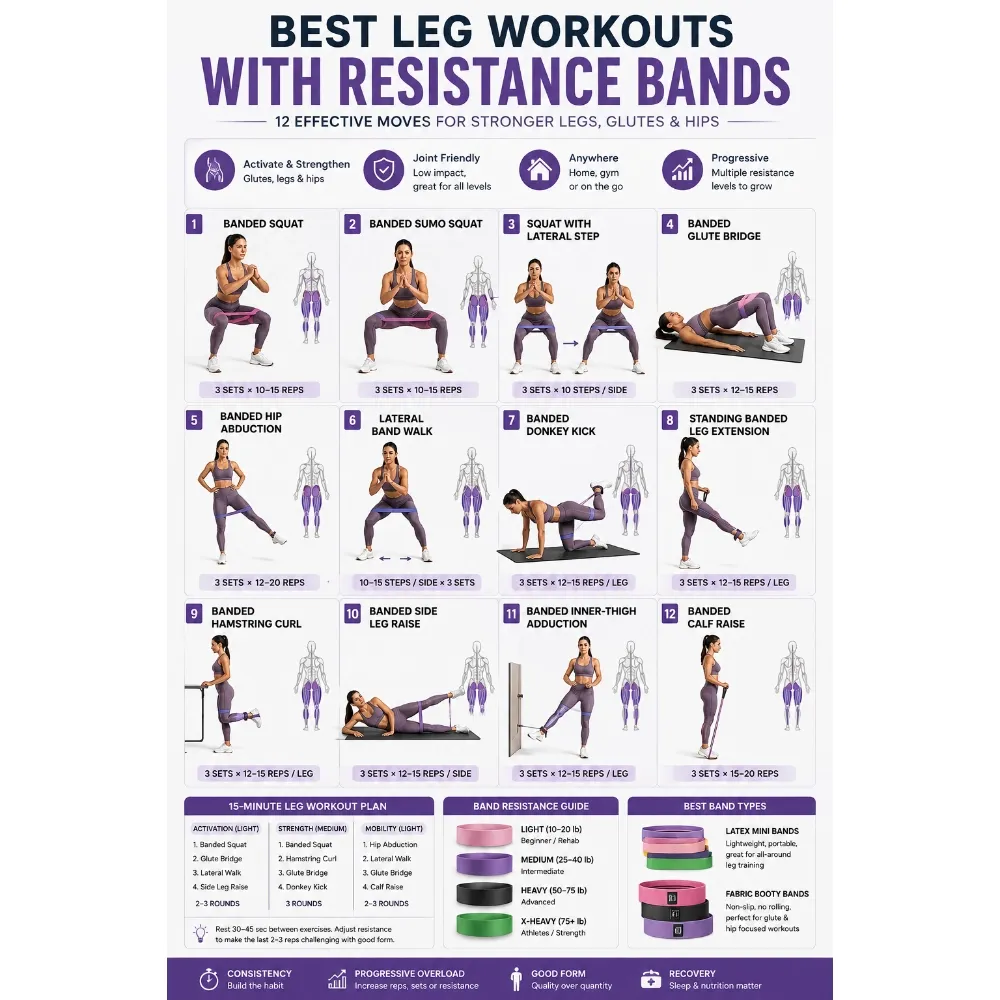
12 Best Leg Exercises Using Resistance Bands
1. Banded Squat
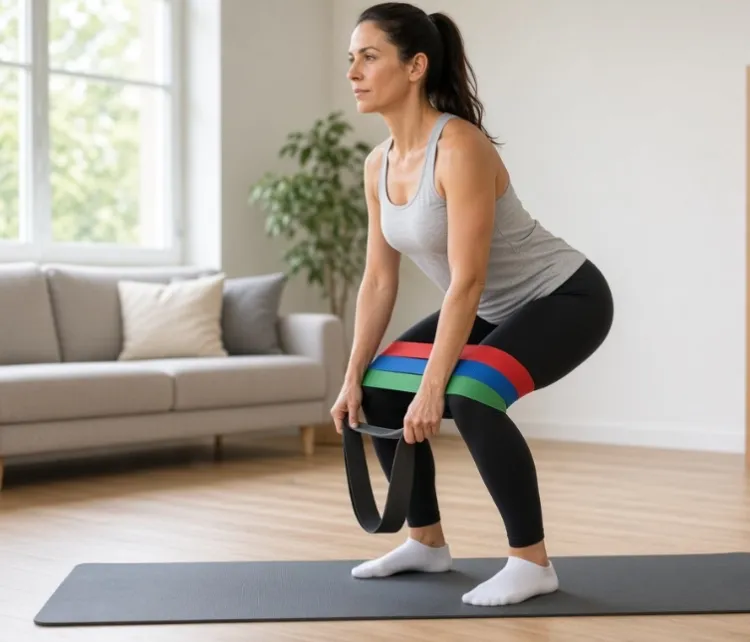
The banded squat is one of the most useful compound movements in a leg bands workout.
How to Do It
Place a mini loop or fabric band above your knees.
Stand with your feet approximately shoulder-width apart and maintain gentle outward pressure against the band.
Lower into a squat while keeping your knees aligned with your feet, then return to standing.
Muscles Trained
- Quadriceps
- Glutes
- Hamstrings
- Hip stabilizers
Suggested Training
3 sets × 10–15 repetitions
2. Banded Sumo Squat
A wider stance changes the emphasis of the squat and increases involvement of the hips and inner thighs.
How to Do It
Position the resistance band above the knees.
Take a wider-than-shoulder-width stance with your toes slightly turned outward.
Lower under control while maintaining outward band tension.
Muscles Trained
- Glutes
- Quadriceps
- Inner thighs
- Hip muscles
Suggested Training
3 sets × 10–15 repetitions
3. Squat With Lateral Step
This variation combines squatting with side-to-side resistance.
How to Do It
Place a loop band above the knees or around the lower legs.
Perform a squat, return toward standing, and then step laterally while maintaining band tension.
Repeat in the opposite direction.
Muscles Trained
- Glutes
- Quadriceps
- Hip abductors
- Outer thighs
This exercise works particularly well in leg workouts resistance bands routines focused on glute and hip activation.
4. Banded Glute Bridge
The glute bridge is an effective lower-body exercise for hip extension and glute training.
How to Do It
Lie on your back with your knees bent and feet on the floor.
Place the band above your knees.
Press your knees slightly outward and raise your hips until your body forms a controlled line from shoulders to knees.
Pause briefly and lower slowly.
Muscles Trained
- Gluteus maximus
- Gluteus medius
- Hamstrings
- Hip stabilizers
Suggested Training
3 sets × 12–15 repetitions
5. Banded Hip Abduction
Hip abduction is especially useful for training the muscles on the outside of the hips.
How to Do It
Place a resistance loop around your thighs.
From a seated or standing position, move the knees or legs outward against the band's resistance.
Return slowly rather than allowing the band to pull the legs back together.
Muscles Trained
- Gluteus medius
- Gluteus minimus
- Hip abductors
Suggested Training
3 sets × 12–20 repetitions
6. Lateral Band Walk
Lateral walks are one of the most recognizable leg exercises using resistance bands.
How to Do It
Place a loop above the knees or around the lower legs.
Bend the knees slightly and keep tension on the band.
Step sideways without bringing your feet completely together between steps.
Muscles Trained
- Gluteus medius
- Gluteus minimus
- Outer thighs
- Hip stabilizers
Suggested Training
10–15 steps each direction × 3 sets
7. Banded Donkey Kick
This exercise emphasizes hip extension and the glutes.
How to Do It
Start on your hands and knees.
Position a suitable loop around your legs or use a long band in a secure setup.
Extend one leg backward against resistance while maintaining a stable trunk.
Return under control.
Muscles Trained
- Gluteus maximus
- Hamstrings
- Hip extensors
Suggested Training
3 sets × 12–15 repetitions per side
8. Standing Banded Leg Extension
A resistance band can provide a compact alternative for knee-extension training when appropriately anchored.
How to Do It
Secure a suitable resistance band behind you and attach or position it so resistance is applied as the knee straightens.
Extend the lower leg under control, then slowly return to the starting position.
Muscles Trained
- Quadriceps
Suggested Training
3 sets × 12–15 repetitions
If you are looking for bands for leg exercises that simulate some gym-machine movements, long resistance bands or tubes are usually more suitable than short booty bands.
9. Banded Hamstring Curl
Resistance bands can also be used to train knee flexion.
How to Do It
Secure a long resistance band to a stable anchor.
Attach it appropriately around the ankle and bend the knee against resistance.
Return slowly to maintain tension.
Muscles Trained
- Hamstrings
Suggested Training
3 sets × 10–15 repetitions per leg
10. Banded Side Leg Raise
Side leg raises are useful for glute and outer-hip training.
How to Do It
Place a mini loop around the thighs or lower legs.
Lie on your side or perform the movement standing.
Raise one leg outward against the band's tension while keeping the movement controlled.
Muscles Trained
- Gluteus medius
- Gluteus minimus
- Hip abductors
- Outer thighs
Suggested Training
3 sets × 12–15 repetitions per side
11. Banded Inner-Thigh Adduction
Not every leg exercise with resistance bands needs to focus on the outer hips.
Bands can also train the inner thighs.
How to Do It
Secure a long resistance band to a stable point beside you.
Attach or position the band around one ankle.
Move the working leg inward toward the body's midline against resistance.
Return slowly.
Muscles Trained
- Hip adductors
- Inner thigh muscles
Suggested Training
3 sets × 12–15 repetitions per side
12. Banded Calf Raise
Resistance can also be added to calf training.
How to Do It
Stand securely on a long resistance band and hold the other end to create tension.
Rise onto the balls of your feet, pause briefly at the top, and return under control.
Muscles Trained
- Gastrocnemius
- Soleus
Suggested Training
3 sets × 15–20 repetitions
Which Resistance Band Is Best for Leg Workouts?
Different band constructions serve different purposes.
Mini Latex Loop Bands
Natural latex mini loops are lightweight and highly elastic.
They are useful for:
- Glute activation
- Lateral walks
- Hip abduction
- Squats
- Warm-ups
- Portable workouts
They are a good choice for users who want compact resistance bands for legs workouts with several resistance levels.
Fabric Booty Bands
Fabric bands are wider and generally feel more stable around the thighs.
They are particularly suitable for:
- Squats
- Glute bridges
- Lateral walks
- Hip abduction
- Glute-focused routines
The woven surface has a lower tendency to roll compared with many thin loops, making fabric bands popular for lower-body training.
Long Resistance Bands
Long loop bands provide a larger range of movement.
They are useful for:
- Squats
- Hamstring curls
- Leg extensions
- Romanian deadlift variations
- Hip extension
- Full-body strength training
For a complete leg workout with bands, many users combine short loops with one or more long resistance bands.
Latex vs Fabric Bands for Leg Training
Feature | Latex Mini Bands | Fabric Bands |
|---|---|---|
Construction | Natural latex loop | Woven elastic fabric |
Feel | Thin and highly elastic | Wider and softer |
Portability | Excellent | Excellent |
Resistance Options | Wide range | Typically Light–Heavy |
Rolling | May occur in some exercises | Lower tendency |
Hip Abduction | Excellent | Excellent |
Squats | Good | Excellent |
Glute Training | Excellent | Excellent |
Upper-Body Versatility | Higher | Lower |
Best For | Multi-purpose training | Glute and hip-focused training |
Choose latex for versatility and compact resistance progression.
Choose fabric when comfort, stability, and glute-focused lower-body training are priorities.
15-Minute Leg Workout With Resistance Bands
You do not need a long workout to train the lower body effectively.
Here is a simple 15-minute leg workout with bands.
Workout A: Glute & Leg Activation
Banded Squats
3 × 15
Glute Bridges
3 × 15
Lateral Walks
3 × 10 steps each direction
Side Leg Raises
2 × 12 each side
Use a Light or Medium resistance band and focus on controlled movement.
Workout B: Lower-Body Strength
Banded Squats
3 × 10–12
Banded Hamstring Curls
3 × 12
Glute Bridges
3 × 12
Hip Abduction
3 × 15
Select resistance that makes the final repetitions challenging without losing control.
Workout C: Mobility & Activation
For lighter training or professionally guided return-to-exercise programs:
Light Hip Abduction
2 × 12
Glute Bridges
2 × 12
Lateral Walks
2 × 8 each direction
Controlled Side Leg Raises
2 × 10 each side
Use light resistance and prioritize movement quality. If exercising after injury or surgery, follow the guidance of an appropriate healthcare or rehabilitation professional.
How to Make a Resistance Bands Legs Workout Harder
As the body adapts, the workout should gradually become more challenging.
You can progress by:
- Moving to a stronger resistance band
- Increasing repetitions
- Adding sets
- Increasing band stretch
- Slowing the lowering phase
- Increasing range of motion
- Combining appropriate bands
- Progressing to more difficult exercise variations
Progressive overload is more important than simply performing the same leg bands workout indefinitely.
Common Mistakes During Leg Workouts With Resistance Bands
Using Too Much Resistance
A heavier band is not automatically better.
If the resistance causes poor posture, limited range of motion, or uncontrolled movement, choose a lighter band.
Placing the Band Incorrectly
Band position affects exercise difficulty.
A loop around the thighs usually feels easier than the same band positioned farther down the legs.
Follow the setup appropriate to each movement.
Moving Too Fast
Elastic resistance can pull the body back toward the starting position.
Control both the working phase and the return phase instead of allowing the band to snap back.
Letting the Knees Collapse Inward
During squats and bridges, maintain appropriate knee alignment rather than allowing the band to pull the knees excessively inward.
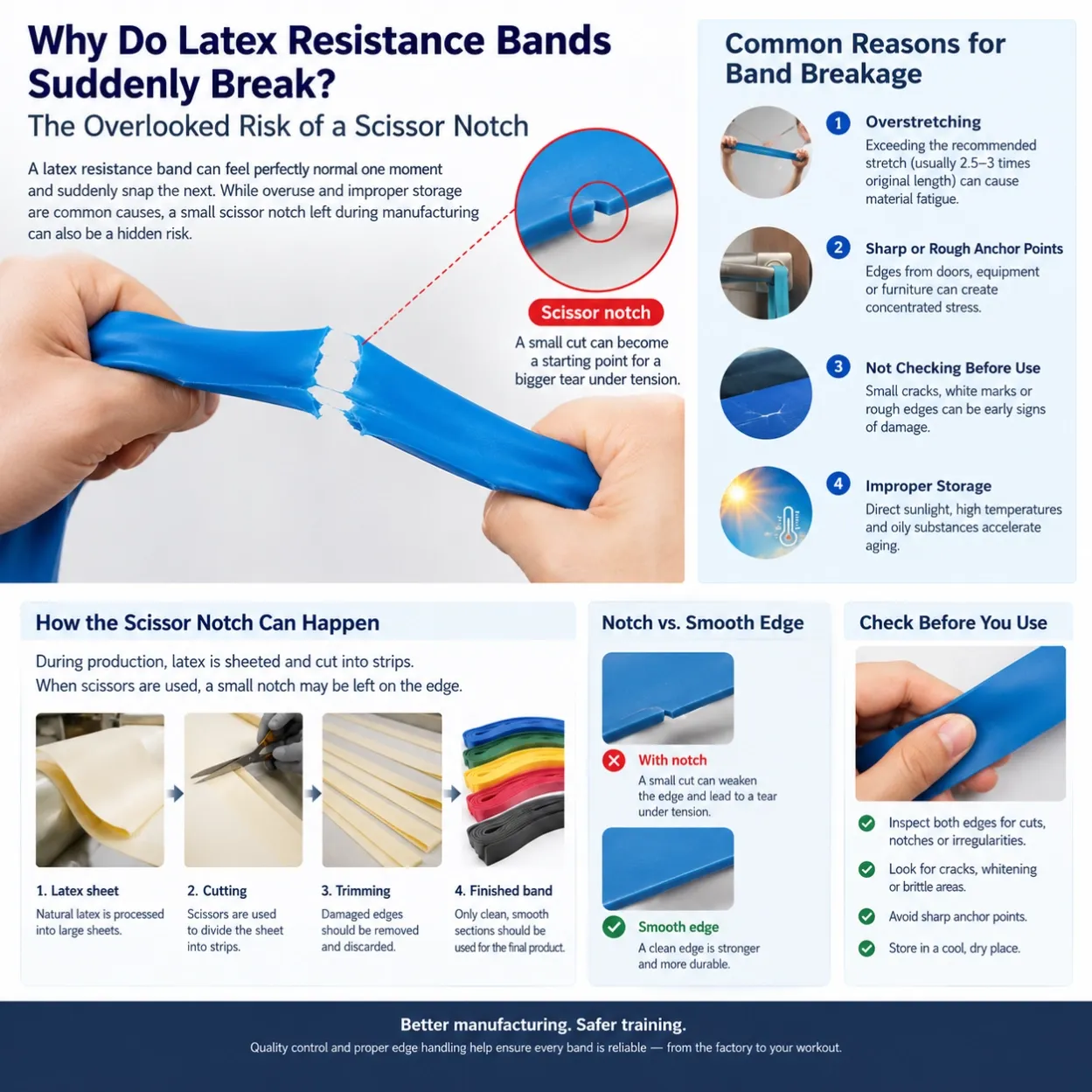
Using a Damaged Band
Inspect resistance bands before training.
Stop using a band if you notice:
- Cracks
- Cuts
- Tears
- Significant surface damage
- Damaged seams
- Permanent deformation
How Often Should You Train Legs With Resistance Bands?
There is no universal schedule for every user.
Training frequency depends on:
- Exercise intensity
- Resistance level
- Training volume
- Fitness level
- Recovery
- Other lower-body workouts
For general fitness, resistance-band leg training can be incorporated into a broader weekly strength program.
The same muscle groups need adequate recovery after challenging training.
Can Resistance Bands Build Stronger Legs?
Yes.
A structured resistance bands for leg workouts program can challenge the quadriceps, hamstrings, glutes, hips, inner thighs, outer thighs, and calves.
For muscle and strength development, the important factors are:
- Sufficient resistance
- Controlled technique
- Progressive overload
- Appropriate training volume
- Consistency
- Recovery and nutrition
Resistance bands are the training tool; how the program is structured determines the training stimulus.
Frequently Asked Questions
What are the best leg workouts with resistance bands?
Some of the most useful leg workouts with resistance bands include banded squats, glute bridges, lateral walks, hip abduction, hamstring curls, leg extensions, side leg raises, and calf raises.
Are resistance bands good for leg workouts?
Yes. Resistance bands for leg workouts can add tension to lower-body movements and train the glutes, hips, quadriceps, hamstrings, inner thighs, outer thighs, and calves.
Can you build leg muscle with resistance bands?
Resistance bands can contribute to muscle growth when they provide sufficient resistance and are combined with progressive overload, appropriate training volume, recovery, and nutrition.
What resistance band should beginners use for legs?
Beginners usually benefit from Light or Medium resistance because these levels make it easier to learn the movement while maintaining control and full range of motion.
Are fabric or latex bands better for legs?
Both can work well. Latex loops are compact and versatile, while fabric bands are wider and tend to remain more stable around the thighs. The best choice depends on the exercise and user preference.
Can I do leg extensions with resistance bands?
Yes. Long resistance bands or tubes can be anchored to provide resistance during knee extension, creating a portable alternative for quadriceps-focused training.
What is an elastic bands workout for legs?
An elastic bands workout for legs is a lower-body routine using elastic resistance to challenge movements such as squats, hip abduction, glute bridges, lateral walks, hamstring curls, and leg extensions.
How long should a resistance band leg workout take?
The workout duration depends on the number of exercises, sets, resistance level, and training goal. Even a focused 15–20 minute routine can include several effective lower-body movements.
Can resistance bands train the inner thighs?
Yes. Long resistance bands can be anchored for resisted hip adduction, which targets the muscles of the inner thigh.
Can resistance bands be used for both legs and glutes?
Yes. Many leg exercises using resistance bands simultaneously train the glutes, hips, and leg muscles because these structures work together during lower-body movement.
Final Thoughts: Building a Better Leg Workout With Bands
A well-designed leg workout with bands does not need dozens of exercises.
A few carefully selected movements can train the major lower-body muscle groups effectively:
Squat → Hip Extension → Hip Abduction → Hamstring Movement → Inner-Thigh Movement → Calf Training
Mini loops and fabric bands are especially useful for glute and hip training, while long resistance bands provide more options for exercises such as hamstring curls and leg extensions.
For beginners, start with manageable resistance and focus on controlled technique. As strength improves, increase the challenge through stronger bands, additional repetitions, more sets, or harder exercise variations.
Whether you are performing a legs workout with elastic bands at home or adding bands to an existing gym program, consistency and progressive resistance matter more than using the strongest band available.
Explore Resistance Bands for Leg Training
Looking for bands designed specifically for lower-body workouts?
Booty Bands & Glute Resistance Bands →
Explore latex and fabric resistance loops for glute, hip, and leg training.
Hip Resistance Bands →
Resistance loops for hip strength, mobility, activation, and lower-body training.
For brands and commercial buyers, custom resistance levels, Pantone colors, logos, multi-band sets, and private-label packaging are available through our OEM manufacturing service.