Sep 8, 2026Material Notes
Latex-Free Resistance Bands: A Buyer’s Guide for Clinics and Brands
Natural latex offers great rebound, but it is no longer the default choice for clinical purchasing.

Latex-Free Resistance Bands: A Buyer’s Guide for Clinics and Brands
Natural latex offers great rebound, but it is no longer the default choice for clinical purchasing. With 1%–6% of the general population and an even higher percentage of healthcare workers sensitive to natural rubber latex, clinics and institutional buyers now require dedicated non-latex product lines.
Switching from natural latex to thermoplastic elastomers (TPE) changes the physics of the band. It impacts force progressive curves, surface tackiness, tensile creep, and long-term shelf stability.
Evaluating a latex-free band requires looking beyond the "non-latex" stamp to verify physical specifications, force curves, and production consistency.
Material Breakdown: TPE vs. Natural Rubber Latex
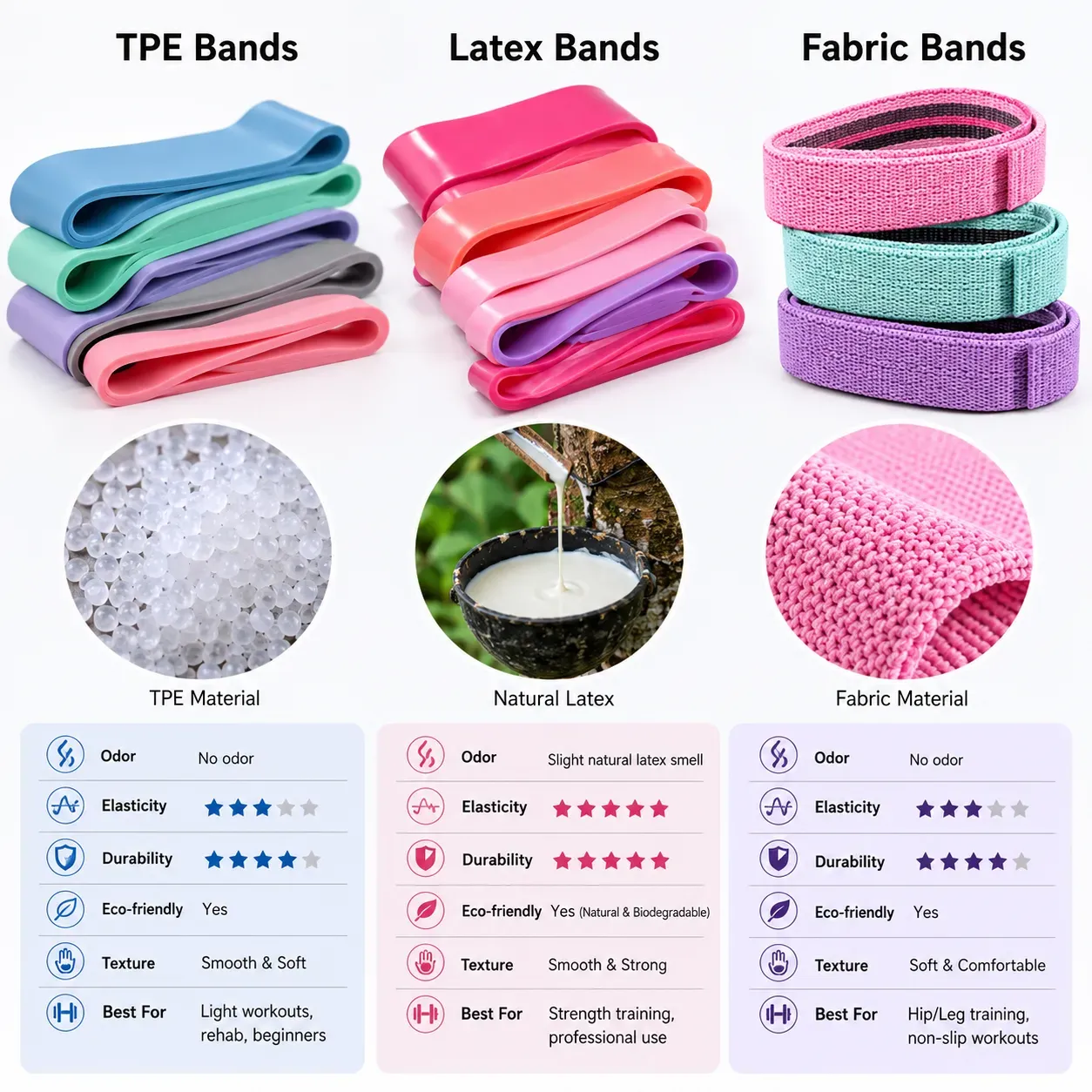
Not all non-latex bands perform identically. Most latex-free therapy bands are extruded using TPE (Thermoplastic Elastomer) formulations, which behave differently from traditional natural rubber latex.
Performance Attribute | Natural Rubber Latex (NRL) | Synthetic TPE Formulations | Procurement Impact |
Proteine Content | Contains natural proteins | 100% Latex-protein free | Eliminates Type I latex allergy risks in clinics. |
Elastic Rebound | Snappy, high hysteresis resistance | Smooth, linear force delivery | TPE feels softer on initial pull; ideal for early-stage rehab. |
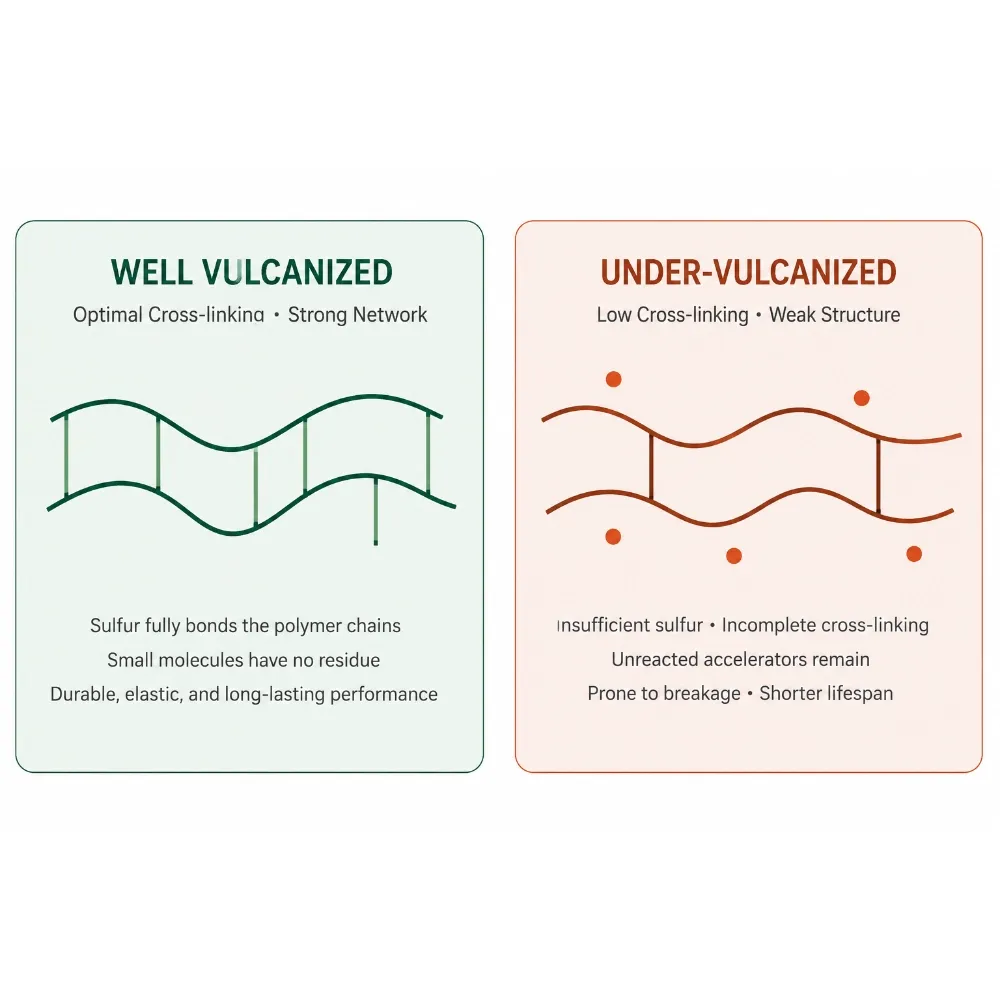
Stress Relaxation / Creep | Very low deformation over time | Moderate risk of permanent stretch | TPE requires specific cross-linking additives to hold strain. |
Surface Finish | Requires powdering or wash | Naturally smooth/matte available | Non-powdered TPE reduces mess in clean environments. |
UV & Ozone Resistance | Moderate (degrades without anti-agers) | High intrinsic stability | TPE holds up longer under warehouse lighting and shelf storage. |
Technical Specifications: Moving Beyond Color Codes
Band colors are marketing conventions, not physical standards. A "Red / Medium" band from Supplier A rarely matches the pull force of a "Red / Medium" band from Supplier B.
When issuing an RFP or PO, specify performance metrics directly:
- Modulus at Agreed Elongation: State exact force requirements (in kg or lbs) at 100%, 200%, and 300% elongation.
- Dimensional Tolerances: Specify gauge/thickness (e.g.0.35mm) and width across the entire roll.
- Permanent Set Limit: Set a maximum threshold for permanent stretch (e.g., <5\% deformation after 100 cycles at 200% elongation).
- Splice Restrictions: For bulk roll orders, specify "Zero Splices / Continuous Cut" to prevent workplace safety hazards during clinical use.
Key Format Options for B2B Sourcing
- Pre-Cut Individual Bands (Home Exercise / Discharge Kits)
- Dispenser Box Rolls (Clinics / In-Patient Facilities)
- Loop Bands & Accessories (Mobility / Retail Fitness)
1. Dispenser Box Rolls (50-Yard / 6-Yard)
- Target Audience: Physical therapy clinics, hospital groups, rehabilitation chains.
- Sourcing Requirements: Reinforced dispenser box, linear yardage markings, and lot-numbered core tubes for inventory tracking.
2. Pre-Cut Bands (Individual Packaging)
- Target Audience: Patient home-exercise programs (HEP), retail brands, discharge kits.
- Sourcing Requirements: Sealed polybags, printed barcode/SKU, custom branded insert cards, and printed safety warnings directly on the material.
3. Progressive Resistance Sets
- Target Audience: D2C e-commerce brands, clinical retail displays.
- Sourcing Requirements: Color-coded progression (3 to 5 levels), custom Pantone matching, branded carry pouches, and bundled instruction guides.
Quality Control Protocol for Factory Acceptance
To prevent batch-to-batch variation, require your manufacturer to execute and document the following pre-shipment tests:
- Durometer/Hardness Checking: Ensures the raw compound formulation matches the signed master sample.
- Tensile & Elongation Testing: Verifies peak force limits before material fracture.
- Cyclic Fatigue Strain: Simulates repeated patient use (e.g., 5,000 cycles) to measure force degradation curves.
- Thickness Consistency Checks: Measured via continuous digital micrometer during sheet extrusion.
- Visual Edge Inspection: Ensures smooth micro-slitting free of burrs or micro-tears that lead to snapping.
Manufacturer Qualification Checklist
Before issuing a Purchase Order, request clear documentation for these 8 procurement checkpoints:
- Exact Material Declaration: Full chemical family (e.g., Medical-grade SEBS-based TPE).
- Allergy Claims Compliance: Verification that packaging reads "Not made with natural rubber latex" rather than unqualified "Hypoallergenic" claims.
- Batch Traceability: Code printing on bands or rolls linking directly to raw material lot numbers.
- Force Profile Data: Force displacement curves across all offered resistance colors.
- Customization Capabilities: Pantone color matching, silk-screen or laser branding options.
- Packaging Material Safety: Confirmation that secondary packaging materials are also 100% latex-free.
- Shelf Life & Storage Guidance: Accelerated aging test reports for hot/cold storage conditions.
- Sample Approval Process: Signed pre-production samples locked for baseline testing prior to mass production.
FAQ for Procurement Teams
What is the most common material used for latex-free therapy bands?
Styrenic block copolymers (TPE formulations) are the industry standard. They deliver progressive stretch without latex proteins.
Can TPE bands be labeled as "Hypoallergenic"?
No. Regulatory bodies (including the FDA) advise against using "Hypoallergenic" or absolute "100% Latex Free" claims. The recommended terminology is "Not made with natural rubber latex."
Why do TPE bands feel softer than natural latex bands of the same thickness?
TPE has a different tensile modulus curve than natural rubber. To achieve identical pull forces, TPE bands are often engineered with slightly thicker gauges or adjusted chemical formulations.
How do we verify continuous length on 50-yard dispenser rolls?
Specify "Zero-Splice Guarantee" in your procurement contract. Lower-tier suppliers often tape or heat-weld shorter cuts together, creating weak points that break under tension.