Sep 2, 2026Material Notes
Why Do Some Latex Resistance Bands Smell Odor? | Vulcanization & Rubber Odor Explained
why resistance bands smeel odor
Why Do Some Latex Resistance Bands Smell a Strong Odor?
Proper Vulcanization Matters — Under-Cured Natural Rubber Can Develop a Strong Odor
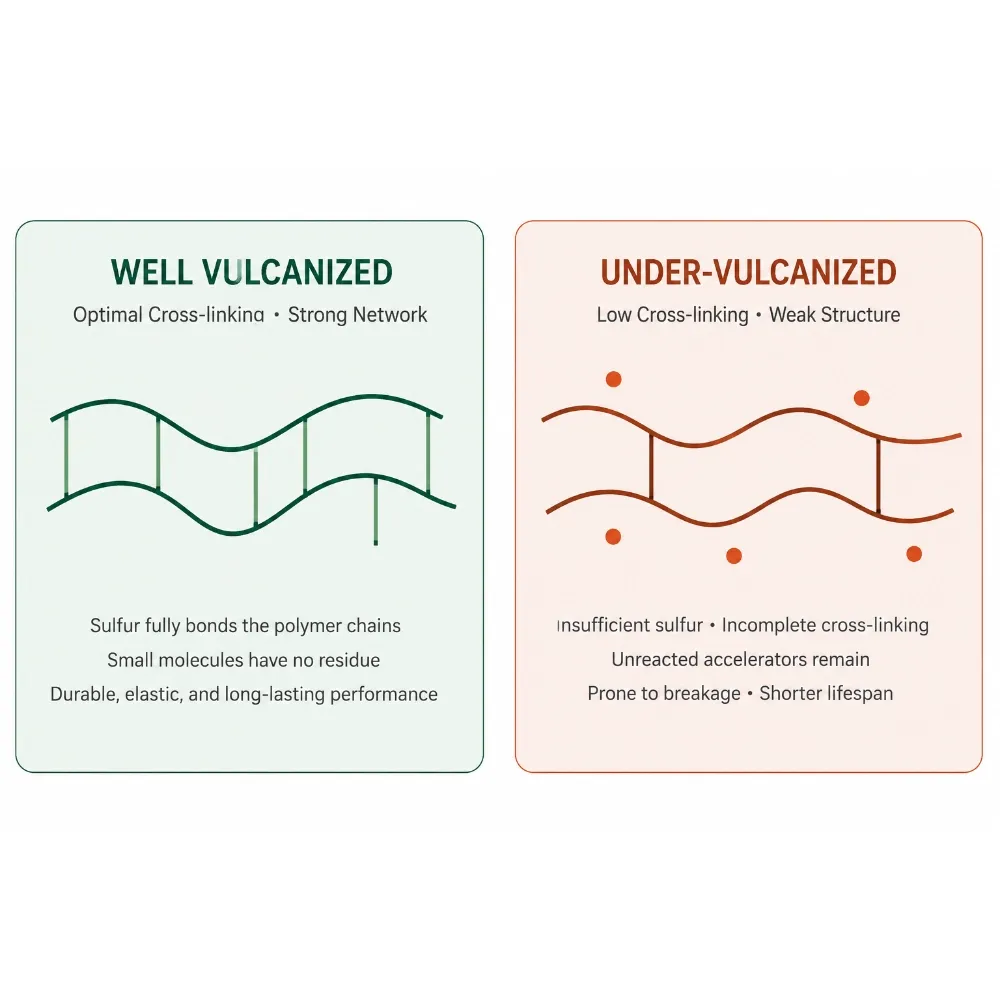
The molecular structures shown above illustrate the difference between properly vulcanized and under-cured rubber. Here is a straightforward explanation of what actually happens.
1. What Does Vulcanization Actually Do?
Before vulcanization, natural rubber consists mainly of long polymer chains that can move relatively freely — imagine a bowl of loose noodles.
During vulcanization, sulfur, together with accelerators and other compounding ingredients, creates cross-links between the rubber polymer chains.
Instead of remaining as independent molecular chains, the rubber develops a three-dimensional cross-linked network.
A simple way to visualize it is:
Uncured Rubber: Loose Polymer Chains
→ Vulcanization
Properly Cured Rubber: Cross-Linked 3D Network
This cross-linked structure is what gives a natural rubber resistance band its required:
- Elasticity
- Tensile strength
- Dimensional stability
- Elastic recovery
- Durability
Without an appropriate degree of vulcanization, the rubber cannot achieve its intended mechanical properties.
2. What Does “Under-Cured” Rubber Mean?
Under-curing means that the vulcanization process was stopped before the rubber reached the required state of cure.
This can create two major problems.
Problem 1: Insufficient Cross-Linking
If there are not enough cross-links between the polymer chains, the rubber network remains relatively loose.
Think of it as a fishing net with openings that are too large.
The polymer chains retain greater mobility, which can result in:
- Lower modulus
- Reduced mechanical strength
- Poorer elastic recovery
- Higher permanent deformation
- Greater mobility of low-molecular-weight compounds within the rubber
These mobile compounds can migrate toward the surface more easily.
In practical terms, an under-cured resistance band may feel unusually soft, recover slowly after stretching, or fail to achieve its intended mechanical performance.
Problem 2: More Unreacted or Residual Compounding Ingredients Remain
This is one possible contributor to the strong odor associated with poorly cured rubber products.
Natural rubber compounds may contain sulfur, accelerators, activators, antioxidants, and other processing ingredients required for vulcanization.
If the curing process is incomplete, higher levels of residual or partially reacted compounds and reaction by-products may remain in the rubber.
Certain accelerators and their decomposition products can have noticeable odors.
For example:
- Thiuram accelerators such as TMTD can be associated with amine- and sulfur-containing decomposition products.
- Dithiocarbamate accelerators such as ZDC types can also generate characteristic odors depending on the formulation and processing conditions.
- MBT and related thiazole accelerators have their own characteristic rubber/chemical odor.
Sulfur-containing volatile compounds and other low-molecular-weight substances can also contribute to the characteristic smell of vulcanized rubber.
If these volatile compounds migrate from the rubber to the surface and into the surrounding air, the odor becomes easier to detect — particularly when the products have been sealed inside packaging.
3. Why Can the Smell Become More Noticeable After Packaging?
A resistance band may not smell particularly strong immediately after production but can develop a much more noticeable odor after being sealed for storage or transportation.
Why?
Because volatile compounds released from the rubber have nowhere to escape.
Inside a sealed bag or retail package, these compounds can gradually accumulate in the enclosed air.
As a result, when the customer opens the package, the concentration of odor-causing volatile compounds can be much higher than in an open production environment.
Factors affecting odor can include:
Rubber Formulation + Cure Conditions + Residual Compounds + Post-Cure Cleaning + Drying + Storage + Packaging + Temperature + Storage Time
This is why odor control should be considered throughout the manufacturing process rather than only at the final packaging stage.
4. Why Proper Vulcanization Is So Important
Proper vulcanization allows the rubber compound to develop the cross-linked structure required for its intended performance.
With an appropriate cure state:
- The rubber develops the required cross-link density.
- Tensile and elastic properties become more stable.
- Permanent deformation can be reduced.
- The mobility of certain low-molecular-weight components may be reduced.
- Overall product consistency can be improved.
Under-cured rubber, by comparison, may contain an insufficiently developed cross-linked network while also retaining more mobile residual compounds.
This combination can contribute to both poor mechanical performance and stronger odor.
Therefore, for natural latex resistance bands, vulcanization is not simply a production step — it is one of the key processes determining the final product's elasticity, durability, stability, and odor characteristics.
5. A Simple Analogy: Vulcanization Is Like Baking a Cake
A simple way to explain vulcanization to customers is to compare it to baking.
A properly baked cake develops the structure it was designed to have.
If you remove it from the oven too early, the outside may look finished while the inside is still undercooked.
Rubber vulcanization works in a similar way.
A resistance band may look acceptable from the outside, but if the rubber has not reached an appropriate state of cure, its internal cross-linked structure may not have developed sufficiently.
This can lead to problems with:
Elasticity + Recovery + Strength + Stability + Odor
That is why simply looking at the finished band is not enough to determine whether the vulcanization process was properly controlled.
6. How Do Manufacturers Determine Whether Rubber Is Properly Vulcanized?
Professional manufacturers should rely on process control and testing rather than appearance alone.
Method 1: Rheometer Testing and Cure Curves
A rubber rheometer can be used to evaluate vulcanization behavior.
One commonly referenced parameter is T90, which represents the time required under the specified test conditions to reach 90% of the torque increase associated with the cure curve.
T90 can be used as an important reference when establishing production cure conditions.
However, actual production settings should also account for:
- Product thickness
- Mold temperature
- Heat-transfer conditions
- Rubber formulation
- Processing method
- Risk of reversion or over-curing
Therefore, the production cure time should not simply be described as “always equal to or longer than T90.” It should be validated for the actual product and manufacturing process.
Method 2: Cross-Link Density Evaluation
Solvent swelling tests can be used to evaluate the relative cross-link density of vulcanized rubber.
In general, a rubber sample with lower cross-link density tends to swell more in an appropriate solvent system.
Comparing swelling behavior between properly cured reference samples and production samples can therefore help identify curing differences.
This is particularly useful when manufacturers need to investigate abnormal material performance.
Method 3: Mechanical Property Testing
Under-cured rubber may show changes in properties such as:
- Lower modulus at a specified elongation
- Higher permanent set
- Reduced strength
- Poorer elastic recovery
For resistance bands, mechanical testing can therefore provide valuable information about whether the product has achieved its intended performance.
Method 4: Practical Production Inspection
Experienced production teams may also identify warning signs such as:
- Unusually tacky surfaces
- Slow recovery after stretching
- Excessive permanent deformation
- Abnormal tear characteristics
- Strong or unusual odor
These observations can be useful for screening, but they should not replace controlled process parameters and objective testing.
Proper Vulcanization Is Part of Resistance Band Quality Control
For a natural latex resistance band manufacturer, vulcanization control directly affects product performance.
A reliable quality-control system should therefore consider:
Raw Material Formulation → Mixing → Molding → Vulcanization → Surface Treatment & Cleaning → Resistance Testing → Repeated Stretch Testing → Final Inspection → Packaging
When evaluating a resistance band supplier, buyers should not focus only on appearance, resistance level, and price.
They should also ask:
- How is the vulcanization process controlled?
- Are cure conditions established through testing?
- How is resistance consistency verified?
- Are repeated stretch tests performed?
- How is odor controlled before packaging?
- How are finished products stored before shipment?
Proper process control helps produce natural latex resistance bands with more consistent elasticity, resistance, durability, and overall product quality.